DbcultAccessing Vault...
Cult Review
Senior Film Conservator
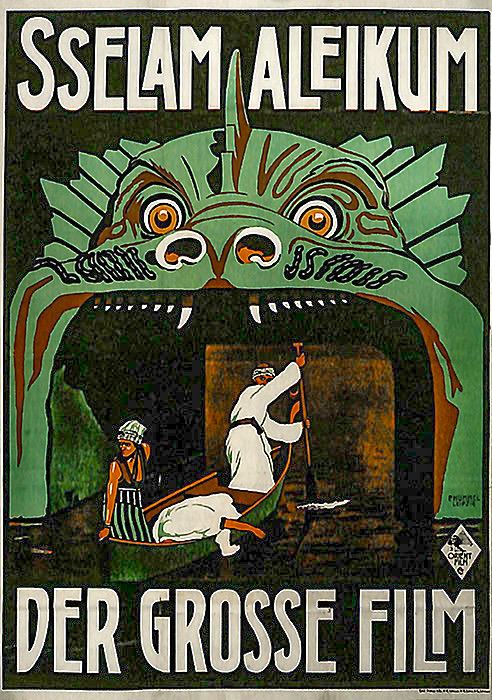
The first thing that strikes you is the humidity—yes, humidity—rising from the celluloid itself, as if the film were stored in a Turkish hammam rather than a German vault. Seelam Aleikum does not begin; it exhales. A curl of Bosporus fog slips across the screen, carrying the faint clang of a tram bell that never quite arrives. We are in Berlin, 1923, yet the city feels porous, colonised by mirages of elsewhere. Director Edmund Linke, who also wrote the scenario and plays the male lead, refuses to let the camera behave like a tourist. It hovers, stalks, eavesdrops, sometimes forgets to blink.
Cinematographer Oskar Ingenohl—moonlighting here between sermons he no longer preaches—bathes the widow’s parlour in iodine yellows that bruise into sickly greens whenever the conversation turns to debt. The palette is a ledger of insolvency. You can practically tally the owed sums by counting how many shades of jaundice streak the wallpaper. Meanwhile, the dock sequences are drenched in a sea-blue so dense it verges on asphalt, a chromatic oxymoron that whispers: every harbour is a graveyard with better PR.
Compare this chromatic bravado to the muted ethical grays of The Rise of Jenny Cushing, where morality is a mere balancing act. Here, morality has vertigo and no balancing pole.
Wittenberg’s face is the film’s most radical special effect. She lets the camera crawl beneath her skin, revealing capillary networks that map private histories of famine and furtive desire. Watch the way her pupils dilate when she hears the Arabic greeting that gives the film its title—an involuntary eclipse that suggests memory itself has a foreign accent. In one devastating close-up, a tear halts at the orbital rim, refuses to fall, becomes a stationary lens through which we glimpse the reflection of a departing ship. The tear is never wiped; the scene cuts away. Next time we see her, the cheek is dry. Somewhere in the suture between shots, grief evaporated or was absorbed back into the bloodstream. We are left to decide which is crueler.
Linke’s Herr Brinkmann carries a hernia belt of existential fatigue. His gait is a ledger of every debt he has never repaid. Yet when he speaks—through the curt, stingy intertitles he penned himself—the diction suddenly swells into voluptuous metaphor, as if language itself were overcompensating for the body’s bankruptcy. The performance is a masterclass in shame: how it slouches in the shoulders, how it clears its throat before lying, how it practices smiles in the reflection of a puddle and still looks unconvinced.
The film’s dialectical tension arises because the screenwriter-actor must inhabit a character who cannot write his own escape. Every intertitle becomes a prison bar forged by the very man who steps through it. Meta-cinema before that phrase had passports.
Pay attention to the child. Not because the plot grants him centrality—he has neither name nor dialogue—but because the editing grants him sanctuary. He appears precisely when the narrative contemplates foreclosure: at alley corners where treaties are voided, at the edges of frames where adults barter future for past. The fez he clutches is too large, a second-hand cosmos, its crimson nap rubbed to liverish brown. It is the sole chromatic rhyme with the widow’s silk swatches, suggesting that empire, reduced to headgear, still circulates like contraband among those it once subjugated.
Compare this motif to the briefcase full of soil in Teasing the Soil, where earth is portable homeland. Here, the fez is portable forfeiture.
Although released without official synchronous score, the film anticipates its own musical absence. Notice how the intertitles grow terse whenever machinery intrudes: “The crane groans.” Three syllables, yet we hear metal fatigue in the mind’s ear. Conversely, during the cabaret vignette—Claire Harten’s sole scene—intertitles swell into ornate stanzas about jasmine and decay. The writing itself becomes a soundtrack, crescendoing when diegetic music would drown, receding when ambient clatter suffices. This negative-space sonata makes the viewer an involuntary composer, humming brass sections that never manifest.
Weimar cinema flirted with the uncanny—Caligari’s somnambulist, Mabuse’s hypnosis—but Seelam Aleikum locates dread in liquidity. Not spectral liquidity, but the prosaic kind that clinks or refuses to clink in pockets. Observe the scene where characters pass a single mark like a relay baton: each hand it enters becomes a vignette of devaluation. By the time the coin reaches the child, it has transformed into a peppermint wrapper. No special effects, just a jump-cut that enacts the sorcery of inflation. The horror is not that the mark vanishes; the horror is that everyone keeps pretending it hasn’t.
This is a useful counterpoint to The Pit, where dread bubbles up from subterranean depths. Here, dread trickles down from bureaucratic altitudes.
The silk warehouse at the narrative’s centre functions like a post-colonial unconscious. Bolts of Anatolian brocade, Bokhara ikat, and Aleppo gauze lie moth-drilled yet unclaimed, as though the continent that produced them had politely declined to pick up the phone. Wittenberg runs her fingers over a pomegranate pattern and, for a fleeting instant, the film superimposes archival footage of Armenian dyers at work. The splice lasts maybe eight frames—blink and you’ll attribute it to nitrate decay—but it detonates a chain of associations: every luxury commodity masks an unpaid historical invoice. The film declines to moralise; it simply lets the fabric speak its own water-stained testimony.
Post-war Berlin teemed with men whose anatomies had become municipal repairs—wooden legs clacking like typewriter keys, jawbones patched with tin. Linke the auteur catalogues these mutilations without voyeuristic linger. Instead, he stages masculinity as utility. Herr Brinkmann’s hernia is not a private ailment; it is a public bridge that collapses under collective weight. In a bravura sequence, the camera pans from Brinkmann’s torn waistband to a literal bridge under construction across the Spree, its steel lattice echoing the truss of his belt. The metaphor is blatant yet devastating: national reconstruction depends upon bodies already rent apart.
Contrast this with A Man of Honor, where integrity is a personal cologne. Here, honor is a utility grid, frayed and lethal.
Do not mistake the widow for a loner. Off-screen, a clandestine ledger links her to Claire Harten’s cabaret artiste and to the unnamed laundress who appears twice beating carpets. They trade more than gossip: stock tips on heartbreak, futures in resentment, bankruptcy rumours that double as lullabies. The film never shows their transactions, only the afterglow—an extra lump of coal in a care basket, a cigarette paper inscribed with a shipping route. This occult economy of women prefigures the modern gig network, yet operates on barter rather than algorithmic surveillance. Their solidarity is not ideological but hydraulic: they prop each other up because the alternative is to drown in the same spate.
Editor Ludwig Christ practices vandalism on the timeline. Scenes fold like faulty deck chairs: a 1919 bread riot intrudes upon a 1923 night café via match-cut on a broken croissant. You realise history itself is gluten, prone to elastic stretch. The most audacious splice arrives mid-film: a shot of the departing widow’s train is interrupted by four frames of a 1914 newspaper headline announcing Sarajevo. The duration is subliminal, yet it recontextualulates every subsequent gesture as epilogue to an assassination that never stopped ricocheting.
Such editorial insurgency distinguishes the picture from The Turn of the Road, where chronology behaves like a polite Anglican procession.
Oskar Ingenohl’s defrocked priest haunts the periphery, vending contraband blessings for pfennigs. His clerical collar is reversed like a scarlet letter, a sartorial admission that grace has become a black-market commodity. In one scene, he barters a baptism for a loaf, then breaks the bread like a parody of Eucharist. The camera frames his fingers trembling, and for a heartbeat the secular and sacred collapse into a single currency whose exchange rate is hunger. The film declines to resolve whether redemption is debased or inflation is transfigured.
Smell is the film’s absent presence. Characters sniff overripe peaches, recoil from sour milk, bury noses in unwool coats. The viewer, of course, smells nothing, yet the repeated gestures construct an olfactory phantom. The silk warehouse reeks in imagination: mildew, camphor, the iodine tang of burlap. This synesthetic lure exposes a paradox—cinema can archive visuals, audio, even haptic texture via scratch, but scent evaporates. Thus the film becomes a meditation on what archives cannot capture, a self-erasing testament to history’s nostrilled ghosts.
The current restoration by the Deutsche Kinemathek reinstates amber tinting referenced in Linke’s production notes, yet leaves intact the water damage on reel three. Purists howl; I applaud. The scars testify. To erase them would be to photoshop a corpse. The digital cleanup of scratches is surgical, but the chemical burns remain, a dermatology of survival. When you watch via streaming, toggle the highest resolution: you can spot mold spores dancing like plankton across the widow’s cheek—a microcosm devouring a macrocosm.
Film ends, but the platform persists. The last image freezes on an empty railway track dissolving into fog. Yet the freeze is imperfect: a hairline fracture runs across the emulsion, causing the track to quiver as if still vibrating from a train that has left the station of history. Hold the pause button and you’ll swear the rails inch apart, a continental drift in miniature. The film’s parting gift is an optical afterlife: when you close your eyes, the phantom track reprojects on the cinema screen of your eyelids, a migrant image searching for a new border.
Seek this film not for answers but for the voluptuous ache of unansweredness. In an era when algorithms flatten past and present into consumable mash, Seelam Aleikum reintroduces the feral irregularity of time unprocessed. It teaches that every greeting contains a farewell, every border an erasure, every archive a smell that got away. Above all, it whispers that cinema’s truest currency is not spectacle but the moment when the viewer forgets to breathe.
For further contrast on moral absolutism, consult When False Tongues Speak; for narrative circularity, see Dull Care. Neither matches the polyphonic sorrow of this Aleikum, forever unspooling in the twilight between continents, currencies, and condolences.
IMDb 5.7
1927
Community
Log in to comment.