DbcultAccessing Vault...
8.4/10
Senior Film Conservator
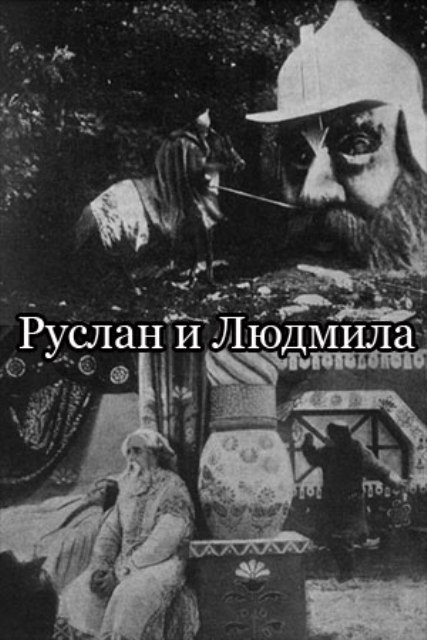
A definitive 8.4/10 rating for a film that redefined the boundaries of cult cinema. Ruslan i Lyudmila remains a cornerstone of transgressive art.
Starewicz, better known for devilish stop-motion beetles, here pivots to Slavic myth with the same clockmaker precision. Every frame feels like a lithograph breathed into flame: cyan shadows swallow faces while crimson halos bloom around cheekbones. He prints Pushkin’s trochaic tetrameter directly onto the emulsion—intertitles shimmer like frost on iron. Tinting is not mere ornament; it narrates. When Ruslan enters the haunted ruins, the stock shifts to bruise-violet, then hemorrhages into scarlet as a severed head sings. You sense the filmmaker’s thumb rubbing pigment into wound.
Compression is savage. The 700-line poem condenses into four reels—roughly forty-four minutes—yet Starewicz resists episodic checklist. Instead he sculpts what Russian Formalists dubbed ostranenie, estrangement. Lyudmila’s abduction occurs inside a single iris shot that closes like an eyelid; the iris opens again on a different century. Narrative causality snaps, replaced by dream-logic worthy of The Ghost Breaker’s haunted corridors or the hallucinated steppes of Loyalty.
Tamara Gedevanova performs captivity like a moth inside a paper lampshade. Rather than clawing at fate, she floats, gown ballooning with studio wind, eyes registering every off-screen menace as if it were a secret about herself. In one astonishing tableau she drapes the sorcerer’s beard over her own face—becoming her own jailer. The gesture lasts three seconds but perforates memory, echoing the masquerade psychosis of Damaged Goods though centuries earlier mythically.
Arsenii Bibikov embodies the epic hero as wax figure gradually kneaded by ordeal. Notice how his armor rusts in real time: first reel gleams, fourth reel flakes. The metamorphosis externalizes interior erosion, a device Griffith would plagiarize for The Battle of Shiloh. His duel with the giant head—achieved with forced perspective and a paper-mâché noggin the size of a carriage—rivals any effects shot in Julius Caesar for sheer audacity sans dialogue.
Because musical accompaniment varied by venue, Starewicz scores the film with motion itself: pendulous braids, horse manes slapping river-surface, a villain’s iron shoes striking sparks. The absence of standardized sound makes each contemporary screening a séance; the audience, like terrified villagers, supplies its own shrieks. Compare this to the synchronized bombast of C.O.D. where every footfall is underlined by orchestra hits—here silence drips, accumulates, drowns.
“The true special effect is not the giant head but the hush that follows its monologue.” — Osip Brik, 1916
Starewicz inserts a 90-second stop-motion interlude: mushrooms unfurl into imps, fence posts gallop away, a chicken lays a crystal egg containing the sorcerer’s soul. Filmed separately on a tabletop, these snippets bleed into live-action via match-cuts so seamless they prefigure Svankmajer by six decades. Scale disintegrates; a toy wagon becomes cathedral-sized. The sequence feels like the fever dream of Rescue of the Stefansson Arctic Expedition compressed into a snow globe.
Pushkin’s poem toys with bridal abduction as erotic game; Starewicz, sensitive to post-1910 suffragette currents, tilts the lens. The camera ogles Ruslan’s battered torso far more than Lyudmila’s décolletage, reversing the scopophilic economy. When our hero is chained in dwarf-lord’s dungeon, his shirt shredded to ribbons, the intertitle reads: “He felt the cold weight of being watched.” For once, masculine flesh is spectacle, foreshadowing the martyred bodies of Without Hope.
The film’s palette argues with itself. Orthodox aureoles—gold leaf halos borrowed from iconostasis—linger behind pagan thrones. In the wedding scene, Lyudmila’s crown is sea-blue (#0E7490) like the Virgin’s maphorion, yet her wrists are bound with scarlet ribbons recalling sacrificial cattle. Chromatic clash embodies Russia’s split soul: Muscovy vs. Kievan Rus, Asia vs. Europe, vodka vs. communion wine. No tidy synthesis arrives; instead the final kiss is double-exposed over an Orthodox cross tilting into a bog.
Contemporary critics dismissed the film as a “Slavic Christmas pantomime missing the clown.” Yet the Petrograd workers’ club circuit adored it; sailors smuggled prints to Shanghai where Chinese projectionists hand-painted additional dragons into the sky. Today, after restoration by Nikolai Izvolov, the tinting fluoresces like St. Elmo’s fire. Digital scans reveal brush-hairs frozen in pigment, each a micro-autograph of anonymous female colorists who, like the Utah pioneers in The Romance of the Utah Pioneers, stitched destiny frame by frame.
Reel 1 ends with a bridal feast; Reel 4 opens with a funeral banquet. Reel 2 showcases Ruslan’s first combat; Reel 3 gives Lyudmila her verbal duel. The mirrored architecture anticipates the palindromic tragedies of Der Eid des Stephan Huller - II, though predating them by a decade. Such symmetry, invisible on first watch, emerges like frost-pattern after several viewings—proof that Starewicz hides mathematics inside myth.
Where Wildflower sentimentalizes rustic virtue and Cameo Kirby exoticizes Creole bravado, Ruslan i Lyudmila treats folklore as Möbius strip: inside is outside, love is violence, rescue is abandonment. Its nearest spiritual cousin among listed titles is The Mystery of a Hansom Cab: both hinge on a vanished woman whose absence refracts male anxieties. Yet Starewicz refuses whodunit closure; the vanishing is the point.
Pushkin winks at predestination; Starewicz stares into its abyss. Characters move as if pulled by strings visible only to us. When Ruslan raises his sword, shadows on the wall anticipate the blow seconds early. Are we watching recorded fate or live volition? The hesitation destabilizes heroism more subversively than any Soviet montage. One recalls the existential paralysis of Captain Alvarez, though set in colonial tropics not Kievan marshes.
Studio censors excised a scene where Lyudmila combs the sorcerer’s beard with a human bone, deeming it “promoting marital cruelty.” Surviving stills show bone bristles dripping mercury; the image haunts like a half-remembered nightmare. Some scholars argue the cut destabilizes the power balance, turning Lyudmila from strategist into prop—a feminist reading aligning with critiques of Breaking the News where female intellect is similarly redacted.
Clips circulate online with chiptune scores, yet the original’s silence still slices deeper. Tarkovsky kept a 16mm print in his dacha, claiming its bog-surface reflections inspired the marsh scene in Stalker. Even Aronofsky’s Black Swan borrows the mirror-duel trope. Folk DNA, once spliced with celluloid, mutates eternally—like the Arctic crew in Rescue of the Stefansson Arctic Expedition who survive by metabolizing myth into warmth.
Watch this film not for plot but for pulse: the flicker between tints, the skipped heartbeats of missing frames, the vertigo when fairy-tale becomes fever-dream. It will not comfort; it will not even cohere. Yet on the third viewing you may notice, scratched into the leader, a Slavic proverb: “The tale is the hole in the fence through which the night looks in.” Peer through that hole and you glimpse cinema’s primal promise—light rearranged into prophecy, pigment into prayer. In an age of algorithmic color grading, such analog sorcery feels almost seditious. Cherish it, archive it, screen it with a live balalaika if you must, but above all let it watch you back.
IMDb —
1920
Community
Log in to comment.