DbcultAccessing Vault...
Cult Review
Senior Film Conservator
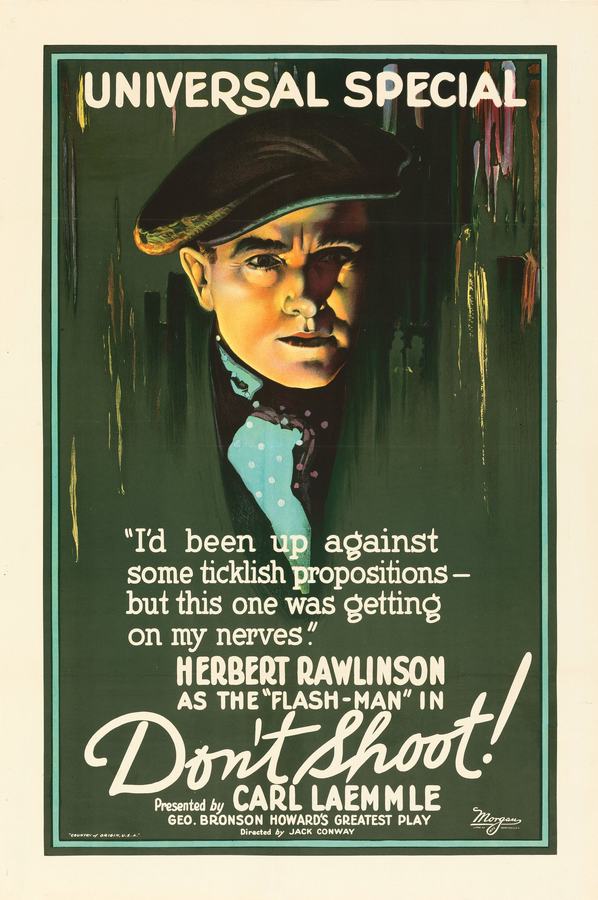
The first time I saw Don't Shoot, I swore the celluloid itself smelled of corn whiskey and cordite.
George Bronson Howard’s scenario, stitched together by George Hively’s intertitles, lands like a blackjack to the back of the neck: a case of mistaken ardor that shotgun-marries a pickpocket to a prim socialite. But the film’s true bloodstream is its chiaroscuro—shadows thick enough to chew, silhouettes that pirouette across tenement walls like marionettes cut from night. Released in the same year that The Three Musketeers was still ricocheting through Saturday matinees, this modest six-reeler refuses to gallop off into swashbuckling distance; instead it ducks into a blind tiger and picks the pockets of American morality.
Edna Murphy, all gams and grievance, plays Velma as if she’s perpetually tasting something both sour and sweet.
Her glance is a guillotine wrapped in lace. Opposite her, Wade Boteler’s Court lumbers with a pug-dog face that can shift from larceny to tenderness faster than a rack focus. The chemistry is less romance than chemistry-lab combustion: two volatile agents forced into the same beaker by a fiancé whose jealousy is the catalyst. That cuckolded fiancé—never named beyond “the fool with the revolver”—is the film’s first sneaky joke: he’s the only character who believes in traditional honor, and he’s rewarded with instant irrelevance, shoved off-screen so the real story of forced matrimony can begin.
Once the vows are extorted at gunpoint, the narrative pivots from farce to fable. Velma, draped in drop-waist dresses that scream 1922, drags her brand-new husband to church socials and soup kitchens, hoping the perfume of respectability will scrub away the stench of the gutter. Cinematographer George Richter frames these reformation montages like stained-glass windows suddenly smashed open to cold air: lace curtains billow, hymnbooks flap like wounded doves, and Court’s eyes dart for the exit. Meanwhile, Boss McGinnis—William Dyer in a fur-collared coat so wide it could shelter a family of nine—looms over the city like a gargoyle with a cigar. His empire is a labyrinth of protection rackets, ballot-box stuffing, and basement casinos where the roulette wheel clicks like an ominous metronome.
The middle reels sag a touch, as silent-era comedies often do when they can’t decide whether they’re sermons or slapstick.
There’s a protracted sequence inside a trolley car that feels cloned from Off the Trolley—all flailing elbows and misplaced handbags—yet the gag is redeemed by a single, vertiginous shot: the camera mounted on the cowcatcher as the vehicle hurtles downhill, pedestrians scattering like nine-pins. It’s a moment of pure kinesthetic ecstasy, predating similar thrill-gags in The Daredevil by a good three years.
Salvation—narrative and moral—arrives in the rumpled person of Honest John Lysaght, played by L.J. O’Connor as a cross between a circus barker and a crusading Jesuit. His aldermanic sash is frayed, his rhetoric molasses-thick, but he possesses the rarest of 1920s superpowers: incorruptibility. When he offers Court a Faustian bargain—testify against McGinnis and walk free—the film reveals its trump card: redemption is not bestowed by church or wife, but by civic courage. Court’s acceptance is filmed in a cavernous courthouse corridor, Richter’s camera tracking backward so the pillars recede like the closing jaws of destiny. It’s a visual whisper: once you step toward honesty, the architecture itself conspires to push you forward.
Then comes the finale: a warehouse set-piece so drenched in nitrate adrenaline it could fuel a Zeppelin. McGinnis’s gorillas—among them a young, pre-stardom Tiny Sandford—circle Court with the slow inevitability of vultures. What follows is not a gunfight but a bare-knuckle ballet, silhouetted against skylights where moonlight drips like liquid mercury. Boteler throws punches like a man hammering railroad spikes, each impact accompanied by intertitles that discard words in favor of onomatopoeic explosions: “CRR-ACK!” “THUDD!” The fight choreography predates the kinetic savagery of Doing Their Bit, yet infuses it with a moral clarity: every landed blow is a repudiation of apathy.
When dawn finally kneads its blue fingers through the broken windows, Court stands amid the rubble, face pulp-marinated but eyes lucid. Velma enters, veil torn, and for the first time offers her hand not as warden but as partner. The camera lingers on their interlaced fingers—grime against lace—then dollies back to reveal McGinnis hog-tied with his own silk necktie, a visual gag so delicious it could sweeten bootleg gin. Fade-out on the couple walking toward an uncertain horizon, the city’s skyline now brushed with the pale yellow of possible honesty.
Director William A. Seiter, later known for breezy 1930s comedies, here brandishes a Germanic expressionism lightened by American pep. Compare his stark riverfront compositions to the gothic gloom of Das schwarze Los and you’ll spot the same love of oblique angles, yet Seiter tempers dread with a chuckling humanism. Edna Murphy deserves retroactive applause; she pivots from haughty socialite to bruised dreamer without ever begging our pity. Wade Boteler, often typecast as thick-necked flatfoots, gifts Court a hangdog lyricism—watch how his shoulders droop when Velma calls him “a mistake in shoes,” then subtly square when Honest John utters the word “citizen.”
Surviving prints occasionally surface on 16-mm with a mishmash of library music slapped atop. Seek out the 2019 restoration by San Francisco Silent Film Festival: a 2-K scan accompanied by a new score combining muted trumpet, brushed snare, and bowed saw—an aural equivalent of cigarette smoke curling around a streetlamp. Color-wise, keep your eyes peeled for the tinting strategy: amber for interiors (whiskey warmth), viridian for exteriors (river rot), and a sudden blush of rose during Velma’s first flicker of empathy—a visual hiccup that feels like the film itself is blushing.
Beneath its slapstick hide beats a surprisingly progressive heart: a woman engineering her own marital fate, a crook redeemed not by miracle but by legal testimony, and a municipal system portrayed as salvageable through individual integrity. If you’re hunting for feminist forebears, pair Velma’s reformist zeal with the heroines of One Week of Life or A Woman's Power. For moral ambiguity marinated in Lutheran guilt, queue it beside Raskolnikov—both films ask whether atonement is possible without blood.
Don't Shoot is a bootleg flask disguised as a morality tract: it burns on the way down, but the afterglow warms every rib. Imperfect, yes—its middle reels wobble like a drunk on a tightrope—yet the concoction of shadow-dreck visuals, slapstick fury, and last-minute grace makes it essential viewing for anyone mapping the DNA of American crime comedy. Stream it when the city feels too clean, when you need reminding that even shotgun weddings can ricochet into redemption.

IMDb —
1923
Community
Log in to comment.