DbcultAccessing Vault...
6.7/10
Senior Film Conservator
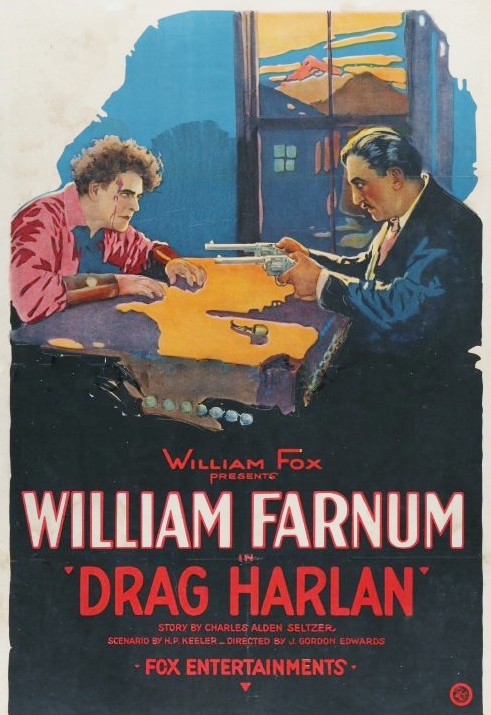
A definitive 6.7/10 rating for a film that redefined the boundaries of cult cinema. Drag Harlan remains a cornerstone of transgressive art.
A western that bleeds noir before noir existed
Picture the American West not as John Ford’s Monumental Valhalla but as a fever-dream crucible where ethics melt faster than silver. Drag Harlan arrives in 1920, a year before Lang’s Dr. Mabuse and two before Murnau’s Nosferatu, yet it already smuggles German-expressionist shadows into cowboy boots. William Farnum—towering, gaunt, eyes like two bullet holes in parchment—embodies a heroism that predates the Hays Code: he kills first, kisses later, and questions his soul only when the smoke clears.
Director J. Gordon Edwards, better known for florid Fox spectacles, strips the genre to its marrow here. Exterior shots bake under white sun that turns every sand-grain into a glass shard; interiors drown in chiaroscuro so thick you could saddle it. The result is a western that feels simultaneously scorched and submerged, as if the Mojave had sprouted gills.
Rather than trot linear beats, the narrative fractures into obsidian shards. A dying prospector’s rasped coordinates ignite Harlan’s gold-lust; the same syllables seed his moral inversion. Each reel loops back on itself—flashbacks nested like Russian dolls—until chronology becomes just another camp-fire tale. One moment Harlan is avenger, next he’s auctioning his gun to the highest bidder; the pivot arrives wordlessly, via a close-up of Farnum’s thumb rubbing a tarnished locket. The film trusts kinetics, not title cards.
The villains, fronted by Herschel Mayall’s black-suited Deacon, resemble Wall Street speculators who took a wrong turn at the Mississippi. They quote scripture while frisking corpses, a duality that prefigures today’s televangelist frauds. Their pursuit of the orphaned ingénue (Jackie Saunders, equal parts porcelain and flint) doubles as a land-grab for the feminine mystique itself; every leer is a surveyor’s flag.
Farnum’s Harlan stalks the frame like a Goya colossus—too big for the horizon, too burdened for eternity. He mimes the classic cowboy taciturnity, yet his micro-gestures leak volumes: a jaw-muscle flutter equals ten pages of monologue. Saunders answers not as damsel but as reluctant cartographer; her eyes redraw the landscape so that every mesa becomes a possible exit ramp. Their courtship occurs in negative space—shared silences thick as bar-smoke—culminating in a rescue staged inside a church whose bell has been melted into bullets. The sacrament is loaded.
Among the supporting rogues, Al Fremont’s weaselly cardsharp deserves mention; his death scene—choking on a communion wafer of paper money—distills the film’s thesis that greed is the only communion this frontier recognizes.
Cinematographer Friend Baker contrasts solar flares with cellar gloom. Daytime vistas sear so brightly the screen seems to blister; night sequences drown in pools of cobalt punctuated by cigarette embers that glow like fallen stars. One bravura shot tracks Harlan through a mine-shaft: lantern in foreground, darkness behind, the camera descending until human and flame fuse into a single trembling halo. It’s a proto-noir flourish that would make John Alton weep.
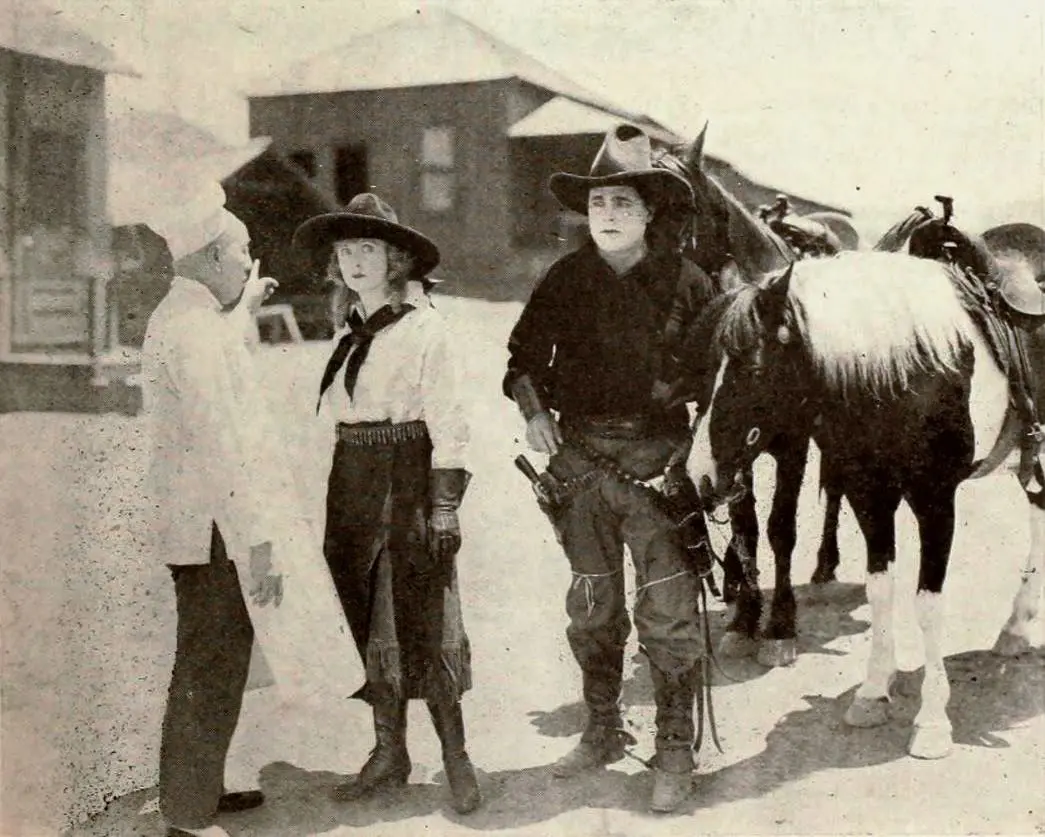
Interiors sport a sickly yellow patina—uric light that suggests both whiskey urine and altar-candle wax. The saloon’s swinging doors become metronomes of fate, ticking off chances until the final gunshot syncs with their halt.
Adapted from Charles Alden Seltzer’s dime-novel, the intertitles dispense with yee-haw dialect. Instead, we get haiku of dread: “Gold sings a siren dirge to the damned.” Keen-eared viewers will catch echoes of this ethos in later anti-capitalist westerns—The Climbers (1919) or Das schwarze Los (1919)—but none marry it to such savage romanticism.
Though released two years before the first synchronized score became fashionable, surviving prints carry cue sheets recommending Wagner’s “Ride of the Valkyries” for the climactic stampede—a cheeky collision of Teutonic bombast with frontier nihilism. Modern festival screenings often substitute doom-metal or Ennio pastiches; either works, because the film’s architecture is musical: crescendo, silence, staccato gunfire, dirge.
If Flirting with Fate (1916) treats mortality as a pratfall, Drag Harlan treats it as a business prospectus. Where Jane Goes A’ Wooing (1919) wraps courtship in screwball ribbon, here romance is a slow-motion hanging. And while The Divine Sacrifice (1918) kneels before transcendence, Harlan spits on the altar and pockets the candlesticks.
Only two of the original five reels are known to survive in 4K scans from nitrate at MoMA; the rest circulate via 16mm show-print bootlegs washed in purple mildew. Even fragmentary, the movie detonates. Imagine hearing half of Beethoven’s 9th and still walking away humming the finale—that’s the magnitude of loss, and the miracle of what lingers.
In an era when billionaires rocket to the stratosphere to escape the mess they made downstairs, Harlan’s shovel-and-six-gun justice feels cathartic. He’s the prototype for every anti-hero from Eastwood’s Man with No Name to Walter White—men who trespass moral borders because the border guards have already been bought. The gold here is bitcoin, the girl is democracy, and the gang wears senatorial pins; swap six-shooter for algorithm, the song remains identical.
Feminist critics may bristle at the rescue trope, yet Saunders’ character wields agency inside the gilded cage. She engineers the final conflagration—misdirecting the villains with false assay figures—thereby turning the mine into a Trojan horse. Her kiss doesn’t redeem Harlan; it signs his death warrant, because love is the one liability he never budgeted for.
Drag Harlan is not a museum relic; it’s a live round wedged in the chamber of American myth. Watch it for the chiaroscuro, rewatch it for the moral migraine. Leave humming the dirge of prospectors who barter their shadows for nuggets, and of cowboys who discover—too late—that the only thing heavier than gold is the space it leaves behind.
IMDb 7.1
1933
Community
Log in to comment.