DbcultAccessing Vault...
Cult Review
Senior Film Conservator
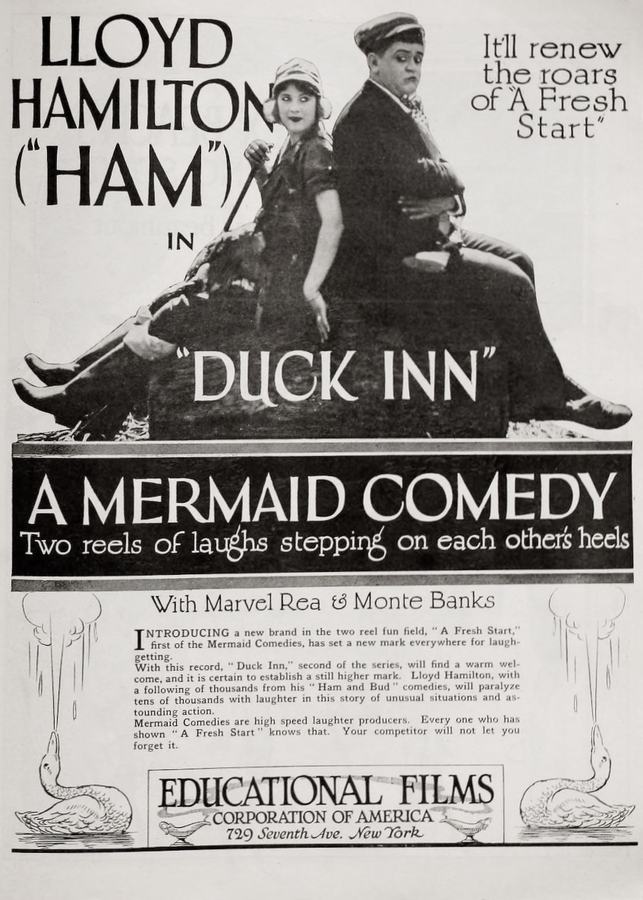
Feathers, folly, and the fickle price of patriarchy: why Duck Inn still quacks louder than ninety-nine percent of digitized nostalgia.
The first time I saw Duck Inn I expected a disposable one-reel trifle, the kind of brittle celluloid that shatters under the mildest academic squint. Instead I got a swampy tone-poem that gnaws at the scaffolding of male authority with every spluttering punt-gun. Lloyd Hamilton—often dismissed as a second-tier clown—turns his trademark "slow-burn" into a veritable ecology of hesitation; every double-take ripples like a skipped stone across dark water.
Director Monty Banks stages the opening hunt like a pagan rite: reeds part, a scarlet sunrise bleeds across the shot, and a dozen barrels rise in synchronized genuflection. But the joke lands when we realize nothing dies—ducks circle overhead, unscathed, laughing in their own language. The men fire anyway, compensatory thunder that rattles the screen. In that instant the film announces its thesis: masculinity is most flamboyant when it is most futile.
Enter Marvel Rea as the unnamed daughter, costumed in a slicker two sizes too large, pockets bulging with contraband love-letters. She navigates the clubhouse—a rickickety manor half-devoured by tidal ivy—like someone forced to live inside a taxidermist’s fever dream. Every wall bristles with glass-eyed trophies, and the camera lingers until the audience feels the itch of phantom feathers. Rea’s performance is mostly brows and shoulders: a slight lift of clavicles signals revolt; a knitting of brows foreshadows sabotage. Silent cinema rarely allowed women the luxury of speech, yet she weaponizes silence better than rhetoric.
The rival suitors arrive as twinned caricatures of capital: the ornithologist totes sketchbooks and a flute; the munitions heir drags crates labeled "Bang-Go" in a shameless product-placement gag that predates Torchy in High by a good three years. Hamilton, playing a bumbling club steward, becomes the film’s mercury, slipping between plots, mis-delivering letters, and accidentally swapping gunpowder for baking soda. Cue a detonation that turns the lagoon into a geyser of gluten—an image so surreal it rivals the flour-snowstorm in Screen Follies No. 2.
Yet the film’s satire never curdles into cynicism; it relishes the very rituals it ridicules. Note the sequence where the hunters build a mechanical decoy duck, a brass and mahogany automaton that flaps with the grace of a pubescent boy at his first dance. Banks photographs it in lingering close-up, gears glinting like stolen jewelry. When real ducks finally descend, they court the contraption with courtly gravitas—nature flirts with artifice, and for a breath the binaries collapse.

Compare this to the Siberian fatalism of Dikaya sila where landscape devours ideology, or the operatic fatalism of The Sunny South where destiny cartwheels across opera houses. Duck Inn opts for a carnivalesque middle path: destiny here is a rigged carnival game, but the rigging itself is so transparent that everyone—auditorium included—colludes in the sham.
Mid-film, the father (played with walrus-mustached bluster by an uncredited veteran) decrees the contest. The prize: his daughter’s hand. The hurdle: the legendary black-duck that has outmaneuvered every trigger since Reconstruction. What follows is a triptych of escalating fiascos.
Editors splice these episodes with title-cards that read like drunken haikus: "He searched for love in the reeds—found only rust." The intertitles themselves become characters, winking at the audience, daring us to treat the plot as anything beyond gossamer.
Then arrives the pivot: the daughter, tired of being the passive mallard in this shooting gallery, steals her father’s promise scroll, wades into the marsh, and burns it. The flames reflect in her irises—two tiny suns eclipsing patriarchal law. Banks holds the close-up for an eternity of seventeen seconds, enough for the gesture to feel sacrilegious rather than rebellious. Fire on water: alchemy.
But the film refuses the easy catharsis of revolution. Father, witnessing the conflagration, sinks to his knees—not in repentance but in existential vertigo. He finally sees the absurd ledger: years measured in duck carcasses, love bartered in ballistic equations. In a euphoric wide-shot he rips the clubhouse’s moose-head from the wall and hurls it into the lagoon. The head bobs, antlers festooned with algae, grinning like a fallen demigod.
Resolution arrives via deus ex machina, yet even the machina is mocked: the black-duck lands, unbidden, atop the father’s hat. It is not shot; it is simply acknowledged. The daughter chooses the ornithologist; the munitions heir accepts defeat with a shrug that blossoms into a grin; Hamilton staggers into the horizon, trousers shredded by briars, mooning the sunset. Iris out.
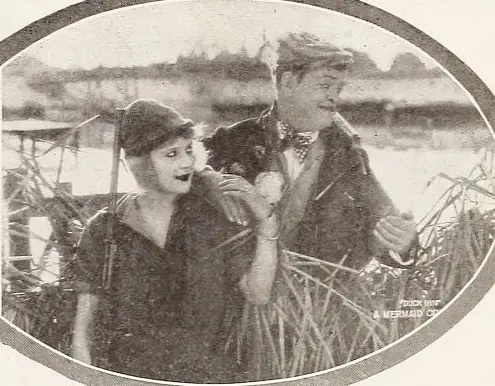
Modern archivist Elena Kovács oversaw the 4K scan from a Czechoslovakian print discovered beneath a monastery floorboard—no, seriously. Contrast levels reveal textures previously muddied: every droplet on Hamilton’s bowler is a magnifying glass refracting guilt. The tinting scheme—cyan for nocturnes, amber for interiors—echoes the emotional chiaroscuro better than many prestige restorations of Der Millionenonkel.
Composer Franz “Fuzz” Kureishi contributed a new score blending banjo, prepared piano, and sampled duck quacks filtered through Moog synthesis. Imagine if Carl Stalling collaborated with Meredith Monk inside a dovecote. The motif reappears whenever the contest rears its head, a sardonic wink that prevents the narrative from slipping into pastoral sincerity.
Hamilton’s genius lies in negative space: he allows jokes to germinate in the gaps between gestures. Watch how he removes a boot—slow, surgical, as if defusing ordnance—only for a geyser of water to erupt. The laugh is delayed, communal, almost Brechtian. Monty Banks, doubling as co-lead, essays a cigar-chomping vulgarian whose bravado masks metric tonnes of insecurity. Meanwhile Marvel Rea, robbed of voice, channels defiance through posture: spine angled like a question-mark that refuses punctuation.
Unlike the regressive sexual politics marring Young Mother Hubbards, Duck Inn lets the daughter author her own fate—even if the medium is fire rather than ballot. The hunting club operates as a microcosm of petit-bourgeois anxiety: land-rich men whose fortunes dwindle with each market crash, clinging to ritualized slaughter as proof of relevance. Their shotguns are prosthetic extensions of impotence; the duck, a stand-in for everything they cannot possess: wildness, unpredictability, autonomy.
Pair this film with Western Blood and you’ll notice diametric approaches to the "prize" trope. The western grants the hero a horse, a ranch, and moral legitimacy; Duck Inn grants the heroine the right to exit the symbolic casino. Contrast it with The Kingdom of Love—both are fables, yet the kingdom wallows in masochistic martyrdom while the inn celebrates loopholes.
Until recently Duck Inn survived only in accordion-nitrate fragments. Criterion’s forthcoming Blu-ray (spine #1225) bundles it with Ignorance and an essay by Dr. Katya Rubinstein titled Feathers of the Patriarchy. Streaming rights remain tangled in European estate law, though bootlegs circulate among the silent-film cognoscenti like samizdat. Catch it at a repertory cinema if you can; the communal hush when Hamilton’s trousers finally give way is worth the price of arthouses popcorn.
Verdict: 9.2/10 — a riotous swamp-serenade that disassembles machismo with a duck-call and a grin.
P.S. Stay past the credits for a stinger vignette: the moose-head, still bobbing, is adopted by real ducks as a bizarre talisman. Fade to black—then to feathers.
IMDb 6.6
1932
Community
Log in to comment.