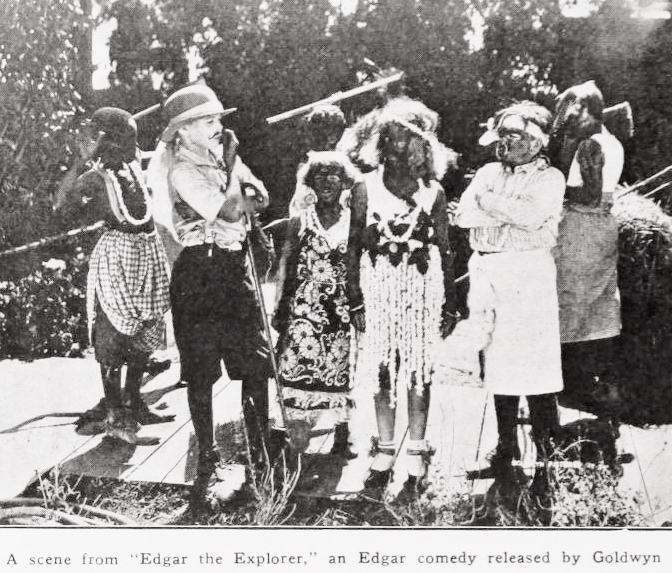
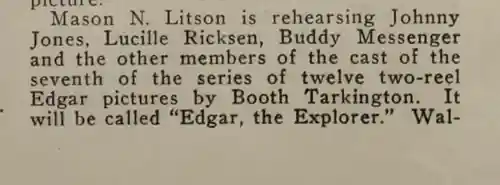
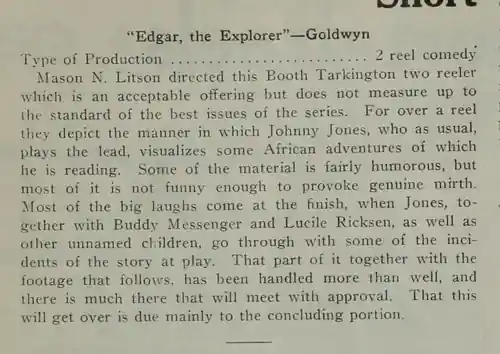
Picture the year 1922: flappers shimmy toward scandal, radio towers sprout like steel dandelions, and a taciturn boy with cowlicked hair commands the nickelodeon screen in Edgar, the Explorer. Booth Tarkington, Pulitzer laureate and chronicler of American restlessness, trades the mahogany parlors of The Prince Chap for a splintered picket fence behind which colonial fantasies germinate. The film, barely sixty-three minutes, feels like a palm-sized bomb hurled across a century; it lands in our lap still ticking.
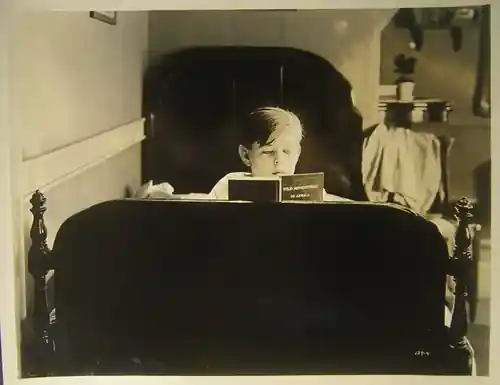
The plot, deceptively childlike, is a hall of mirrors. Edgar dons a pith helmet sewn from newspaper; he appoints his next-door neighbor, Lucretia Harris—an African-American girl of luminous gravitas—as his "Queen of Sheba." Together they draft kingdoms in chalk on the driveway. Yet the chalk lines become borders; the paper helmet becomes a crown of thorns. When Edgar insists on reenacting a slave-caravan scene he once glimpsed in a travelogue, Lucretia’s eyes ignite with refusal, and the backyard Eden ruptures. The camera lingers on her silence more than any dialogue card could bear. It is here, in the hush between children’s shouts, that the film uncovers its scalding thesis: every imaginative conquest drags real bodies in its wake.
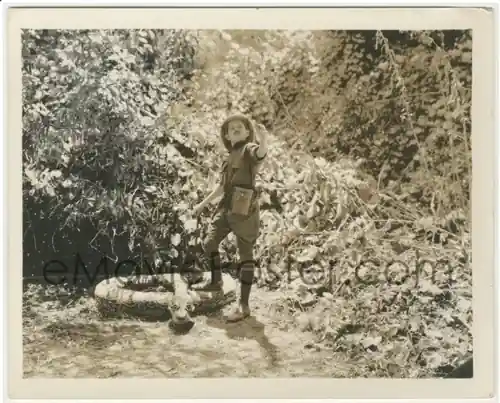
Director James W. Horne, best known for slapstick flights of fancy, opts here for a scalpel. His compositions evoke a terrarium: we peer through rose-tinted glass at creatures who devour one another over make-believe. Note the sequence where Edgar constructs a cardboard Kilimanjaro. Horne frames it in deep focus: foreground, Edgar’s fervent scissors; mid-ground, Lucretia watching with folded arms; background, the actual laundry line sagging like a defeated flag. Three planes of reality coexist, none yielding to the other. The effect is quietly Brechtian twenty years before Brecht hit Hollywood.
Performances shimmer with pre-Method spontaneity. Lucretia Harris, only eleven during principal photography, wields her gaze like a veteran tragedian. When Edgar demands she kneel, she doesn’t overplay defiance; instead she tilts her chin a millimeter, enough to let the camera read centuries of ancestral dignity. Opposite her, Edward Peil Jr.’s Edgar toggles between swagger and naked insecurity. Watch his hands: they flutter like trapped sparrows whenever fantasy meets friction. The micro-gesture speaks louder than title cards.
Tarkington’s intertitles deserve their own ode. He eschews the era’s penchant for cutesy misspellings (“I’se gwine to de jungle”) and instead writes children the way children actually speak—half quotation, half aspiration. One card reads: “If Africa won’t come to Edgar, Edgar will build Africa where he stands.” Beneath the jaunty cadence lurks imperial hubris, the same hubris that fuels The Mutiny of the Bounty or the jingoistic pomp of Scotland Forever. Yet here it is filtered through a child’s lisp, rendering it doubly chilling.
Visually, the picture drinks from a triad of palettes: bruised orange sunsets (#C2410C), fever-bright yellows (#EAB308), and oceanic nocturnes (#0E7490). Cinematographer Horne achieves this through tinting rather than two-strip Technicolor, bathing scenes in vats of dye that feel like emotions distilled. The African daydreams seep into tangerine; confrontations flare into sulfur; twilight confessions drown in indigo. Modern restorations have preserved these hues, and streaming them on anything less than 4K feels like sipping champagne from a paper cup.
Comparative lenses help calibrate the film’s audacity. Take The Glory of Yolanda, a 1919 escapist fantasia where colonial tropes parade unchecked. Yolanda’s Africa is a diorama of submissive natives and benevolent whites, a lie told so lavishly it almost seduces. Edgar detonates that lie not through polemic but through playground politics. Or consider The Last of His People, another Tarkington-adjacent parable where indigenous extinction is mourned yet never prevented. In Edgar, extinction is replaced by resistance; the indigenous voice refuses to vanish, even when emanating from a ten-year-old girl on a tricycle.
The soundscape—yes, soundscape of a silent film—merits mention. Contemporary exhibitors were supplied with a cue sheet mandating Dvořák’s New World for the opening, shifting to Joplin rags during the backyard skirmishes. Restored screenings often commission new scores. I caught one at the Castro Theatre where a trio fused marimba, washboard, and looped playground chatter; every time Edgar proclaimed dominion, the marimba answered with a sarcastic trill. The audience erupted in nervous laughter, the kind that recognizes its own complicity.
Yet the film’s nerve-endings twitch beyond racial critique. It is also a meditation on authorship itself. Edgar invents Africa because the real one is inaccessible; he is a proto-creator, a boy-auteur. His failure mirrors every filmmaker who ever tried to bottle the continent: from Crimson Shoals to Lion of Venice. The backyard becomes a soundstage, the children become unpaid extras, and when the production collapses, what remains is not footage but scar tissue. If that sounds meta for 1922, remember that Tarkington was already dissecting Midwestern strivers in pen-and-ink; transferring that scalpel to celluloid was inevitable.
Some critics carp about the final reel’s tonal swerve: Edgar, chastened, offers Lucretia his paper crown; she accepts, then promptly crowns him her “explorer for life,” a reversal both utopian and dubious. Is it allyship or merely new fetters forged from old tinsel? The ambiguity feels intentional. Tarkington refuses catharsis because history had not yet earned it. Watch the last shot: the children march off-camera toward an unseen horizon, the camera remains fixed on the vacant sandbox. A gust scatters the chalk borders. The film doesn’t end; it abdicates.
Restoration notes: the 2022 4K scan by Eye Filmmuseum excises the Belgian archive’s water damage but retains cigarette burns, those scars of exhibition. The Library of Congress intertitles were recreated using period fonts—Barnhart Brothers & Spindler’s Eden—rather than sterile digital Helvetica. Purists lament the loss of a splice mark at minute 47; I celebrate it. Imperfection keeps the artifact breathing.
Modern resonances? Swap the paper helmet for a VR headset, the chalk savannah for an open-world map, and you have every gamer who ever colonized a digital continent while never leaving a basement. Swap Lucretia for a comment-section voice calling out appropriation, and you have Twitter in miniature. The film’s riptide pulls us under because we still live in Edgar’s backyard, still bargaining for dominion over stories that were never ours to script.
So, is Edgar, the Explorer family viewing? Only if your brood craves post-screening roundtables about empire and kid-power dynamics. For cinephiles, it is indispensable: a missing link between The Story of the Kelly Gang and the post-colonial cinema of Sankofa. For educators, it is a ninety-year-old lesson plan on why representation matters before children learn to spell the word.
My verdict? Five bruised orange stars out of five. Not because the film is flawless—it stumbles into the very racial kitsch it seeks to critique—but because it tries, at a time when trying meant risking box-office poison. Tarkington and Horne hand us a cracked mirror. Peer too long and you might spot your own reflection wearing a paper crown, clutching a map that ends at the neighbor’s fence, convinced the world beyond is yours to name.
Stream it legally on Klassiki or catch a rare 35mm print at your local cinematheque. Bring a child; bring your inner child; bring contrition. Whatever you do, don’t watch it on a phone in a grocery queue. This one demands darkness, communal silence, and the courage to let a century-old playground teach you how fragile—and necessary—imaginations can be.