DbcultAccessing Vault...
Cult Review
Senior Film Conservator
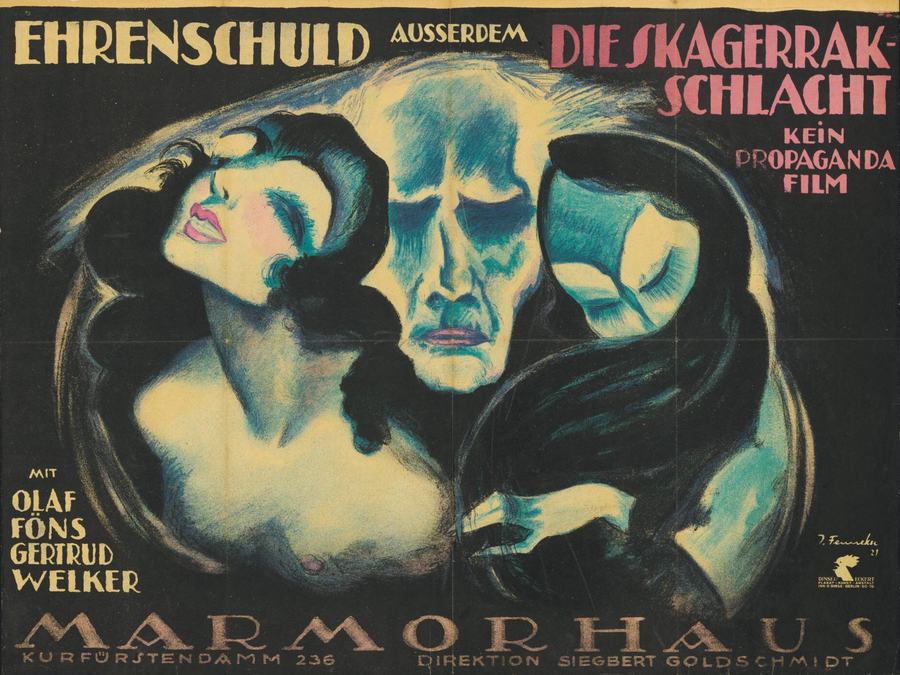
Ehrenschuld is not a film that asks to be understood. It demands to be felt. From its opening shot—a desolate harbor swallowed by fog—the film establishes a tone of melancholic inevitability, as if the very landscape conspires to trap its characters within their fates. The protagonist’s return home is less a homecoming than a reckoning, a collision of memory and reality that dissects the anatomy of regret with surgical precision. This is a story where every glance holds a history, every pause a confession.
The film’s true brilliance lies in its duality of pacing. The first act crawls with the deliberateness of a man sifting through wreckage, while the second erupts into a tempest of emotional revelations. Harriet Bloch and Marie Luise Droop’s screenplay avoids contrivance, instead opting for a sparse, almost minimalist approach to dialogue that lets the actors fill the voids with raw subtext. Olaf Fønss, as the guilt-ridden mariner, delivers a performance of quiet devastation, his eyes perpetually shadowed by the weight of unspoken truths. His chemistry with Gertrude Welcker—alternately tender and explosive—forms the film’s emotional nucleus, a volatile dance between past and present that never feels contrived.
Visually, Ehrenschuld is a masterclass in chiaroscuro. Directorial choices emphasize verticality and isolation: characters are often framed in narrow doorways or towering windows, their silhouettes dwarfed by the oppressive grandeur of their surroundings. The cinematography leans into a muted palette of grays and deep blues, punctuated only by flashes of candlelight or the sickly yellow of a dying lamp. These visual motifs mirror the protagonist’s internal disintegration, a man unraveling under the paradox of wanting to escape his past while being inexorably drawn back to it.
Themes of honor and betrayal are dissected with surgical precision, particularly in the subplot involving Willy Kaiser-Heyl’s enigmatic character—a figure who embodies the film’s central moral ambiguity. His interactions with the protagonist are charged with unspoken tension, each line delivery a chess move in a game where the stakes are human lives. The script refuses to vilify or sanctify any character; instead, it presents a gallery of flawed individuals, their choices as tragic as they are inevitable.
What sets Ehrenschuld apart is its refusal to sanitize its characters’ motivations. The childhood sweetheart, played with aching vulnerability by Editha Seidel, is not a passive muse but a woman grappling with her own complicity in the web of lies. Her quiet strength contrasts with the more flamboyant desperation of Boris Michailow’s role, a character whose moral flexibility serves as a foil to the protagonist’s rigid sense of duty. These performances, layered and unflinching, prevent the narrative from descending into melodrama, instead grounding it in a stark realism that lingers long after the credits roll.
The film’s structure is both its greatest strength and its occasional weakness. Long stretches of silence and slow-motion sequences—such as a pivotal scene where the protagonist watches a ship vanish into the horizon—risk alienating viewers seeking narrative momentum. However, these moments are not filler; they are the film’s heartbeat, a deliberate rhythm that forces the audience to confront the same existential void the characters inhabit. This approach pays dividends in the third act, where revelations are delivered with the quiet finality of a closing door, leaving no room for catharsis yet offering a strange kind of solace.
Comparisons to A Gentleman’s Agreement are inevitable, given their shared exploration of moral compromise, but Ehrenschuld diverges in its quieter, more introspective tone. Unlike the American film’s courtroom crescendos, this German drama finds its power in silence and suggestion. Similarly, The Devil’s Riddle’s penchant for arcane symbolism is replaced here with a focus on the visceral textures of everyday life—the creak of a floorboard, the flicker of a match, the tremor in a voice. These details accumulate into a sensory experience that transcends mere storytelling.
The score, a haunting blend of accordion drones and string crescendos, deserves special mention. It is not merely an accompaniment but a character in its own right, weaving through the film’s emotional beats with a mournful persistence. Particularly effective is its use during a rain-soaked confrontation between the protagonist and the woman tied to his brother’s death. The music swells and recedes like the tide, mirroring the push-and-pull of their relationship—a dance of mutual accusation and unspoken longing.
For all its technical brilliance, Ehrenschuld is ultimately a film about the irreconcilable nature of human choices. It does not offer answers but instead paints a world where every decision fractures the soul a little more. This is not a film for those seeking comfort; it is an unflinching mirror held up to the contradictions of the human condition. The final shot—a close-up of the protagonist’s face as dawn breaks over the sea—captures this duality perfectly: light breaking through but never fully banishing the shadows.
In the pantheon of 20th-century German cinema, Ehrenschuld holds a unique place. It is a film that resists categorization, straddling the line between neorealism and expressionism, between a character study and a philosophical treatise. Its legacy lies not in its answers but in the questions it dares to ask—and the silence with which it leaves them hanging.
IMDb —
1925
Community
Log in to comment.