DbcultAccessing Vault...
Cult Review
Senior Film Conservator
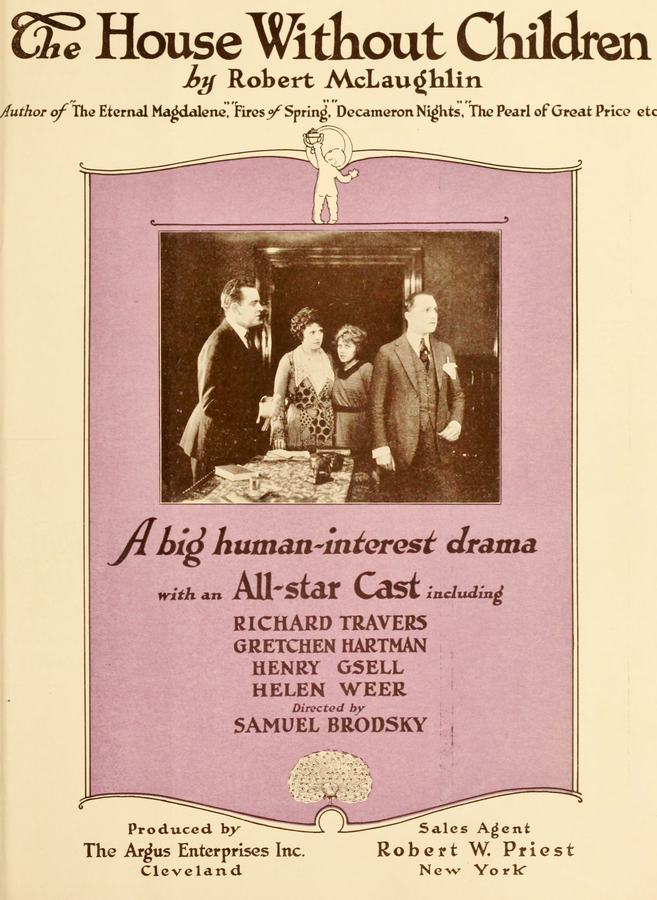
The opening frames of The House Without Children establish a claustrophobic interior, lit in stark chiaroscuro, where the Walker household teeters on the brink of emotional bankruptcy. Richard Walker, portrayed with a brooding intensity by Henry G. Sell, is a man whose identity is inextricably linked to the notion of legacy. His yearning for a son is not merely personal; it is an echo of patriarchal imperatives that dominate early twentieth‑century narratives. Margaret, embodied by Gretchen Hartman, counters this with a progressive stance on contraception, positioning herself as an early feminist voice within a genre that rarely affords such agency.
Margaret's arguments for birth control are delivered with a measured calm that belies the turbulence underneath. Hartman's subtle glances and restrained gestures convey a woman wrestling with societal expectations versus personal autonomy. In contrast, Florence (Edith Stockton) is the quiet fulcrum around which the drama pivots. Her pregnancy, a clandestine act of rebellion, is rendered with a delicate vulnerability that makes her eventual confession to Margaret all the more poignant.
Jim (George Fox), the cousin whose charm masks opportunism, is a catalyst for the film's moral ambiguity. His proposal, motivated by an impending inheritance, exposes the mercenary undercurrents that pervade the Walker household. Lawrence Branford (Richard Travers), the steadfast secretary, offers a counterpoint of sincerity; his love for Florence is earnest, and his eventual marriage to her provides a restorative resolution that underscores the film's thematic emphasis on authentic connection.
At its core, the film interrogates the clash between emergent modernist ideals and entrenched Victorian mores. Margaret's advocacy for birth control is not merely a plot device; it reflects a broader cultural shift toward reproductive autonomy that was gaining traction in the 1920s. Richard's denunciation of Margaret as a "modern woman" is a scathing indictment of the era's patriarchal anxieties, revealing how personal grievances are often amplified by societal pressures.
The subterfuge surrounding the child's identity serves as a narrative allegory for the concealment of inconvenient truths in a rapidly changing world. By passing the infant off as his own, Margaret attempts to preserve the illusion of familial continuity, yet the deception ultimately unravels, exposing the fragility of constructed identities.
When juxtaposed with contemporaneous works such as Mountain Law or Les frères corses, the Walker saga distinguishes itself through its intimate focus on domestic power dynamics rather than external conflict. While Mountain Law explores legal morality in a rugged landscape, The House Without Children turns the lens inward, dissecting the courtroom of the home where love, duty, and deception collide.
Director Robert McLaughlin employs a restrained visual style that amplifies the film's emotional stakes. The use of deep shadows and selective lighting creates a visual metaphor for the secrets that linger in the corners of the Walker residence. Close‑ups of Margaret's face, bathed in a soft yellow glow (#EAB308), convey her internal conflict, while scenes featuring Florence often employ a cool sea‑blue tint (#0E7490) to suggest both melancholy and resilience.
The mise‑en‑scene is meticulously composed; the recurring motif of a cracked window pane mirrors the fractured relationships within the household. When the infant is born, the camera lingers on the fragile form, the lighting dimming to a muted orange (#C2410C) that foreshadows the impending tragedy.
Henry G. Sell's portrayal of Richard is a masterclass in restrained masculinity. His occasional glances toward the empty cradle reveal a yearning that is both personal and symbolic. Hartman's Margaret, meanwhile, oscillates between steely resolve and tender vulnerability, a duality that makes her eventual maternal awakening feel earned rather than contrived.
Edith Stockton's Florence is a study in quiet strength. Her confession to Margaret is delivered in a hushed tone, yet the weight of her words reverberates throughout the narrative. The chemistry between Florence and Lawrence, though understated, culminates in a union that feels both inevitable and restorative.
The film's pacing is deliberate, allowing each revelation to breathe. The year‑long absence of Richard and Jim functions as a narrative crucible, intensifying the domestic pressures that lead to Florence's pregnancy. The subsequent deception, the child's deteriorating health, and the eventual death are spaced to maximize emotional impact without descending into melodrama.
Notably, the screenplay refrains from overt moralizing. Instead, it trusts the audience to grapple with the ethical ambiguities presented. The child's death, while heartbreaking, serves as a catalyst for Margaret's transformation, suggesting that loss can precipitate growth.
Although a silent film, the strategic use of intertitles and musical accompaniment enhances the emotional texture. The intertitles are succinct, employing a literary cadence that mirrors the film's thematic depth. The accompanying score, likely a blend of piano and string motifs, underscores moments of tension with a low, resonant hum, while tender scenes are accompanied by a lilting melody in a major key.
Nearly a century after its release, The House Without Children remains a compelling artifact of early cinema's engagement with gender politics and familial expectations. Its exploration of reproductive rights anticipates later feminist discourses, while its portrayal of deception within intimate relationships offers timeless insights into human frailty.
For scholars interested in the evolution of domestic drama, the film provides a valuable case study. Its nuanced characters, coupled with McLaughlin's visual restraint, make it a worthy companion to other period pieces such as Les frères corses and Das Phantom der Oper, each of which interrogates societal norms through distinct narrative lenses.
In sum, The House Without Children is a meticulously crafted drama that balances thematic ambition with restrained storytelling. Its performances are layered, its cinematography evocative, and its moral quandaries resonant. While the film's length may test contemporary attention spans, its rich tapestry of character study and social commentary rewards patient viewers. The resolution—Margaret's awakening, Florence's marriage to Lawrence, and Richard's reluctant acceptance—offers a bittersweet closure that acknowledges both the cost of deception and the possibility of redemption.
For cinephiles seeking a window into the silent era's capacity for psychological depth, this film stands as a testament to the medium's ability to convey complex narratives without spoken word. Its influence can be traced in later works that grapple with similar themes of parenthood, autonomy, and the often‑hidden machinations of domestic life.
IMDb 5.2
1917
Community
Log in to comment.