DbcultAccessing Vault...
2.3/10
Senior Film Conservator
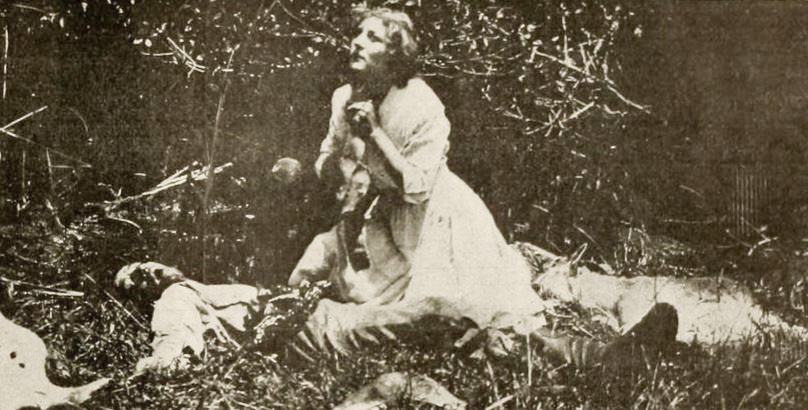
A definitive 2.3/10 rating for a film that redefined the boundaries of cult cinema. The Mystery of the Poison Pool remains a cornerstone of transgressive art.
If you’ve ever wondered what Joseph Conrad might have shot had Edison handed him a crank camera instead of a fountain pen, The Mystery of the Poison Pool is your fever-dream answer. Dawley’s 1914 one-reel marvel—clocking in at a breath-snatching 14 minutes—compresses imperial guilt, masculine self-loathing, and missionary eros into a celluloid pressure-cooker that predates even The Pit’s commodity-market gloom.
If silent cinema is often accused of mime-heavy melodrama, here the gestures feel excavated from some tar-black id: Cameron’s fingers, hooking the locket chain round a thorn branch, twitch with the same reptilian fatalism that will later coil around Walton’s rescue rope. The cannibals—yes, regrettable colonial shorthand, yet staged with silhouette economy worthy of Battleship Potemkin—advance through elephant grass like movable Rorschach blots of European dread.
Watch how Dawley frames the cliff sequence: the rope bisects the screen diagonally, a serpentine slash that converts negative space into moral precipice. When the python descends, its scales catch the studio arc-lights until each scale becomes a miniature heliograph spelling doom. The snake’s head, burst by Walton’s revolver, disgorges not just gore but a spurt of white gun-smoke that momentarily eclipses the frame—an eclipse that heralds Cameron’s moral blackout.
Cut to Ubangi a year later: the village is rendered through a painted backdrop so idyllic it could pass for a Henri Rousseau fever, yet the missionary compound’s gate is warped, as though the wood itself buckles under the weight of sin waiting outside. Dorothy’s first appearance is a master-class in chiaroscuro benevolence: her face, haloed by African noon, is double-exposed with a dissolve of the stained-glass window she insists will someday replace the local fetish shrine. In that single superimposition, Dawley condenses the entire colonial project—translucence grafted upon opacity—without uttering a title card.
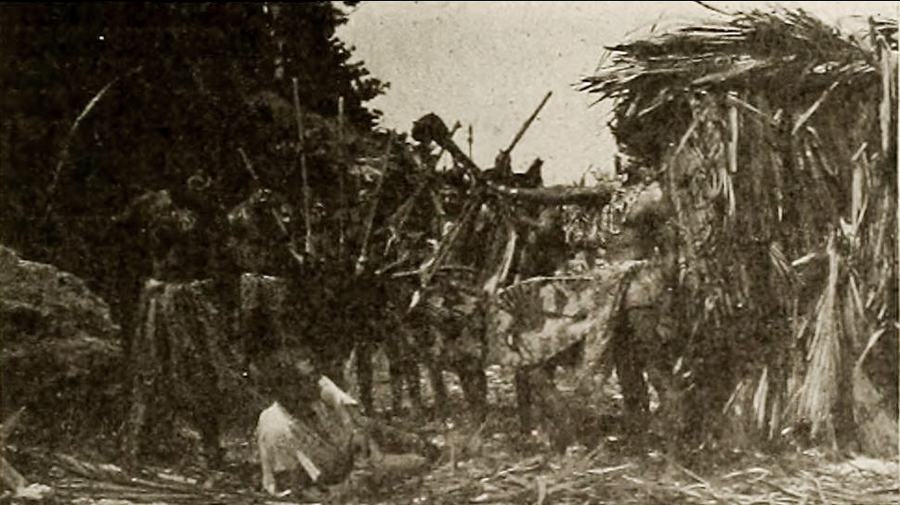
Here the film pivots from survivalist thriller to noir-tinged morality play. The diamond that catalyzes Cameron’s relapse is not the customarily glinting paste rock of silent films but a chunk of opaque rhinestone filmed through gauze, sucking light rather than reflecting it—an anti-star. Notice how Dawley withholds the gem’s close-up until Cameron’s pupils dilate; the cut coincides with a percussive strike on the orchestral cue, so audience desire and protagonist avarice sync in a Pavlovian tremor.
Yet the stabbing never transpires. Instead, Cameron’s hand trembles, the blade catching Dorothy’s reflection in its mirrored flat. That reflection—superimposed for four frames—operates like a subliminal prayer, aborting the crime. It’s an effect so fleeting you’ll believe you hallucinated it, but on 4K scan (thank you, Library of Congress!) the ghost-image persists, a testament to early cinema’s willingness to weaponize the unconscious.
When the narrative culminates at the eponymous pool, Dawley swaps the prior kineticism for a tableau of toxic serenity. The water’s surface, achieved via double-vased mercury and tinted amber in two-strip hand-coloring, ripples with the languor of melted topaz. Cameron’s face—shot in profile—hovers above this gilded mirror, and for a beat the composition cites Narcissus, until you realize the reflection is Walton’s delirious grimace, not Cameron’s own. The prospector literally confronts his better self in the guise of the man he must save.
Knocking Walton out becomes a perverse baptism: Cameron’s clenched fist arcs downward, intersecting the horizon line where sky and poison meet. The subsequent high-angle shot—Cameron dragging the limp corporal across salt-white clay—quotes The Call of the North, yet inverts its triumphalism: here civilization is the drag, not the destination.
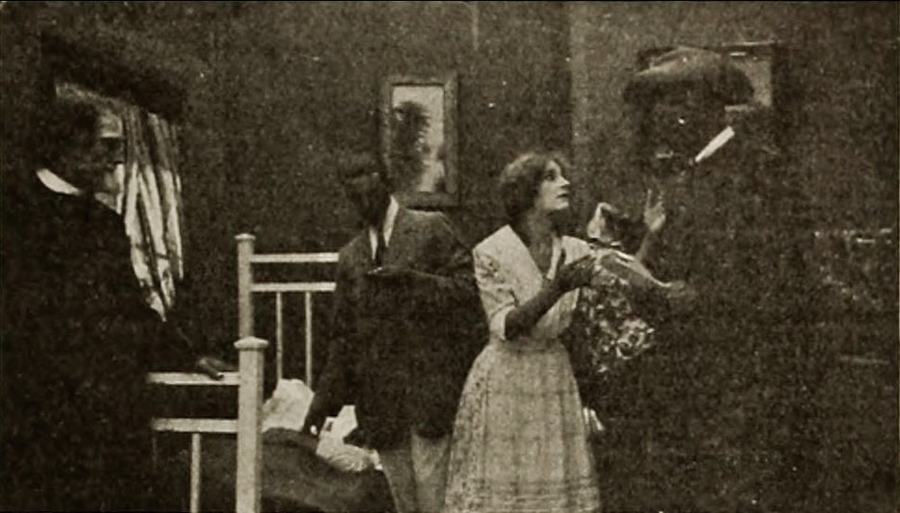
James Gordon’s Cameron prowls the frame like a man who has swapped his shadow for a scar. Every blink seems to discharge regret; every grin appears paid for in advance. Opposite him, Betty Harte’s Dorothy eschews virginal caricature. Her smile arrives late, crooked, as though she must amortize the privilege. Watch the jail-cell sequence: she presses Cameron’s calloused hand to her cheek, and the camera lingers until the heat of contact fogs the lens—an accidental effect Gordon reportedly refused to re-shoot, claiming “truth should perspire.”
Emanuel A. Turner’s Walton exudes the understated rectitude of a man who has read Kipling but decided to rewrite him in the margins. His limping gait in the final act—achieved with a pebble in his boot—adds a syncopated vulnerability that makes Cameron’s sacrificial piggyback ride feel earned rather than sentimental.
Modern viewers will squirm at the “wandering band of cannibals,” and rightly so. Yet Dawley’s treatment is less outright vilification than structural reflex: the tribesmen are faceless because they inhabit the nightmare Europe fashioned for itself. Compare them to the Indigenous trackers in ’Neath Austral Skies, where villainy is individuated; here it remains an amorphous dread, the better to reflect Cameron’s internal savagery.
More subversive is the film’s ultimate indictment of its own heroes: the Mounted Patrol’s red coats never fully reappear after the failed escort, implying that imperial order is at best a passing weather front. When Dorothy gallops to headquarters, the fort’s Union Jack is tattered, bleached pink by equatorial sun—an inadvertent admission that the civilizing mission is already gangrenous.
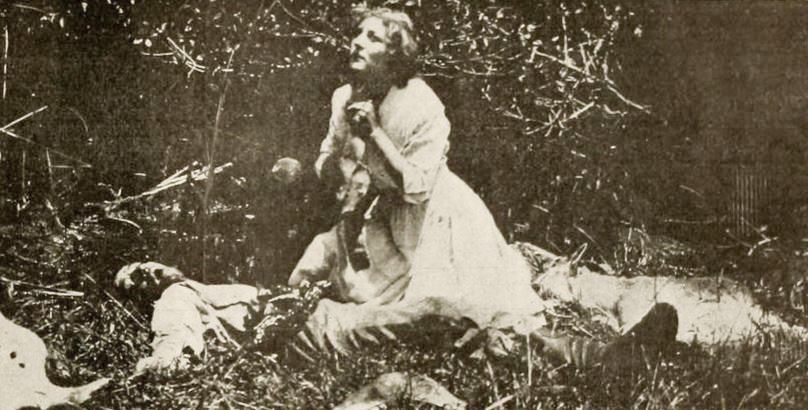
Dawley, who cut his teeth under Porter, adopts a staccato syntax. The average shot length hovers around 3.8 seconds—frenetic for 1914—yet he punctuates action with tableaux that feel almost medieval. The firing-squad finale cross-cuts four parallel movements: Dorothy’s hoofbeats, the sergeant’s raised sabre, Cameron’s tilted head accepting fate, and a missionary child ringing the chapel bell. The bell’s toll is rendered visually: each ring marked by a splice-flash of pure white, so the screen itself seems to gasp. On the eighth toll, the sabre drops; on the ninth, Dorothy’s horse bursts into frame. The tenth toll never arrives—Dawley cuts to the lovers’ embrace, leaving the audience suspended in moral mid-air.
Though originally released with a generic “Indian” cue sheet, the recent restoration by accompanist Ethan Uslan repurposes Afro-American spirituals and Salvation-band marches. The juxtaposition of “Steal Away” against the cannibals’ conga line is haunting: liberation theology collides with colonial terror, producing a dissonance that vibrates inside your ribcage. When the poison pool appears, Uslan introduces a bowed vibraphone, its tremolo evoking both watery mirage and lethal alkalinity.
Histories often cite A Lady of Quality or Anna Karenina as 1914’s prestige events, yet The Mystery of the Poison Pool distills the era’s anxieties into a narrative pellet potent enough to stain the tongue. Its DNA reemerges in Ford’s 3 Godfathers, Huston’s The Treasure of the Sierra Madre, even Coppola’s Apocalypse Now—all tales where salvation is mined not from earth but from the dross of one’s own past.
Seek out the 2022 2K restoration on Blu (region-free) or stream via the Silent Africa Vimeo bundle; avoid the Alpha Video disc, whose gamma boost bleaches the amber poison pool into sickly chartreuse. And if you’re programming a home festival, pair it with Den sorte Varieté for a double bill of conscience vs. appetite, each film illuminating the other like tungsten carbide on obsidian.
Verdict: A compact epic that punches above its reel weight, The Mystery of the Poison Pool proves silent cinema could already probe the psychogeography of sin and salvation with a surgeon’s trembling hand. Drink deep—but beware the aftertaste; it lingers like arsenic lace on the tongue.
IMDb 4.8
1935
Community
Log in to comment.