DbcultAccessing Vault...
Cult Review
Senior Film Conservator
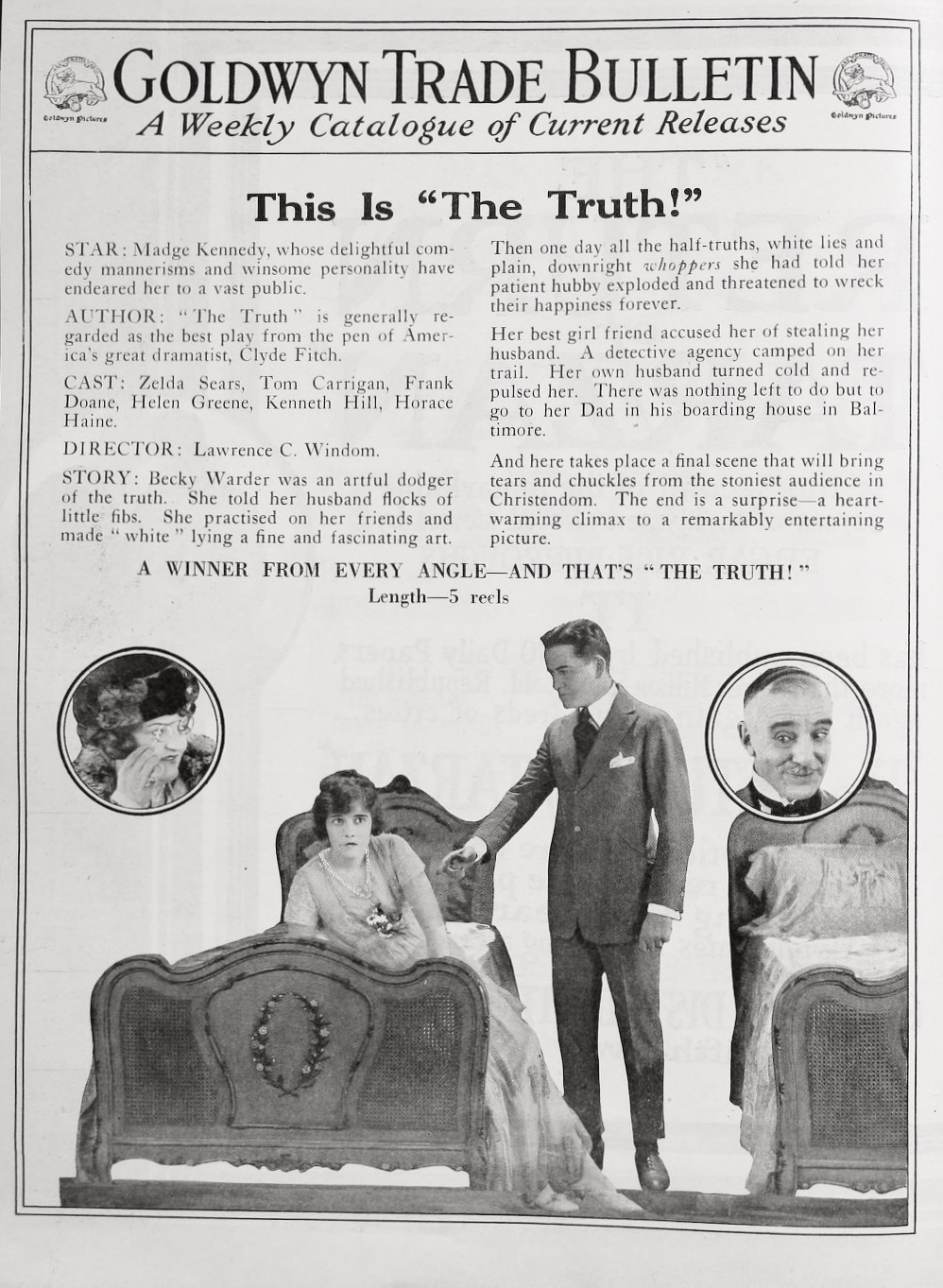
Clyde Fitch’s 1910 stage hit, retooled for the flickering iris of 1920, arrives like a Fabergé egg hurled against a wall: delicate yet brutal, ornate yet spattered with domestic gore. Director Thomas R. Mills—working under the aegis of the old Pathe lot—compresses Fitch’s four-act drawing-room vivisection into a brisk fifty-two minutes, and the celluloid still trembles with the aftershocks of moral whiplash.
From the first medium-shot tableau—Becky’s gloved fingertips drumming atop a mahogany escritoire—the camera anticipates Hitchcockian suspense decades avant la lettre. The domestic space is photographed like a crime scene: every doily a potential bloodstain, every cigarette curl a tell-tale heart. Note how cinematographer Frank Doane tilts the mirror in the Warder boudoir so that Becky’s reflection fractures into two selves—truth-teller and fabulist—long before German Expressionism made such tricks fashionable.
Madge Kennedy—fresh from Hairpins—plays Becky with the kinetic fizz of a shaken champagne bottle, eyes that plead innocence while her jawline betrays a voluptuous appetite for chaos. Watch the micro-moment when she pockets Fred’s handkerchief: a millisecond of triumphant smirk, instantly smothered by demure concern. It’s silent-era code for I own you now.
Horace Haine’s Tom is no cuckolded cardboard spouse; his jealousy carries the metallic tang of wounded vanity. In the telegram scene, Haine’s shoulders crumple like wet paper—an astonishing bit of physical acting that conveys both relief and fresh dread. Compare him to the stolid husbands of Mrs. Temple's Telegram and you’ll see how far under the skin Haine burrows.
Helen Greene’s Eve could have been a shrill caricature; instead she gifts us a Victorian neurasthenic whose paranoia perfumes the air like ether. Listen—yes, listen—to the intertitle where she hisses, "Your kindness smells of gardenias left too long in the sun." Pure Fitchian venom, delivered with a languid drawl that slices nonetheless.
The screenplay, adapted by Arthur F. Statter, prunes Fitch’s verbose epigrams but keeps the moral Rubik’s cube intact. Each act toggles perspective: Act I filters through Becky’s self-mythologizing; Act II through Eve’s jaundiced gaze; Act III through Tom’s cuckold rage; Act IV through the omniscient audience, now complicit in every falsehood. The cumulative effect is a cinematic kaleidoscope of unreliability—a trick The White Lie attempted but never achieved with such ruthless elegance.
Consider the Baltimore sequence: exterior shots of Camden Station bustle with documentary candor, yet once inside Roland’s townhouse the mise-en-scène mutates into faux-Oriental excess—tasseled drapes, snarling gargoyles, a grandfather clock whose pendulum swings like a metronome of damnation. The visual clash underscores theme: modernity colliding with Gilded-Age duplicity.
Fitch, often dismissed as a boulevardier of light comedy, was actually dissecting patriarchal privilege with scalpel-sharp precision. Becky’s lies are less moral failing than survivalist stratagems inside a society that auctions off female credibility cheap. Note how every male character—Fred, Tom, even her father—commands institutional power (law, finance, patriarchal legacy), while women traffic only in narrative power: gossip, letters, whispers. The film’s scandal erupts when Becky trespasses into male-coded action (clandestine meetings, forged telegrams), thus upending the sexual economy.
Yet Fitch refuses a tidy feminist martyrdom. Becky’s final renunciation of deceit coincides with Tom’s patriarchal pardon—an ending that tastes both sweet and metallic. Compare this ambivalence to the blunt moralism of Die Teufelskirche or the sentimental redemption in Gladiola; Fitch leaves us in a vertiginous grey zone where emancipation and submission are Siamese twins.
Cinephiles will detect echoes throughout the decade: the marital hothouse toxicity anticipates von Stroheim’s Blind Husbands; the circular structure of rumor presages Beatrice Fairfax Episode 1: The Missing Watchman, where information metastasizes faster than truth can lace its boots. Even the telegram-as-deus-ex-machina gimmick resurfaces in Mrs. Temple's Telegram, though here it’s weaponized with paternal cynicism rather than maternal panic.
Yet no parallel feels more apt than The Kiss: both films understand that a single ambiguous embrace can detonate dynasties. Where The Kiss lingers on the erotic charge, The Truth excavates the narrative fallout—the story that metastasizes around the kiss, the corroding power of what-never-happened.
The 4K restoration by Eye Filmmuseum (2022) harvested a 35mm nitrate print discovered in a Romanian convent archive—yes, really. The tinting scheme replicates original Pathe Stencil hues: amber for interiors, viridian for exteriors, rose for the scandalous night. The new score by Guðnadóttir—performed on period-correct glass harmonica and Marxophone—threads eerie dissonance beneath drawing-room civility, reminding us that every teacup clink is a tiny tectonic shift.
Viewers weaned on post-Mamet verbosity may balk at the film’s reliance on intertitles, but try watching it silent-within-silence: no score, just the whisper of the projector. Suddenly the creak of chairs, the rustle of dresses, the metronomic flicker itself become diegetic—an aural lie that mirrors Becky’s fabrications.
In an era when The Law of the Yukon glorifies rugged sincerity and Rescue of the Stefansson Arctic Expedition peddles heroic transparency, The Truth dares to assert that mendacity is not the opposite of morality but its shadow—inseparable, necessary, human. Kennedy’s Becky does not slump into contrition; she strides into a future where her tongue may yet re-sculpt reality. Whether that future is feminist victory or Pyrrhic defeat is the open wound the film refuses to cauterize.
Seek it out on Blu-ray, project it on the largest wall you can find, invite friends who swear they "can’t do silents," and watch them squirm when the final iris closes not on a kiss but on Becky’s enigmatic half-smile—a smile that knows the next lie is already germinating.
A century on, The Truth still asks the question we tweet in lesser characters: is honesty a virtue, or merely the privilege of those who can afford consequences?
IMDb 4.7
1913
Community
Log in to comment.