DbcultAccessing Vault...
Cult Review
Senior Film Conservator
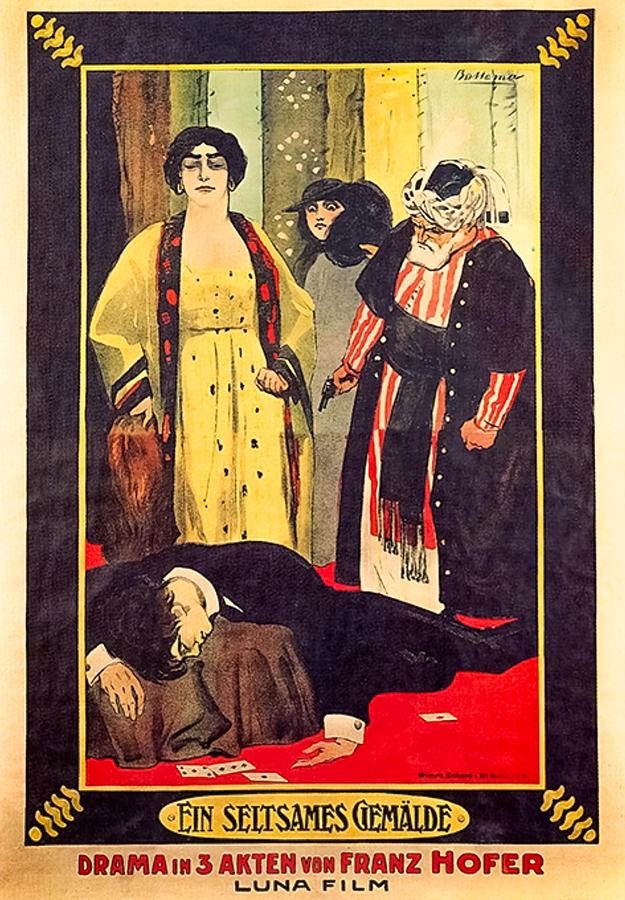
Forget haunted houses; Hofer gifts us a haunted rectangle. From the instant Martin Wolff’s cadaverous painter drags the orphaned portrait up four flights of splintered stairs, the film treats the frame like a carnivorous pet. It drinks kerosene hues, exhales cobalt smoke, and by reel three it’s literally chewing the furniture. From today’s vantage the metaphor feels prophetic: art in the age of mechanical reproduction devours its author. Yet in 1914 this was seditious stuff—German cinema was still toddling from the carnival tent into the firelight of Expressionism, and here was a feature-length accusation that every image is a vampire.
Lissi Lind’s dual performance is a master-class in uncanny glide. As the painted chimera she never blinks; as the fleshed doppelgänger she blinks twice too often, each flutter a taunt. Close-ups linger until the face becomes geography: cheekbones like Alps, pupils like blackout wells. The camera doesn’t cut away—it abdicates. You’re left alone with a visage that seems to re-compose itself between frames, an early analogue deep-fake achieved with nothing more than mercury-vapor lighting and a stubborn refusal to let the actress breathe.
Shift a year later and you’ll find Der Andere exploring split identity through courtroom theatrics; Hofer had already weaponized the motif without ever uttering the word doppelgänger. Where Der Andere intellectualizes, Ein seltsames Gemälde dermatologizes—identity becomes a rash you can’t scratch.
Location footage masquerades as studio hallucination. Horse-drawn drays clop across Friedrichstraße but the negative’s been solarized until cobblestones ripple like stirred ink. This is the city as pigment bath, a place where streetlights drip saffron onto snow and every passer-by leaves a comet-tail of after-images. Compared to the tidy realism of One Hundred Years Ago (a quaint historical pageant), Hofer’s metropolis is a wet painting you can smell across the century.
Color tinting in 1914 was usually a Sunday-fair gimmick—rose for romance, arsenic green for crime. Here the tinting follows emotional half-life: cadaverous blues infect the painter’s insomnia, amber jaundice creeps across bourgeois parlors, and the final auction is soaked in carmine so thick it resembles a public disembowelment. Because prints survive only in desaturated dupes, you have to squint to catch the intent; when the reel flares orange, it feels like the projector itself is hemorrhaging.
While contemporaries like Should a Woman Divorce? wag moralistic fingers at female agency, Hofer inverts the scopic economy. The model surveys the painter long before he surveys her; she dictates poses, withholds her name, and finally signs the canvas herself—an act that reads like castration with a fine sable brush. The film anticipates feminist film theory by six decades, yet never announces itself as tract; it simply lets the power seep across the varnish.
Look at Die badende Nymphe and you’ll see nudity contained by pastoral froth; Hofer refuses such safe containers. His nymph is fully clothed but spills out of the frame anyway, an unstoppable seepage. The horror lies not in what is revealed but in what cannot be framed: identity, authorship, gender, even the borders of the filmstrip itself.
No musical cue sheets survive, so screenings today unfold in hush punctuated only by the projector’s mechanical pant. That vacuum amplifies synesthetic suggestion: you swear you smell linseed and turpentine, you taste the metallic tang of cadmium red. The silence becomes a character—an accomplice that holds your head still while the image knifes your cornea.
The finale is Berlin’s avant-garde elite gathered in domino masks, a ritual worthy of The Black Chancellor but stripped of political bombast. Here the only ideology is acquisition: who owns the image, who owns the woman, who owns the right to erase both? When the gavel lands, the screen itself seems to fracture—a trick achieved by double-exposing a cracked glass plate over the lens. The resulting shockwave ripples outward, implicating the audience in the purchase. You came to gawp, you leave as accessory after the fact.
Martin Wolff performs his descent by degrees of stiffness: fingers curl into claws, spine straightens into plank, eyes glaze into varnished beads. It’s a rigor mortis that predates Caligari’s somnambulist by months, yet feels less stylized than authentically exhausted. Watch the way he lifts a brush—like a man recovering his own amputated limb. Meanwhile Lissi Lind glides opposite, all fluid contempt, her silhouette never quite touching the ground. Together they form a living diptych: wood and water, rigidity and flow.
Contemporary critics dismissed the film as “Kunstkitsch,” a freakish novelty for jaded sensibilities. By 1916 it had vanished into distribution limbo, occasionally resurfacing in provincial tent shows paired with slapstick shorts. A censored Prussian print excised the blood-auction sequence, reducing the climax to a polite handshake between painter and patron—an edit tantamount to ripping the scream out of Munch. Most prints were recycled for their silver content during the war, so today only a single 35mm nitrate reel survives, housed in an unmarked tin discovered inside a Bonn shoemaker’s bellows in 1978.
Recent 4K scanning reveals brush-bristles in the negative—literal detritus from Hofer’s on-set over-painting of the lens. Rather than scrub these “blemishes,” restorers let them dance like radioactive dust. The decision polarizes purists; for this critic the scuffs are scars worth preserving, proof that the film itself is a wet canvas still tacky to the touch.
Trace the genealogy and you’ll spot its pigment in The Student of Prague, in Vampyr, even in the video-curse chill of Ringu. A century onward, when Instagram filters graft our faces onto algorithmic doubles, Hofer’s cautionary fable feels less quaint than prophetic. The portrait no longer hangs in a gallery; it’s cached on a server farm, refreshing every midnight.
Ten years after Hofer’s canvas-curse, Cocaine Traffic would depict addiction as spectral possession; swap white powder for scarlet pigment and the bloodline is unmistakable. Both films understand that the real narcotic is the image, not the substance.
Because your smartphone is already a pocket-sized frame. Because every selfie is a miniature commission where you play both painter and painting. Because Hofer’s flickering nightmare offers the rare mercy of unmasking the transaction before you click “post.” And because, quite simply, no other 1914 title will make you terrified of your own reflection—unless you count the moment the screen cuts to black and the house lights reveal a theater full of strangers staring back at you with eyes that refuse, categorically, to blink.

IMDb 7.2
1930
Community
Log in to comment.