DbcultAccessing Vault...
Cult Review
Senior Film Conservator
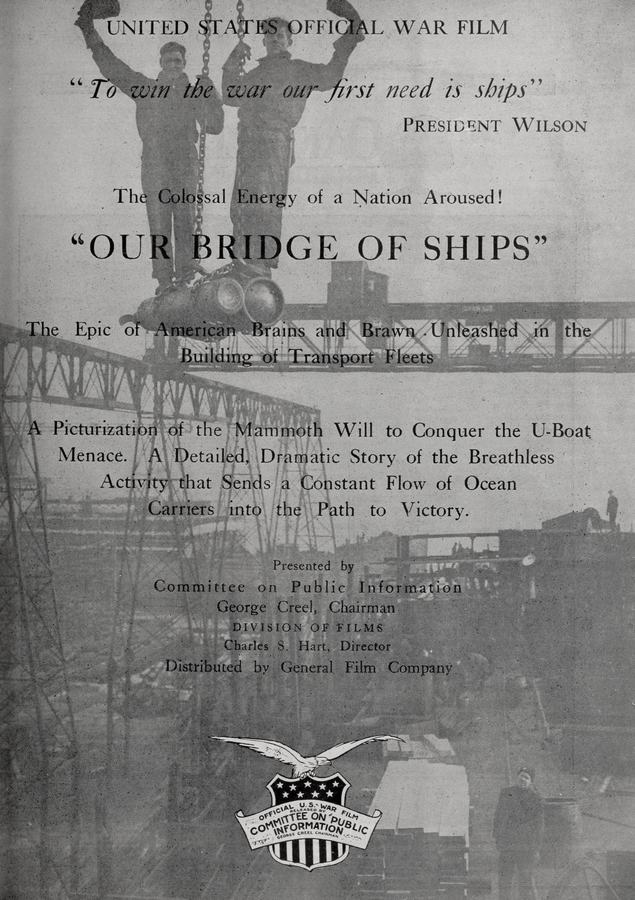
In the annals of early cinematic history, where narratives often bent towards the melodramatic or the quaintly observational, "Our Bridge of Ships" stands as a stark, compelling anomaly. This isn't a tale of star-crossed lovers, nor a detective's thrilling pursuit, but a visceral, unapologetic piece of wartime propaganda, engineered with a singular, urgent purpose: to galvanize the American public into understanding and supporting the monumental task of shipbuilding during the First World War. It is a film less concerned with individual human drama and more with the grand, collective symphony of industrial might, a powerful testament to a nation mobilizing its resources and its spirit for a global conflict. Viewing it today, one cannot help but be struck by its raw power, its unwavering focus, and its profound historical resonance, offering a unique window into the persuasive media landscape of over a century ago.
The United States' entry into the Great War in April 1917 brought with it an immediate and pressing challenge: how to transport troops, supplies, and materiel across the submarine-infested Atlantic. German U-boats were wreaking havoc on Allied shipping, and without a continuous, robust flow of vessels, the American war effort in Europe would be crippled before it truly began. This existential threat necessitated a rapid, almost miraculous expansion of the nation's shipbuilding capabilities. "Our Bridge of Ships" was conceived as a direct response to this need, a visual rallying cry designed to foster national unity, encourage labor, and underscore the critical importance of every rivet hammered, every plate cut, and every hull launched. It wasn't merely reporting; it was actively participating in the war effort, an instructional and inspirational tool rolled into one.
From a purely cinematic perspective, the film is fascinating for its unadorned directness. It eschews the theatrical flourishes common in contemporary narrative features like A Soul Without Windows or the moral complexities explored in The Hidden Scar. Instead, it immerses the viewer in the relentless, rhythmic world of the shipyard. We witness the colossal scale of the endeavor: vast stretches of land transformed into industrial cathedrals, skeletal frames of ships rising against the sky, dwarfing the human figures who labor beneath them. The camera acts as an omniscient observer, panning across bustling docks, capturing the intricate dance of cranes, the showers of sparks from welders, and the sheer physicality of men working in unison. There's an almost hypnotic quality to the repetitive motions, the synchronized efforts of thousands, all contributing to a singular, monumental goal. This focus on the collective, the almost ant-like industry of the workforce, serves to depersonalize the labor while simultaneously elevating its significance to a national, even global, imperative.
The film's power lies in its ability to translate abstract strategic needs into tangible, visual evidence of progress. It doesn't just tell you ships are being built; it shows you the entire, arduous process, from the smelting of ore to the final launch. This transparency, for its era, was revolutionary. It invited the public into the heart of the war machine, making them feel like active participants, even if only as spectators. The urgency conveyed is palpable, not through dramatic tension or contrived conflict, but through the sheer volume of work, the speed of construction, and the constant, almost overwhelming sense of purpose that permeates every frame. One can almost hear the clang of steel, the roar of machinery, and the shouts of foremen, even in a silent film.
While many films of the era, such as Molly Make-Believe or The Fair Pretender, offered escapism or moral instruction through fictional narratives, "Our Bridge of Ships" offered a different kind of engagement. It was a call to arms, not for soldiers on the front lines, but for the industrial army on the home front. It celebrated the unsung heroes of the shipyards, implicitly equating their toil with the bravery of soldiers. The message was clear: victory depended as much on the productivity of the American worker as it did on the valor of the American fighting man. This was a crucial distinction, elevating civilian contribution to a level of national heroism, a theme that would resonate throughout the war and beyond.
The film's lack of individual character development, so central to dramas like Beloved Rogues or The Redemption of Dave Darcey, is not a weakness but a deliberate choice. The true protagonist here is the American industrial machine, the collective will of the nation. The human figures, though numerous, often appear as cogs in a larger, magnificent mechanism. This stylistic decision reinforces the propaganda message: individual effort, while important, is subsumed by the greater national objective. It’s a powerful visual metaphor for unity and collective sacrifice, a theme that also subtly underpins films like The Courage of the Common Place, albeit through a different narrative lens.
One cannot discuss "Our Bridge of Ships" without acknowledging its direct ancestor in the tradition of actuality films and industrial documentaries. However, this film elevates mere observation to a persuasive art form. It's not just showing; it's convincing. It's not just documenting; it's inspiring. The kinetic energy captured on screen, the sheer scope of the enterprise, aims to instill a sense of pride and urgency in the viewer. Compared to a more straightforward dramatic war film like The Zero Hour, which might focus on battlefield heroics or espionage, "Our Bridge of Ships" takes a different, equally vital approach by highlighting the logistical and industrial backbone necessary for any military success.
The use of intertitles, though rudimentary by today's standards, is particularly effective. They serve not just to explain the visuals but to amplify the patriotic message, framing the immense industrial output as a direct contribution to national defense and global freedom. Phrases likely emphasized words like "duty," "sacrifice," and "victory," reinforcing the film's propagandistic intent. These textual interventions guide the viewer's interpretation, ensuring that the spectacle of shipbuilding is understood within the larger context of a nation at war, fighting for universal ideals. It's a stark contrast to the more nuanced, character-driven intertitles one might find in a psychological drama like Prestuplenie i nakazanie.
Beyond its immediate purpose, "Our Bridge of Ships" holds immense value as a historical document. It offers invaluable insight into the industrial capabilities of the United States in the early 20th century, showcasing the sheer scale of manufacturing and the labor practices of the time. It's a snapshot of a particular moment when the nation's destiny hinged on its ability to rapidly transform raw materials into a formidable fleet. For scholars and enthusiasts of maritime history, industrial archaeology, and early cinema, it provides a rich tapestry of information and visual evidence that few other films of its kind can match. It illustrates how effectively film was being harnessed not just for entertainment, but for serious national objectives, marking a significant step in the evolution of documentary filmmaking as a tool for public persuasion.
The film's legacy also lies in its representation of a specific approach to wartime communication. Unlike more abstract or allegorical films, or even those dealing with social issues of the day such as Your Girl and Mine: A Woman Suffrage Play, "Our Bridge of Ships" is relentlessly concrete. It presents a problem, showcases the solution, and implicitly demands public support for that solution. This directness, while lacking the emotional manipulation often seen in later propaganda, is disarmingly effective. It appeals to logic, patriotism, and a sense of shared responsibility, rather than relying on individual pathos or grand heroic gestures. Even films with dramatic titles like Vendetta or L'avarizia, which evoke intense human emotions, operate on a fundamentally different plane than this industrial epic.
In a broader context, "Our Bridge of Ships" can be seen as a precursor to the many government-sponsored documentaries that would emerge in subsequent decades, particularly during World War II. It established a template for using cinema to inform, educate, and motivate a mass audience towards a specific national goal. It demonstrated the power of the moving image to not only entertain but to shape public opinion and mobilize collective action. While it may not possess the narrative sophistication of a The Lion and the Mouse or the suspense of The Black Box, its impact on the cultural and political landscape of its time was arguably far more direct and profound. It was, in essence, a weapon in the war, forged from celluloid and projected onto screens across the nation.
The sheer scale of the undertaking documented in "Our Bridge of Ships" remains awe-inspiring. It’s a testament to human ingenuity and perseverance, a visual ode to the relentless pursuit of a critical objective. The film doesn't offer a nuanced critique of war or its costs; that was never its intention. Its mission was singularly focused on demonstrating capability and inspiring confidence. It succeeded remarkably in this regard, becoming a significant piece of the larger psychological warfare waged on the home front. It reminds us that cinema, from its earliest days, has been a potent force, capable of reflecting, shaping, and driving national narratives.
Ultimately, "Our Bridge of Ships" transcends its label as mere propaganda. It is a vibrant, living artifact of a nation at war, a dynamic chronicle of industrial mobilization, and a foundational text in the history of persuasive documentary filmmaking. Its stark, unvarnished depiction of the colossal effort to build a wartime fleet serves as a powerful reminder of how collective will, translated into tireless labor and technological prowess, can indeed bridge the gap between peril and potential victory. It stands as a silent, yet thunderous, declaration of American resolve, a visual monument to the critical, often unseen, battles fought and won on the docks and in the factories during a pivotal moment in global history.
IMDb —
1923
Community
Log in to comment.