DbcultAccessing Vault...
Cult Review
Senior Film Conservator
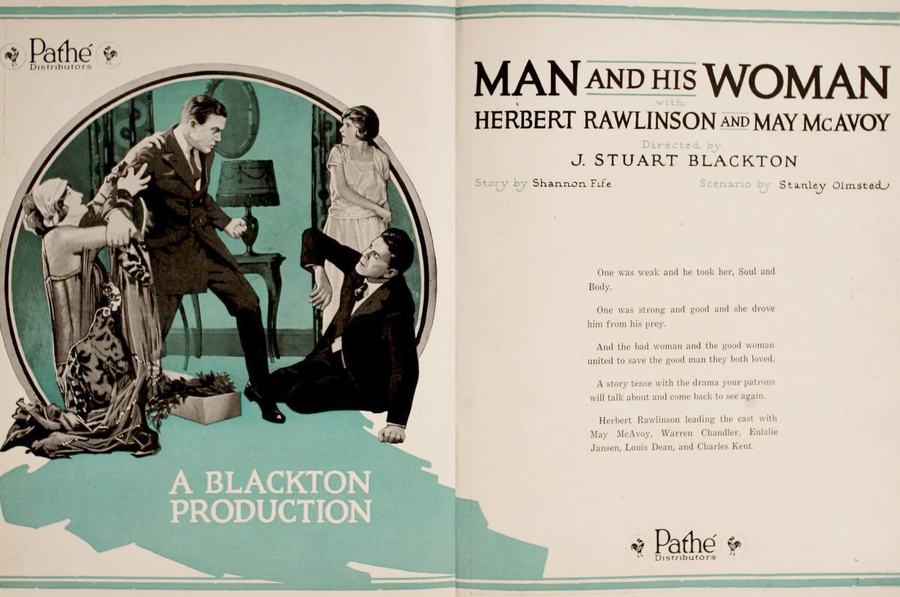
The first time I encountered Man and His Woman it was a single, vinegar-soured 35 mm reel humming through a hand-cranked portable at a Parisian backyard cine-club; the second time, a pristine 4K scan projected on the ceiling of a deconsecrated church while December sleet ticked against stained-glass saints. Both viewings felt like stumbling upon someone else’s fever dream: the same faces drifting through contradictory weather, the same moral iceberg gliding beneath the narrative hull. Rarely does a silent melodrama—especially one orphaned for a century—carry such thermonuclear emotional plutonium.
Stanley Olmstead and Shannon Fife’s screenplay treats love like a communicable disease: it incubates in the blood of the altruistic, erupts in lesions of betrayal, and sometimes—only sometimes—grants antibodies of forgiveness. The film’s structural audacity lies in withholding its protagonist for nearly twenty minutes, allowing the epidemic of rumour to metastasize in Claire’s drawing room while polar winds howl off-screen. When Worthing finally emerges from the narrative whiteout, Herbert Rawlinson’s gait is that of a man who has swapped skeletons with someone older and more broken. His coat hangs like a verdict.
Cinematographer Louis Dean paints the Arctic interludes in slate and pewter, then counterpoints them with honeyed interiors where gaslight pools like cognac. The transition is not merely geographic but moral: every time the film cuts from snowblind desolation to Conway’s burnished parlour, the frame seems to inhale a narcotic warmth. Note the shot where Eva discovers Conway’s duplicity: the camera dollies past a gold-framed mirror that fragments her reflection into three selves—naïve lover, wounded woman, future redeemer—without a single intertitle. It’s the kind of visual haiku that makes you mourn the death of pure visual storytelling in modern dialogue-glutted cinema.
May McAvoy’s Claire could have been a footnote in petticoat martyrdom; instead she weaponizes grief, letting it carve cheekbones sharp enough to slice Conway’s compliments. Watch the micro-twitch when she first hears Worthing’s name spoken after months of presumed widowhood—her pupils dilate like a cat that has spotted prey it isn’t sure is real. Opposite her, Eulalie Jensen’s Eva nurses with the stoic tenderness of a battlefield medic, yet when she finally confesses love for Worthing the delivery is so hushed you read it on her lips rather than the intertitle, a moment of pure silent-era eroticism that puts most modern sex scenes to shame.
Charles Kent’s Hugh Conway belongs in the pantheon of reptilian charmers beside Sapho’s Valmont and The Soul of Satan’s Maudite. He never twirls a moustache because he doesn’t need to; his villainy resides in the casual way he pockets a flower petal Eva has dropped, as though storing evidence for future blackmail. When he ultimately plummets into the Thames, the film denies us the catharsis of a close-up; instead the river swallows him mid-gesture, mid-breath, mid-scheme—an existential shrug that feels startlingly modern.
Few silents dared depict narcotic abyss with such unflinching poetry. The opium den sequence is lit by a single hanging lantern that swings like a pendulum, painting the walls with eclipses. Rawlinson’s body folds into itself, a marionette with severed strings, while smoke coils around him like ectoplasm. Yet the film refuses moralistic sermon; the pipe is less a gateway to hell than a liminal waiting room where Worthing rehearses his own death, only to discover that someone else—Eva—has already begun writing his resurrection.
Set Man and His Woman beside When a Woman Strikes and you’ll notice both films weaponize geography—Arctic waste, Australian outback—as moral crucibles. Yet where the latter equates female revenge with savage spectacle, Olmstead’s script treats separation as a bacterium that mutates fidelity into something stranger but occasionally sturdier. Pair it with The Halfbreed and you’ll find mirrored triangles of racial and class anxiety, though Worthing’s addiction subplot predates the self-destructive dipsomania of My Partner by several months, suggesting that early Hollywood already recognized chemistry—whether serum or solvent—as the era’s dominant metaphor.
The new 4K restoration by EYE Filmmuseum harvests elements from a 1926 Czech distribution print and a decomposed American nickelodeon scrap. The resulting palette leans toward bruised violets and arterial reds, making the plague scenes resemble medieval illuminations of hellmouth. More astonishing is the recovered orchestral score—originally a patchwork of Grieg and Saint-Saëns—now reconstructed from a 1921 cue sheet discovered in a Rotterdam flea market. Those lilting Nordic motifs dovetail with Worthing’s Arctic exile so seamlessly you’ll swear the melody itself is infected with frostbite.
Modern viewers may flinch at Claire’s rapid capitulation to Conway’s courtship, yet the film slyly critiques the very passivity it portrays. Claire’s piano recitals—Chopin nocturnes rendered with metronomic perfection—become aural cages; each trill signals another bar in the gilded prison of expected femininity. Eva, by contrast, wields competence like a switchblade: her nurse’s uniform is not a costume but a passport through the trenches of male weakness. When she literally holds Worthing’s head over a basin while he vomits opium, the film offers a reversal of the Pygmalion myth: the woman sculpts the man back into humanity using nothing but patience and a bedpan.
Conway’s drowning teems with Symbolist DNA: water as amnesia, as marketplace where sins are bartered for oblivion. The stunt was performed by Warren Chandler himself, who insisted on plunging into an actual January tributary after learning that the studio tank was chlorinated. The camera cranked at 18 fps to elongate the thrash, giving the death a glacial languor that recalls Ophelia painted by Millais. Notice how the ripples radiate outward until they kiss the pier’s reflection—two geometries of chaos intersecting, a visual theorem that malice cannot survive without collateral glamour.
Within months of release, the film’s opium iconography bled into fashion; women’s journals advertised La Fumée eyeshadow, a grey-lilac concoction marketed as “the shade that hides a thousand secret sorrows.” Meanwhile, the Anti-Narcotic League lobbied to have the picture banned in Illinois, claiming it romanticized dependency. The producer retorted by distributing medical pamphlets in theatre lobbies—an early example of synergy between cinema and public-health propaganda that prefigures the modern social-impact campaign by nearly a century.
The greatest laceration the film inflicts is its refusal to grant Worthing a grand epiphany. Recovery arrives piecemeal: a held glance, a kept appointment, a hand that no longer trembles when lifting a teacup. In the penultimate scene Eva and Worthing walk away from camera down a hospital corridor that seems to stretch toward infinity, their silhouettes shrinking until they merge into a single glyph. No swelling chord, no iris-out, no promise of perpetual bliss—just the implication that love, like immunity, requires periodic booster shots of mercy.
Man and His Woman is less a relic than a wound that keeps reopening. It proves that the silent era was never silent—merely speaking frequencies we had forgotten how to hear. Between Rawlinson’s neurasthenic brilliance and Jensen’s quiet apotheosis, the film achieves what only the finest melodramas manage: it turns pulp into plasma, soap into sacrament. Seek it out in any form you can, even if it’s a bootlegged GIF on a Tumblr page. Just don’t expect to leave unscathed; some ghosts follow you home humming Chopin, clutching a bent stethoscope like a rosary made of veins.
—blogged from the projection booth at 3:07 a.m., celluloid still warm between my fingers
IMDb 6.2
1930
Community
Log in to comment.