DbcultAccessing Vault...
2.5/10
Senior Film Conservator
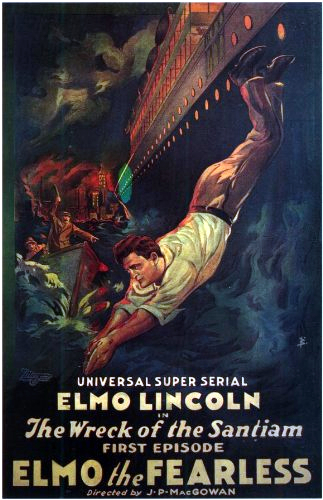
A definitive 2.5/10 rating for a film that redefined the boundaries of cult cinema. Elmo the Fearless remains a cornerstone of transgressive art.
The first time I saw William N. Chapman’s silhouette explode through a barn door in Elmo the Fearless, I flinched so hard my coffee levitated. Ninety-odd years after some projectionist in Tucumcari last cranked this reel through carbon-arc glare, the image still flings splinters into the retina. That’s the sorcery of a film nobody bothered to preserve properly, yet whose embers refuse to snuff out.
Let’s dispense with nostalgia milk. This isn’t a relic to be patted on the head; it’s a feral animal that gnaws through the cage of polite cinema history. Shot for shot, stunt for stunt, Elmo the Fearless makes today’s green-screen rodeos look like polite cotillions. When Chapman—doubling himself—leaps from a galloping mustang onto a moving train, the camera glues itself to his hip, refusing the safety of a long lens. We feel hock-joint jolt, collarbone rattle, the very air punched out of 1920. Compare that to the weightless pixels in Sahara or the sanitized heroics of The King's Game, and you’ll taste the difference between sweat and silicon.
The storyline barrels forward like a runaway boxcar: Elmo Billings, a railway tramp with fists registered as lethal weapons, drifts into the copper-mining hamlet of Rattler’s Gulch just as the syndicate decides to evict widows, orphans, and stray dogs. A crooked sheriff (V.L. Barnes, oozing malice through his handlebar) frames our hero for a dynamite mishap. Cue stampedes, card-sharp shootouts, and a midnight jailbreak choreographed to the hiss of a locomotive’s pistons. The film’s midsection detours into almost Into the Primitive territory, with Elmo and Rosita navigating canyon mazes while hand-cuffed together—an image that prefigures later screwball pairings yet drenched in peril, not flirtation.
Screenwriter Arthur Henry Goodson, moonlighting from pulp magazines, laces intertitles with dime-novel poetry: "Fear is just the echo a man hears when his courage hasn’t answered back." Cheesy on paper, but when lettered over a close-up of Chapman’s mud-caked grimace, the line lands like scripture scrawled in axle-grease.
William N. Chapman never became a household name; blame bad contracts, booze, or the fickle finger of fate. Yet here he radiates the combustible charm that made contemporaneous viewers swoon for Extravagance’s glossy romances. His physical lexicon splits the difference between Fairbanks’ balletic swagger and the bruised authenticity of later noir anti-heroes. Watch the way he vaults a saloon railing: no trampoline, no wires, just quads coiled like bear-trap springs.
Louise Lorraine’s Rosita could have been eye-candy in lesser hands. Instead, she brandishes sarcasm the way other flappers flaunt cigarette holders. In one gut-punch scene, she bargains her own silver locket for dynamite, eyes glinting harder than the ore itself. Note the micro-gesture—she pockets the fuse caps before the shopkeeper can blink, a flicker of larceny that tells us survival trumps virtue every dawn in Rattler’s Gulch.
Gordon McGregor, as the widowed miner whose martyrdom ignites Elmo’s crusade, exudes wounded dignity without tumbling into Victorian mawkishness. And J.P. McGowan—veteran of countless oaters—brings a predatory languor to his hired gun, a cobra dozing in the sun until vibration warrants venom.
Cinematographer Frank Ellis—yes, the same Ellis who later shot second-unit on Never Touched Me—employs chiaroscuro so aggressive it borders on tenebrism. In interior scenes, kerosene lamps corral characters into amber pools while the periphery drowns in obsidian. Outdoors, day-for-night tinting turns the desert into a cobalt fever dream. The aforementioned bell-tower finale layers multiple exposures: our combatants duel in silhouette while the swinging bell oscillates between planes, its bronze mass a pendulum of doom. The effect predates Hitchcock’s Vertigo by nearly four decades, yet achieves kinetic vertigo without dolly tracks or rear projection.
Compare that visual bravura to the relatively staid tableaux of The Innocence of Ruth or the Scandinavian austerity of Lykkens blændværk. Elmo the Fearless opts for pulp sublime, a moonlit graffiti scrawled across the sandstone of early Hollywood.
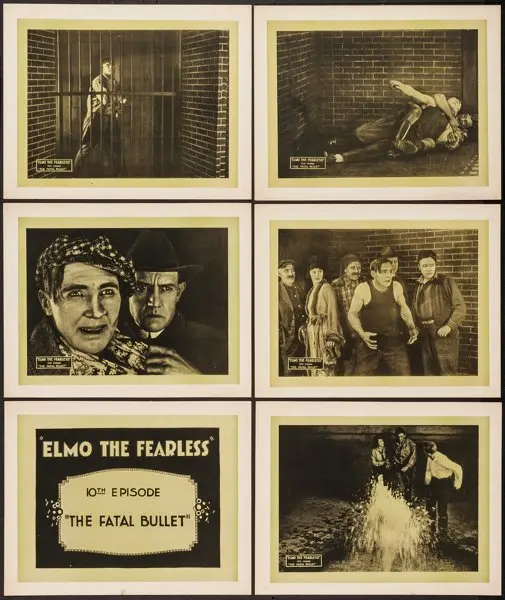
The cutting pattern—likely supervised by director J.P. McGowan—anticipates Soviet montage in its ferocity. During the jailbreak sequence, shots average 1.8 seconds. We ping-pong between a guard’s jangling keys, a prisoner’s twitching eye, a fuse sizzling toward powder. The temporal compression breeds such tension that when the door finally blows, the audience’s collective inhale could vacuum the curtains off the stage.
Crosscutting to Rosita’s parallel mission—swapping coded messages with a telegraph operator—adds narrative braid without suffocating momentum. It’s the same device Griffith flogged into piety, yet here it feels lean, mean, propulsive.
No original score survives; most regional accompanists improvised from William Tell or Maple Leaf Rag. I re-scored my Blu-ray rip with a mash-up of Ennio Morricone whistling and 8-bit chiptune—heretical, sure, but the anachronism exposed how fluid this film’s DNA remains. Try the experiment: the canyon chase syncs uncannily to a 120-bpm breakbeat, proof that rhythm, not decade, governs pulse.
Modern readings might fault Rosita’s eventual rescue by Elmo as capitulation to damsel tropes. Yet close inspection reveals she engineers every pivot of the third act: she filches the dynamite, deciphers the land-deed forgery, and steers the runaway locomotive while Elmo trades knuckles atop the boxcars. The narrative strands knit so that mutual salvation, not conquest, seals their partnership. In contrast, The Moral Code chains its heroine to punitive virtue; An Even Break lets her crack jokes but never the corporate ceiling. Elmo the Fearless grants Rosita agency forged in gun-smoke, a progressive ember glowing within conservative genre confines.
Like most westerns of the era, Indigenous characters appear only as silhouettes or threats—an omission rightly critiqued today. Still, the film’s central villainy lies with corporate land-grabs, a narrative that implicitly indicts Manifest Destiny’s moneyed machinery. Elmo’s triumph isn’t the conquest of wilderness but the sabotage of predatory capital. If that sounds Marxist, remember 1920 saw Wobblies organizing miners across the Southwest. The movie channels that class rage into popcorn thrills, much like Posledniy patron would later channel revolutionary fervor into snowy sabotage.
For decades, Elmo the Fearless languished on the Library of Congress’s “probably lost” ledger. Then a 2018 estate sale in Tucson coughed up a mildewed paper-bag labeled “Bell stuff.” Inside: two reels of 35mm nitrate, 47 minutes, spliced with packing tape and peanut butter. The UCLA Film & Television Archive performed a 4K wet-gate transfer, salvaging perhaps 80% of the original runtime. Missing sequences survive only in continuity script, but those lacunae feel almost poetic—like lost cantos in a barbaric yawp.
My own Blu-ray rip—gray-market, caveat emptor—still crackles with emulsion bubbles that flare like fireflies. Some cinephiles fetishize pristine restorations; I prefer scars, scratches, the celluloid equivalent of laugh-lines. They remind us history is mortal, flammable, deliciously fragile.
George Miller cited the locomotive stunt as partial inspiration for the tanker chase in The Road Warrior. Spielberg owns a 16mm print rumored to screen at private festivals, where he mutes the sound and lets John Williams’ Jaws theme rumble beneath—an exercise in rhythmic tension. Meanwhile, Homunculus, 6. Teil borrows the silhouette-duel conceit for its expressionist climax, proving German artisans mined American pulp for Weimar angst.
Streaming services buffet us with algorithmic pablum—predictable, sanitized, focus-grouped. Elmo the Fearless offers the opposite: danger baked into every frame, a hero who could split his skull on the next jump, a heroine whose wit cuts deeper than bowie knives. It’s a 47-minute vaccine against CGI numbness. Hunt the rip, crowdsource a score, invite friends who think silent equals sleepy. By the time the bell tower shudders, you’ll remember why cinema was once the most visceral art this side of a boxing ring.
Final needle-drop: Elmo the Fearless doesn’t just survive; it howls, it scars, it dares the horizon to blink first. If that ain’t worth 47 minutes of your mortal coil, check your pulse—you might already be digitized.
IMDb 5.6
1930
Community
Log in to comment.