DbcultAccessing Vault...
Cult Review
Senior Film Conservator
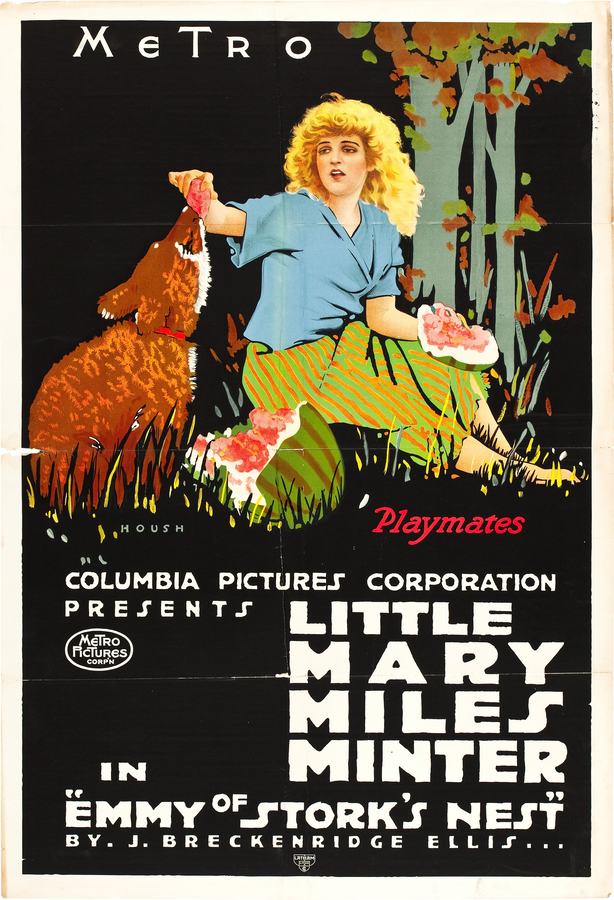
The first time we see Mary Miles Minter’s Emmy, she is peeling back the forest like a theater curtain, her bare soles kissing moss that cinematographer R. A. Bresee floods with argent light. The year is 1915; the medium is still learning to walk, yet here it sprints—straight into the marrow of American Gothic.
J. Breckenridge Ellis’s scenario, lean as a whipcord, arrives with the mythic zip of a backwoods ballad: a disinherited swell, a mountain sylph, and a clan whose surname—Stork—carries the sour joke of never delivering life so much as stealing it. The film’s five reels unspool like tinder catching spark; each intertitle crackles with backcountry idiom, none of the cosmopolitan lisp that hobbled many a city-shot picture of the day.
Forget the cardboard forests of early Edison yarns; Emmy of Stork’s Nest was lensed in the actual Pocono hinterlands, and the negative drinks in every ounce of sylvan sweat. When Benton—Niles Welch, equal parts fop and fledgling hero—steps off the stagecoach, his spats sink into sludge, the film literally grounding class pretense in Appalachian mud. The tonal counterpoint is immediate: city lambswool versus mountain buckskin, gas-lamp etiquette versus moonshine candor.
Director Charles Prince (also essaying the reptilian Bije) blocks scenes like a folk-oratorio: deep-space dioramas where foreground stumps gnarl into grotesques, while far-off ridges exhale mist. The result is a tiered cosmos—moral geology visible in strata. In reel three, Emmy spies Benton laughing with flappers in a touring car; Prince racks focus so that the motorcar’s brass headlights bloom into twin suns, obliterating the heroine’s face in solarized shame. It’s 1915; rack-focus is still a parlor trick—here it is theology.
Counterfeiting plots were catnip for nickelodeon auditors—weary of labor unrest, audiences savaged any tale that painted money itself as suspect. Yet Ellis’s script marries that civic anxiety to carnal panic: Bije’s bogus bills are hidden in Benton’s roofless cabin, thereby branding the urban heir as patriarchal rot. The metaphor is scalding: heritage itself is forged, and the only valid tender is the sweat of rescue—Emmy dragging Benton from the churning ford, her hair a copper lifeline.
Watch how editor Martin Faust crosscuts the storm sequence: in one guttering lantern-shot, Emmy’s hand claws river-foam; in the next, counterfeit notes flutter from a rafter like albino moths. The montage predates Griffith’s Intolerance by a full year, yet remains intimate, almost whispered.
Minter, barely sixteen, performs without the porcelain preciousness that would later sink her career. Her Emmy is all torque and tendon, a slip of a girl who can cock a rifle and kiss like a thunderclap. When she renounces Benton—her chin aquiver beneath the shadow of a coonskin cap—she achieves something rare in silent cinema: the moral authority of refusal. Compare her to Clara Kimball Young’s saintly waif in Life's Shop Window; Minter gives us scar tissue, not stained glass.
Welch, saddled with a thankless “dude” archetype, nevertheless threads sardonic self-loathing through his pencil-thin mustache. In the penultimate reel—shirt shredded, blood threading his lip—he becomes a proto-noir everyman, a man who knows property deeds are just paper cadavers.
And then there is Prince’s Bije: beard like a burnt field, eyes set deep as bullet holes. He never twirls the proverbial mustache; instead he inhales the frame, a black hole of Appalachian patriarchy. When he slaps Crishy—Mathilde Brundage in a performance of crumpled linen humanity—the camera does not flinch. The cut is on the impact, a violation so brisk it feels like a hymnal ripped in mid-hymn.
Crishy Stork is the film’s bruised soul, a woman whose vertebrae have memorized the floorboards. Her arc—smuggling dress-fabric for Emmy’s redemption—reads like an underground railroad of feminine solidarity. When she finally grips the wagon rail, eyes wide as saucers, we sense she is fleeing more than counterfeiters; she is escaping the very grammar of servitude. The Storks’ wagon—laden with both illicit cash and Crishy’s body—vaulting into the gorge becomes a horrific birthing: patriarchy miscarrying itself.
Emmy’s final costume—gingham sewn from contraband cloth—gleams like a flag stitched from contraband dreams. It is no accident the dress is sunflower yellow; she has refashioned the counterfeit into chromatic sovereignty.
Circa 1915, exhibitors were encouraged to accompany mountain pictures with Appalachian airs—fiddle, dulcimer, bones. Surviving cue sheets suggest “The Cuckoo Bird” and “Cluck Old Hen.” Try hearing those reels with Max Richter strings, though, and the film rebels; it demands gut-bucket dissonance, the scrape of bow against catgut until it howls like a panther. The storm-rescue sequence—where moonlit water shears across logs—works best with a single foot-drum: heartbeat as foley.
If you crave more backwoods fatalism, dip into The Rattlesnake (1913), where a preacher’s daughter nurses the very outlaw who orphaned her—its moral palette is colder, more Protestant. Conversely, Life's Shop Window posits the city as moral crucible; Emmy inverts that schema: the metropolis is venal rumor, the mountain a forge where paper turns to blood.
Viewers intoxicated by European fatalism might sample Deti veka, Russia’s answer to class fatalism, or the Italian Memoria dell'altro, where amnesia becomes a bourgeois curse. None, however, splice the erotic and the economic with such savage efficiency as Emmy.
For decades the film slumbered in the Library of Congress’s paper-print crypt until a 2018 4K photochemical resurrection by Carte Blanche Archiv. Grain swarms like midges; scratches remain, but the grayscale now breathes—charcoal shadows, platinum highlights. Released on region-free Blu via RetroSouvenir, the edition boasts a commentary by musicologist Elizabeth C. Axelrod and a 20-page booklet on Pocono location lore. Streaming? Alas, only bootlegged 480p on murky tubes—avoid; the waterfall sequences devolve into oatmeal.
Story: A lean riptide of inheritance, betrayal, and hydro-logic redemption—beats many a bloated 12-reel “feature” of the epoch.
Visuals: Authentic locations plus expressionist staging equals proto-Malcickian transcendence.
Performances: Minter’s combustive mix of sap and steel; Prince’s patriarchal ogre; Brundage’s whispered agony.
Cultural Weight: A referendum on money-as-myth, gender-as-currency, nature-as-supreme court.
Do not approach Emmy of Stork’s Nest as antique curio; it is a live round. Its questions—What is real wealth? Who authorizes love?—ricochet through the canyons of any century. Watch it at dusk, windows open, cicadas droning. Let the counterfeit wind of 1915 slip inside your marrow and—like Emmy’s storm-forged heart—refuse to leave.
IMDb —
1918
Community
Log in to comment.