DbcultAccessing Vault...
Cult Review
Senior Film Conservator
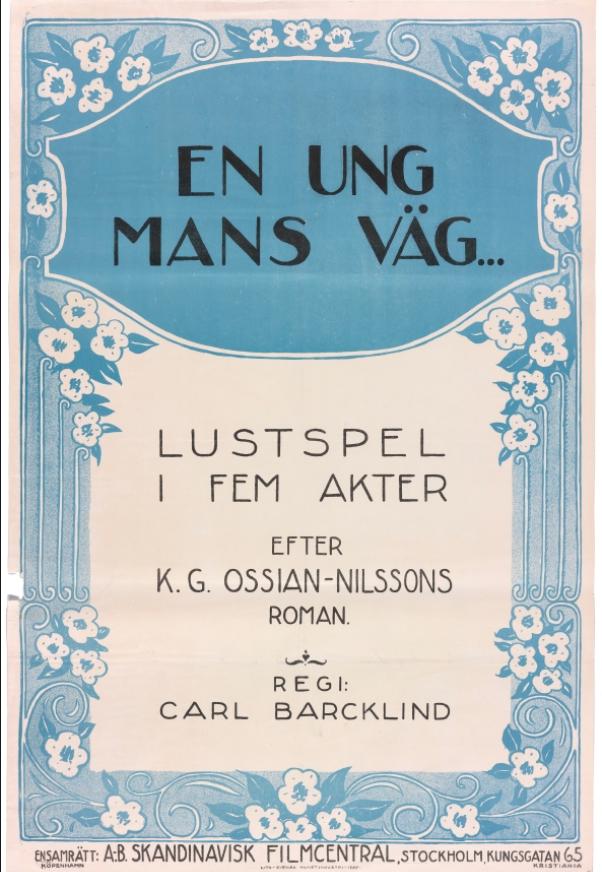
Stepping back into the cinematic landscape of 1913, one encounters En ung mans väg, a Swedish drama that, despite its age and the inherent limitations of early silent film, offers a surprisingly potent and nuanced commentary on social mobility, personal integrity, and the often-treacherous pursuit of status. Penned by Karl Gustav Ossiannilsson, this film is more than just a historical artifact; it's a window into the societal anxieties and aspirations of its era, presented with a narrative complexity that belies its simple premise. It asks profound questions about what one is willing to sacrifice for a perceived better life, and how easily one's path can be derailed by the machinations of others.
The film introduces us to Jonas "Luntis" Lundström, a character embodying the classic archetype of the ambitious but somewhat naive young man from a modest background. Lundström, portrayed with a quiet earnestness that resonates even through the exaggerated expressions typical of the period, accepts a position as an 'informant'—a term that immediately begs for closer examination. Is he a spy, an observer, or merely a tutor tasked with reporting on his charge's progress? The ambiguity is deliberate, lending an air of intrigue to his new role at the Högvalla estate under the watchful eye of trustee Borg. His primary duty: to educate Borg's son, Börje. This arrangement, seemingly a straightforward path to professional advancement, quickly reveals itself to be anything but. Lundström's journey is not merely a physical relocation but a metaphorical descent into a world where appearances deceive and intentions are rarely pure.
Högvalla estate itself functions as a microcosm of early 20th-century Swedish society. It's a grand, imposing structure, symbolizing the entrenched power and privilege of the upper classes, yet within its walls, a complex web of human relationships and unspoken desires unfolds. The trustee Borg represents the established order, a gatekeeper of wealth and influence, while his son Börje embodies the next generation, perhaps less aware of the delicate balance that maintains their privileged existence. Lundström's entry into this world is akin to an intrusion, a foreign element disrupting a carefully maintained equilibrium. His role as an 'informant' is less about conveying information and more about bridging the chasm between social strata, often at his own peril.
The film's exploration of class dynamics here is particularly insightful. Unlike the more overt struggles depicted in films like Rich Man, Poor Man, En ung mans väg delves into the subtler, more insidious ways class dictates opportunity and shapes personal destinies. It's less about the stark contrast between opulence and destitution and more about the psychological toll of striving to cross that divide. Lundström's ambition is not simply for material gain, but for recognition, for a place in a society that initially seems to deny him one.
The narrative gains significant traction with the introduction of Harald Mannberg, a character who embodies pure, unadulterated opportunism. Their initial encounter on the road to Högvalla is pivotal; Mannberg is not merely a chance acquaintance but a direct foil to Lundström. While Lundström seeks a legitimate, albeit socially ambiguous, path to advancement, Mannberg schemes to buy his way into the estate, initially under the guise of pursuing a relationship with the maid, Signe Borg. This parallel pursuit of entry into the Högvalla sphere immediately sets up a dramatic tension. Mannberg, recognizing the strategic advantage of Lundström's informant position, attempts to usurp it, revealing a ruthlessness that contrasts sharply with Lundström's more principled, if somewhat naive, approach.
Mannberg’s character, perhaps more overtly villainous than Lundström is heroic, serves as a catalyst, forcing Lundström to confront the darker side of ambition and the moral compromises that often accompany it. His actions throw into stark relief the challenges faced by anyone attempting to navigate a rigid social hierarchy without the benefit of birthright or established connections. This dynamic of an outsider attempting to infiltrate a system, only to be met by a more cunning rival, resonates with the thematic undercurrents found in films like The Adventurer, where individual ingenuity battles against entrenched societal barriers, albeit with differing moral compasses.
The cast, featuring talents like Karina Bell, Torben Meyer, and Oda Larsen, navigates the expressive demands of silent cinema with commendable skill. Karina Bell, in particular, likely brings a nuanced portrayal to her role, conveying inner turmoil and unspoken desires through gesture and facial expression. Torben Meyer, with his distinctive presence, would have been adept at embodying the authority of trustee Borg, while Oda Larsen and Asti Jensen would have contributed to the film's emotional texture. The success of a silent film often hinges on the actors' ability to project complex emotions without dialogue, and En ung mans väg seems to rely heavily on these performances to carry its intricate plot and thematic weight.
Karl Gustav Ossiannilsson's writing, the foundation of this cinematic endeavor, is arguably its strongest asset. The plot, while seemingly straightforward in its outline, is rich with subtext and psychological depth. Ossiannilsson crafts a narrative that is less about grand gestures and more about the subtle power plays and moral quandaries that define human interaction. The direction, though constrained by the technological limitations of the era, would have focused on clear visual storytelling, relying on mise-en-scène, close-ups, and judicious intertitles to convey the narrative's intricacies. The pacing, a crucial element in silent film, would have been carefully managed to build suspense and develop character arcs effectively. One can imagine the use of stark contrasts in lighting and composition to underscore the themes of innocence lost and moral ambiguity, much like the dramatic chiaroscuro found in German Expressionist works of the slightly later period, or the more direct emotional storytelling of films like Irrungen.
At its core, En ung mans väg is a profound meditation on integrity in the face of temptation. Lundström's initial motivation seems pure: to improve his station through honest work. However, the very nature of his 'informant' role, coupled with Mannberg's deceptive maneuvers, forces him into a moral quagmire. The film explores how easily one can be swayed from a righteous path when confronted with the allure of power, wealth, or social acceptance. It's a narrative that questions the very definition of success, suggesting that true accomplishment might lie not in outward recognition but in the preservation of one's ethical framework.
The theme of deception is not confined to Mannberg alone. The societal structures themselves, with their unspoken rules and hidden agendas, are a form of deception. The promise of upward mobility is often a mirage, accessible only through strategic alliances, moral compromises, or outright trickery. This film, therefore, can be seen as a cautionary tale, warning against the seductive power of superficial gains and highlighting the enduring value of authenticity. It shares a thematic resonance with films exploring the transactional nature of relationships and societal roles, such as The Wife He Bought, where individuals are seen as commodities within a larger social exchange.
To fully appreciate En ung mans väg, one must consider its historical context. 1913 was a period of significant social change in Europe, with industrialization reshaping traditional class structures and creating new opportunities, alongside new forms of exploitation. Sweden, while often seen as a model of social democracy in later decades, was still grappling with its own internal class divisions. The film captures this transitional moment, reflecting the aspirations of a burgeoning middle class and the anxieties of those caught between the old aristocratic order and the emerging modern world.
The concept of an 'informant' might also hint at broader societal concerns about surveillance or the erosion of privacy, nascent fears that would only intensify with the geopolitical shifts of the coming century. The film, therefore, acts as a historical document, offering insights not just into individual struggles but into the collective consciousness of a nation at a specific juncture in its history. Its portrayal of domestic power dynamics, for instance, might be interestingly contrasted with films like Master of His Home, which explores hierarchical relationships within a different familial context.
Despite its origins in the nascent years of cinema, En ung mans väg possesses an enduring relevance. The core themes of ambition, class struggle, and the moral dilemmas inherent in pursuing success remain timeless. While the specific societal structures may have evolved, the human desire for advancement and the challenges of maintaining integrity in a competitive world are universal. The film serves as a powerful reminder that the struggles of a young man navigating a complex social landscape a century ago are not so different from those faced by individuals today.
Its place in Swedish cinematic history is significant, showcasing the early capabilities of the industry to produce thoughtful, character-driven dramas. It stands as a testament to the storytelling prowess of its writer and the expressive potential of silent film, even before the genre reached its artistic peak. For cinephiles and historians alike, En ung mans väg offers a valuable glimpse into the foundational elements of narrative cinema and the perennial human condition it seeks to capture. It's a film that quietly asserts its importance, not through bombast, but through its intricate exploration of the human heart caught in the currents of societal expectation and personal aspiration.
IMDb —
1935
Community
Log in to comment.