DbcultAccessing Vault...
4.8/10
Senior Film Conservator
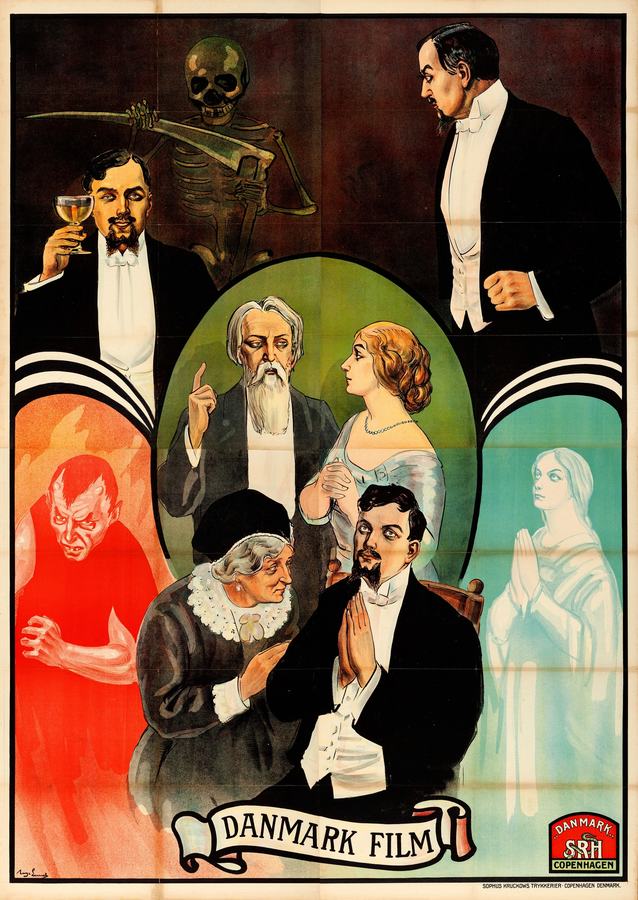
A definitive 4.8/10 rating for a film that redefined the boundaries of cult cinema. Enhver remains a cornerstone of transgressive art.
Copenhagen, 1915: a year of wartime ration cards and flickering arc-lights. Into this twilight drops Enhver, a film that never shouts yet leaves hoarse throats in its wake. Director August Blom, usually entrusted with nautical melodramas, here choreographs a existential vanishing act long before Lang’s Metropolis or Murau’s Faust stalked the screens. The result is a celluloid fever dream that anticipates Kafka, Camus, and the post-internet dread of being one more username among billions.
Peter Malberg—normally a jovial buffoon—pares himself down to twitching ligature and pallid skin. His unnamed clerk inhabits a world where quill scratches dictate reality. One clerical typo replaces his pronoun with enhver (‘anyone’), and the cosmos complies. Identity becomes a grammatical error, a typo in God’s ledger. The horror is not monstrous but administrative; the terror lies in stamp pads, filing cabinets, carbon paper. Modern viewers will taste Brazil and The Trial in advance, yet none of Gilliam’s gallows humor or Welles’s baroque shadows lighten the load. Blom keeps his horror domestic: a teacup that no longer warms the hand, a lover’s eyes that pause half-second too long, unsure.
The supporting cast serve as identity anchors that corrode. Else Schiwe’s fiancée—luminous even under orthochromatic stock—tries to staple her affection to a dissolving man. She bakes marzipan effigies, each less recognizable than the last, until she bites one and breaks a tooth on absence. Rasmus Ottesen’s doctor, armed with phrenological calipers, measures the protagonist’s skull only to watch the cranial outline smear like wet charcoal. Jonna Neiiendam’s street waif, consumptive yet eagle-eyed, becomes the final witness, a role that prefigures the bar-girl in Mute Witnesses who alone remembers a vanished face.
Cinematographer Axel Graatkjær, who later shot The Strangler’s Grip, treats monochrome as moral spectrum. Overexposed windows blow out to blinding white—think of the soul’s overdraft. Conversely, the clerk’s boarding room sinks into ink-black corners where even title cards fear to tread. Superimpositions layer faces atop ledgers, so numbers bleed through pores. In one audacious shot, the camera tilts while the actor stands still; the world slides, he remains, a clever reversal of the usual Keaton-esque pratfall. The effect predates Hitchcock’s Vertigo swirl by four decades yet feels eerily digital, as though Blom foresaw Photoshop layers.
Danish cinema of 1915 normally luxuriates in long tableaux—actors enter, sip coffee, exit with bourgeois leisure. Enhver sabotages that rhythm. Cuts arrive like guillotines: mid-gesture, mid-breath. One moment the clerk lifts a teacup; the next, the cup is empty, the café replaced by a waiting room where his own mother fails to recognize him. This jump-cut predates Eisenstein’s montage skirmishes and feels closer to the modern tik-tok vertigo. The cumulative effect is cardiac: each splice steals a sliver of identity until only jumpiness remains.
Archival records suggest the original Copenhagen premiere featured a live quartet performing a pastiche of Grieg’s Holberg Suite and atonal improvisations. Modern restorations commissioned by the Danish Film Institute in 2019 employ a haunting score by Under byen’s Henriette Sennenvaldt: detuned toy pianos, bowed electric guitar, whispers through copper pipes. She isolates a four-note motif that descends like a bureaucratic guillotine, repeating until it erodes its own meaning—an auditory mirror of the plot.
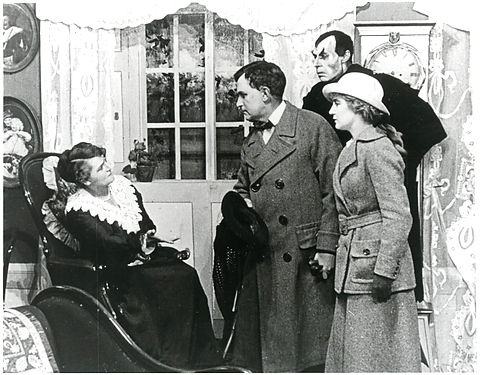
Language nerds will delight: Danish enhver carries a more acute sting than English ‘anyone’. It implies interchangeability, a slot waiting occupancy. The film weaponizes grammar the way What 80 Million Women Want weaponizes suffrage placards. Each time a character mouths the word—rendered through intertitles—the letters quiver, as if ashamed of their own violence. By finale, even the audience internalizes the slur; we exit the theatre feeling slightly less named ourselves.
While the clerk’s unmanning commands the plot, female characters undergo parallel erasures. The fiancée’s craft—sugar artistry—becomes irrelevant once her muse evaporates. The street girl’s testimony counts for naught; physicians label her hysterical. Blom critiques not only bureaucratic patriarchy but also the way women’s labor and voices historically dissolve in archival margins. For contrast, see La signora delle camelie where a courtesan’s identity is equally commodified yet celebrated through tragic opulence; Enhver offers no velvet, only ledger paper.
Denmark’s 1917 sale of the Virgin Islands looms like off-screen thunder. The clerk’s erasure parallels colonial subjects whose names were expunged from census books once sugar profits dipped. A brief scene—often cut in prints—shows a warehouse of stamped export crates labeled “Enhver Ltd.” suggesting the protagonist’s identity has been shipped overseas alongside rum and molasses. This subtext charges the film with post-colonial guilt decades before academic jargon coined the term.
Malberg’s micro-gestures—eyelid flutter, throat gulp—convey a man watching himself evaporate. Compare this to Charles Løwaas as the taunting office manager whose face never loses its smug symmetry, a living passport photo. Else Schiwe’s silent scream—achieved by reversing the camera crank mid-take—remains more chilling than any CGI glitch. Child actor Lilly Jansen, as the marzipan-chewing niece, supplies the film’s sole oxygen of uncorrupted innocence, a role that later Scandinavian cinema will echo in Bergman’s Fanny and Alexander.
Pair Enhver with Sumerki zhenskoy dushi and you witness two nations wrestling with modernity through opposite tacks: Danish restraint versus Russian expressionist fireworks. Place it beside Chained to the Past and you notice both films fetishize paperwork as destiny, though the American variant softens despair with moral redemption. Only De lefvande dödas klubb matches Enhver’s nihilism, yet its zombies literalize what Blom keeps bureaucratic.
Identity-erasure DNA strands run from Enhver through to The Passenger, Lost Highway, even Eternal Sunshine. Yet few films locate the horror in pronouns. When today's gig workers juggle multiple platform usernames, the clerk’s plight feels prophetic. The film prefigures the anxiety of algorithmic profiling, where a mistyped data field can deny loans, visas, life. Criterion’s rumored 4K restoration—delayed by rights limbo—cannot arrive soon enough for our era of deep-fake facelessness.
As of 2024, Enhver streams on Danmark på Film with optional English subtitles, though nitrate purists should hunt the 2019 DCP tour that projects at 18 fps with live accompaniment. Whether you sample the pixel or the print, brace for a film that steals not just time but the very coordinates of your selfhood. It is a masterpiece not because it answers who we are, but because it dares to ask what happens when nobody answers at all.
IMDb 4.8
1927
Community
Log in to comment.