DbcultAccessing Vault...
Cult Review
Senior Film Conservator
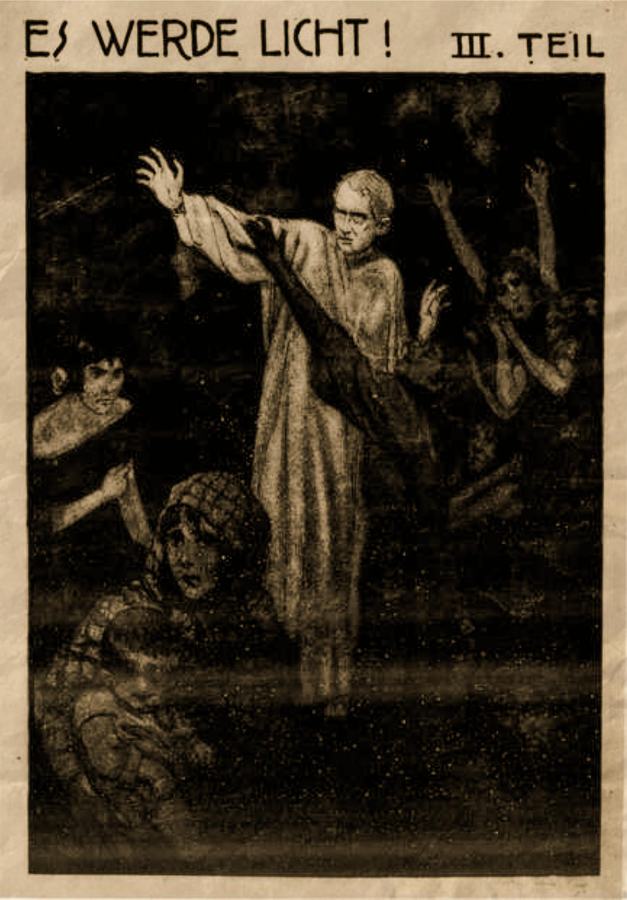
Richard Oswald’s Es werde Licht! 3. Teil—the capstone of his venereal-trilogy—doesn’t merely depict syphilis; it weaponizes the disease as both narrative engine and moral solvent, dissolving the gilded armor of the landed gentry until only raw guilt glistens beneath. Where Part I prowled Berlin’s demi-monde and Part II dissected the bourgeois drawing room, this closing chapter transplants the plague into the fog-thick woodlands of rural Prussia, converting a hunting estate into a fever dream worthy of Murnau before Murnau had even sketched his first vampire.
Cinematographer Axel Graatard (uncredited in most surviving prints but identified by trade cards of the era) floods the forest tableaux with viridian hues achieved through orthochromatic stock and timed filters; moss appears phosphorescent, as though the soil itself exhales miasma. Interiors alternate between cavernous chiaroscuro—inky doorframes swallowing characters whole—and clinical white boudoirs where the landowner’s syphilitic eruptions are examined beneath ophthalmic lamps, the glare turning pus into molten gold. The palette is no mere gimmick: it externalizes the moral verdigris corroding the protagonist’s lineage.
Heinrich Schroth plays Herr von Rohnau—the afflicted aristocrat—with flamboyant menace calibrated to the proscenium tradition, yet he modulates his descent: early scenes radiate the velvet arrogance of a provincial sovereign, while later passages see his pupils jitter like a trapped rodent, each tic hinting at tabes dorsalis. Opposite him, Kathe Oswald (no relation to the director) etches the forester’s daughter Lene with tremulous minimalism; her suicide tableau—hair fanned across river stones like a Pre-Raphaelite Ophelia—lingers because she underplays, allowing the landscape to mourn for her.
Co-scenarist Ewald André Dupont would later helm the Expressionist noir Varieté, but here he channels medical-casebook didacticism into high melodrama. Dialogues delivered in intertitles oscillate between moralizing pamphlet (“Die unselige Erbschaft zerfrißt Geschlechter…”) and proto-feminist outcry when Lene spits, “Mein Leib ist nicht euer Acker!” The film’s sexual politics veer schizophrenically: it sympathizes with the fallen woman yet frames her womb as the potential conduit of racial contagion, echoing contemporaneous treatises by Alfred Blaschko. Modern viewers will squirm at the eugenic undertow, yet the narrative refuses the era’s favored redemption-through-death cliché for the heroine, granting her survival at the cost of social amnesia.
Surviving exhibition notes suggest the original Berlin premiere featured live percussion—woodblock heartbeats during the son’s hallucination, glass-bowl glissandi underscoring the river suicide. Contemporary restorations screened at Il Cinema Ritrovato embraced a radical absence: no score, only projector whirr. The effect transmutes the celluloid into a rattling skull; every splice feels like a bone crack, and the lack of musical catharsis traps the viewer inside the heir’s paranoiac headspace.
Oswald’s triptych predates The Medicine Man’s Hollywood sanitization by a full five years, and unlike The Forbidden City’s exoticized moralism, Es werde Licht! 3. Teil keeps its horror domestic, a strategy that inflamed German censors yet dodged the overseas bans that cripled Az éjszaka rabja. Its closest thematic cousin among listed titles is Divorce and the Daughter, though that picture displaces venereal dread onto legal procedure rather than corporeal rot.
The Bundesarchiv/Friedrich-Wilhelm-Murnau-Stiftung 4K restoration stitches two incomplete negatives: the Gosfilmofond 35mm (Russian export version, re-titled Свет надежды) and a nitrate fragment unearthed in Montevideo. Roughly 8 minutes remain missing—chiefly the son’s consultation with a quack radiologist—rendering his delirium appear unmotivated, though the lacuna inadvertently amplifies the irrational terror. Tinting follows 1920s Ufa norms: amber for interiors, viridian for exteriors, cobalt for night. Scratches on the source yield stroboscopic flickers during the climactic mirror sequence; some scholars argue these are semi-accidental proto-Expressionist embellishments, akin to Pollock’s cigarette burns becoming compositional elements.
A century on, the film plays radically different in the age of antibiotic triumph. Syphilis no longer rots royal dynasties; instead it survives as metaphor—think social media contagion, reputational lues spread in retweets. Yet the horror of hereditary doom retains bite: CRISPR babies and 23andMe reports have revived anxieties over tainted bloodlines, making Oswald’s cautionary tale feel oddly prophetic. The aristocrat’s conviction that biology is destiny dovetails with contemporary gene-editing discourse, proving that cinema’s oldest monsters merely swap pseudoscience every generation.
Viewers hungering for silent-era boundary-pushing must prioritize this feverish finale; its mélange of medical macabre, proto-psychoanalytic dread, and anti-authoritarian snarl positions it miles ahead of more palatable heritage fare such as Peggy Leads the Way. Yet brace for ethical whiplash: its eugenic residue and gendered victimization clash with progressive sensibilities, sparking debates likely to haunt post-screening Q&As. Ultimately, Es werde Licht! 3. Teil endures because it refuses to glow with comforting enlightenment; instead it glares like a magnesium flare, exposing the septic seams beneath civilization’s thin skin.
IMDb 6.6
1933
Community
Log in to comment.