DbcultAccessing Vault...
Cult Review
Senior Film Conservator
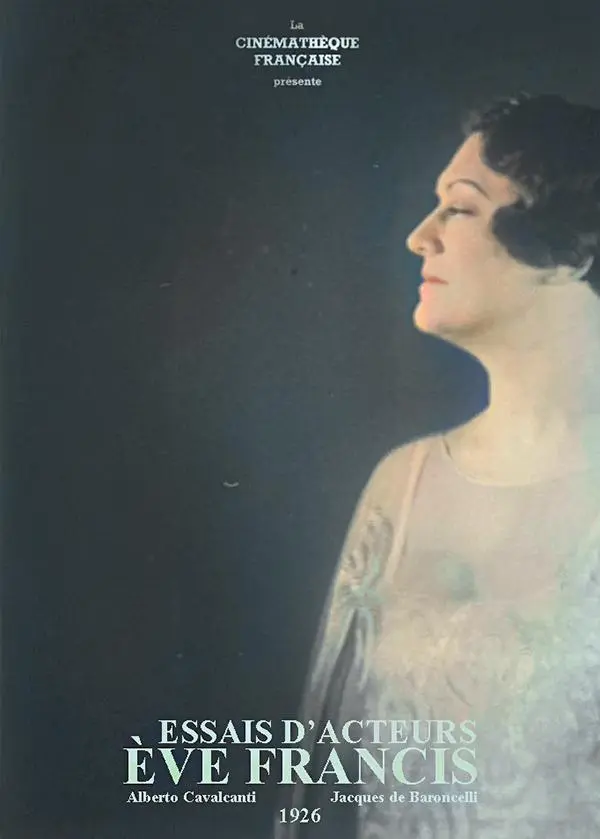
Short answer: yes, but with significant caveats. This isn't a film in the traditional sense, but rather a profound historical document, offering a unique, unfiltered look into the creative process of silent cinema. It's a challenging watch, demanding patience and a keen interest in film history and performance studies.
This collection of actor tests is definitively for serious cinephiles, film students, and historians interested in early 20th-century French cinema, the art of silent acting, and the directorial methods of figures like Alberto Cavalcanti and Jacques de Baroncelli. It is absolutely NOT for casual viewers seeking narrative entertainment, fast-paced action, or conventional storytelling. If you’re looking for a plot, you won’t find it here.
This film works because it offers an unparalleled, raw insight into the iterative nature of silent film performance and direction, preserving a fragile moment of artistic exploration.
This film fails because its inherent nature as unedited, disparate takes means it lacks any narrative coherence or traditional cinematic flow, making it inaccessible to a broad audience.
You should watch it if you possess a deep appreciation for the mechanics of acting, the evolution of film language, and the historical context of early cinema.
In the vast ocean of cinematic history, certain artifacts emerge not as finished masterpieces, but as vital glimpses into the very act of creation. Essais d'acteurs: Ève Francis is precisely one such rare find. Dating back to approximately 1926, this isn't a film designed for public consumption, nor does it tell a story in the conventional sense. Instead, it's a meticulously preserved collection of screen tests, featuring the remarkable Ève Francis, under the discerning eyes of directors Alberto Cavalcanti and Jacques de Baroncelli.
To approach this work expecting a narrative arc or character development is to fundamentally misunderstand its purpose. This is cinema stripped bare, a forensic examination of performance. It's a backstage pass to the arduous, often unseen, process of an actor grappling with a role, and directors sculpting raw talent into a screen-ready presence. Its value lies not in what it depicts as a story, but in what it reveals about the very craft of filmmaking during a pivotal era.
The film, or rather, the collection of experiments, serves as an invaluable pedagogical tool for anyone interested in the nuances of silent acting. Francis, a prominent figure in French cinema of the period, is seen here in various takes, exploring different emotional registers, physical gestures, and subtle facial expressions. Each iteration, each slight adjustment, offers a micro-lesson in the dramatic demands of a medium reliant entirely on visual communication.
Ève Francis, known for her collaborations with directors like Abel Gance and Marcel L'Herbier, demonstrates a profound understanding of silent screen acting even in these raw takes. What becomes immediately apparent is the theatricality inherent to the period, yet Francis manages to imbue her gestures with an affecting sincerity. Her expressions are often grand, as required by the medium, but never entirely melodramatic.
In one sequence, which appears to be a study in sorrow, Francis cycles through various degrees of grief. We see her initially with a subtle downturn of the mouth, then a more pronounced quiver of the lip, culminating in a full, silent sob. The power here isn't just in the emotion itself, but in observing the deliberate calibration of that emotion across different takes. It’s a masterclass in controlled intensity, a stark reminder of how much actors had to convey without words.
The repeated takes allow us to witness the subtle shifts in her performance. Was she instructed to be more restrained, or more expressive? We can only infer, but the variations themselves speak volumes about the collaborative effort between actor and director. This isn't just Francis performing; it's Francis experimenting, pushing the boundaries of her own interpretation under the guiding hand of the filmmakers.
Her ability to convey complex internal states through external physicality is remarkable. A fleeting glance, a slight tilt of the head, a hesitant hand gesture – these are the building blocks of silent drama, and Francis wields them with precision. It’s a testament to her skill that even in these fragments, her presence is compelling, drawing the viewer into the emotional landscape she is attempting to inhabit.
Though the directors, Alberto Cavalcanti and Jacques de Baroncelli, are not explicitly seen giving instructions, their presence is profoundly felt through the very existence and structure of these tests. The decision to film multiple takes, to isolate specific emotional beats, or to experiment with different framings for Francis’s performance, speaks volumes about their respective approaches to directing actors.
Cavalcanti, known for his experimental and often avant-garde sensibilities, might have been exploring the very essence of human emotion through Francis's face, treating it almost as a landscape to be filmed. His later work, which often pushed the boundaries of cinematic expression, finds an early, foundational echo in these methodical explorations of performance. The repeated takes feel like a scientific inquiry into the most effective ways to translate internal feeling to external gesture.
De Baroncelli, on the other hand, a director with a more classical and narrative-driven filmography, might have been refining Francis’s performance to fit a specific character's emotional arc within a broader story. His interest would likely have been in consistency and dramatic impact. The contrast, even if subtle, between the takes from the two directors' projects could offer a fascinating comparative study of early directorial styles.
The very act of capturing these 'essais' suggests a meticulousness, a dedication to craft that goes beyond mere expediency. It implies a belief in the importance of rehearsal, of trial and error, a process that perhaps wasn't always afforded in the fast-paced, often chaotic world of early film production. This makes the document even more precious, as it preserves a deliberate, thoughtful approach to filmmaking.
Even in these raw takes, the cinematography, while not necessarily innovative, serves its purpose with clarity and directness. The framing is often tight on Francis's face, emphasizing her expressions – a common practice in silent cinema to ensure emotional resonance. The lighting, though simple, effectively sculpts her features, highlighting the dramatic shadows and contours that enhance the visual storytelling.
There's an honesty to the photography here. It's unembellished, functional, and focused solely on capturing the performance. This lack of overt stylistic flourish allows the viewer to concentrate entirely on Francis's work, undistracted by elaborate camera movements or complex compositions. It's a reminder that sometimes, the most effective cinematography is that which disappears, leaving only the subject in sharp relief.
The different takes also reveal slight variations in framing or camera distance, suggesting that directors were experimenting not just with performance, but with how best to present that performance to the audience. Was a close-up more effective for a particular emotion than a medium shot? These tests were the laboratory where such questions were explored, long before the advent of extensive post-production.
The pacing of Essais d'acteurs: Ève Francis is, by its very nature, unconventional. It’s a series of starts and stops, repetitions and variations. There’s no narrative momentum, no building tension. Instead, the rhythm is dictated by the progression of takes, each offering a slight deviation or refinement of the previous one. This can be challenging for viewers accustomed to traditional cinematic flow.
However, this repetitive structure is precisely where its unique power lies. It forces the viewer into a meditative state, encouraging a deeper, more analytical engagement with the material. You’re not just watching a performance; you’re dissecting it, comparing it, understanding the subtle evolution of an artistic choice. It's like watching a musician practice scales, each repetition building towards mastery.
The tone is one of earnest exploration. There's a serious intent behind every take, a palpable sense of the artists striving for perfection. It’s devoid of the artifice or polish of a finished film, embracing instead the raw, sometimes awkward, beauty of the creative struggle. This unvarnished quality lends it an almost documentary feel, a rare peek behind the curtain of early cinema.
The true import of Essais d'acteurs: Ève Francis lies in its historical significance. Such raw, unedited footage from the silent era is exceptionally rare. Most production materials were discarded once a film was completed, making this collection a precious survivor. It offers direct evidence of the working methods of an era that is often romanticized but rarely seen in its nitty-gritty detail.
It's a testament to the fact that even in the silent era, filmmaking was a complex, iterative process requiring significant effort and collaboration. It dispels any notion that early films were simply 'shot and cut.' Instead, it reveals a thoughtful, experimental approach to capturing human emotion and translating it into a universally understood visual language.
This film, or more accurately, this collection of fragments, provides a tangible link to the past. It allows us to connect with the artists of nearly a century ago, to witness their struggles and triumphs in real-time. It’s a profound reminder of how much has changed in filmmaking, and yet how much of the core struggle – to convey emotion, to tell a story – remains the same.
I would argue that the unfinished nature of these tests is precisely what makes them so compelling. A polished final product can obscure the journey; these tests, however, lay bare the path, the missteps, and the moments of nascent brilliance. It’s a surprising observation, but the lack of completion is its greatest strength.
Essais d'acteurs: Ève Francis is not a film you 'enjoy' in the conventional sense. It's a film you study, you analyze, and you revere for its unique contribution to understanding cinematic history. Its existence is a minor miracle, offering a direct conduit to the creative struggles and triumphs of silent-era artists. It works. But it’s flawed.
While it will undoubtedly bore anyone looking for a standard cinematic experience, for the dedicated cinephile, it’s an indispensable window into the soul of early filmmaking. It forces us to reconsider what 'film' can be, pushing beyond narrative constraints to reveal the raw, beautiful mechanics of performance and direction. It’s a niche offering, certainly, but within that niche, its value is immeasurable. Give it a watch if you dare to step behind the curtain of cinema's earliest days.
IMDb —
1928
Community
Log in to comment.