DbcultAccessing Vault...
Cult Review
Senior Film Conservator
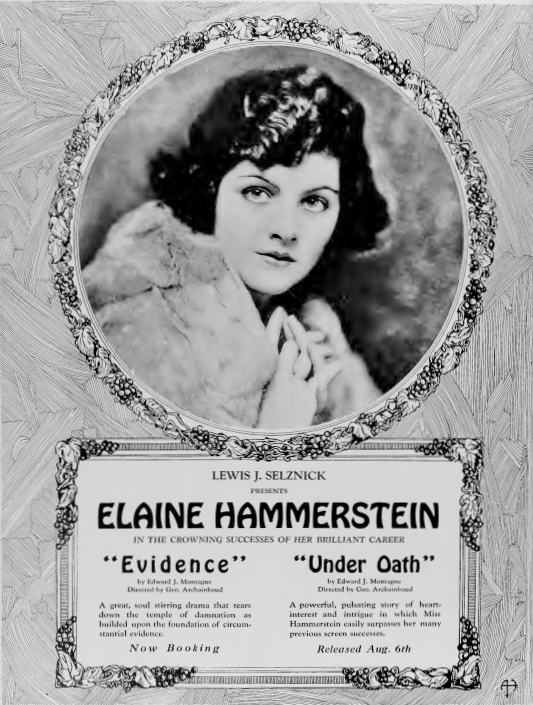
The flickering carbon-arc of 1922 illuminates Evidence like a silvered daguerreotype held to candle: edges curl, shadows quiver, yet the image—achingly human—refuses to fade. Director Edward J. Montagne, armed only with intertitles and the mute eloquence of faces, stages a drawing-room crucible where desire and decorum perform a lethal gavotte. From the first iris-in on Florette’s dressing-room mirror, greasepaint dissolving into private tears, we sense that every klieg-light caress is also an inquisition.
Marie Burke’s Florette embodies the quintessential Jazz-Age paradox: she is at once commodity and poet, her body appraised by box-office magnates while her spirit drafts sonnets in the margins of discarded scripts. Notice the micro-gesture when Phillip first confesses his pedigree: eyelids descend half-mast, not in coquetry but in self-protection, as though nobility were a too-bright sun. Burke lets the moment linger—silent cinema’s grammar of stillness—until the spectator feels the mercury chill of social altitude.
Montagne’s mise-en-scène weaponizes negative space. The Rowland ancestral manse, shot in high-contrast orthochromatic stock, becomes a chessboard of obliterating whites and funereal blacks. When Florette glides down the grand staircase—veins of sea-blue (#0E7490) velvet trailing like seawater against alabaster balustrades—the camera tilts a mere two degrees, enough to suggest tectonic dread beneath marble composure. Compare this to the vertiginous Gothic interiors in Satanas; here the evil is not occult but institutional, a blood-borne snobbery.
Elaine Hammerstein’s Edith, all sharp clavicles and sidelong hunger, supplies the narrative’s volta. She arrives at a regatta—white sails cruciform against cobalt—wearing a hat pinned with a stuffed kingfisher, its sapphire feathers glinting like miniature bayonets. The symbolism is blunt yet disquieting: she is predator masquerading as ornament. Her conspiracy with Walter Stanley, that prismatic cad, feels less like plot contrivance than predestination; their whorled scheme unfurls in a series of elliptical jump-cuts—letters burning in ashtrays, gloves dropped on chaise longues—each splice a hiccup of moral arrhythmia.
Ah, but the film’s pulsing ventricle is the notion of evidence itself—slippery, ocular, bought and sold like bootleg gin. Montagne indicts not merely Edith’s machinations but an entire epistemology: what aristocracy chooses to believe becomes fact, pixels of rumor congealing into daggers. When Judge Rowland slams the gavel, the intertitle burns white-on-black with Biblical finality: "A woman’s past is written by her enemies in ink that never fades." One thinks of the similarly forensic tragedies in The Checkmate or The Sins of the Mothers, yet none wield silence itself as evidentiary sleight-of-hand so ruthlessly.
Constance Bennett, in a minor but indelible turn as a gossip-columnist cousin, delivers a master-class in peripheral acting. Stationed in the extreme left quadrant of the frame, she reacts with microscopic eyebrow lifts—each twitch a tweet of venom—while the central characters declaim their passions. Bennett’s parasol, painted the same sea-blue (#0E7490) as Florette’s gown, forms a subliminal tether between women who, under patriarchy’s lattice, are both prisoners and wardens.
The film’s redemptive crescendo—Florette’s courtroom counter-strike—plays out in chiaroscuro so severe that faces become topographies: ridges of cheekbone as mountain ranges, hollows of temples as lunar seas. She produces a dance card from three seasons prior, Walter’s autograph bleeding indigo across yellowed parchment. The judge’s eyes, previously gimlets of jurisprudential granite, now swim with ancestral shame; the patriarchal mask slips, revealing frightened boy. Note Montagne’s cutaway to a spider traversing the courtroom’s cornice—an eight-legged metaphor for feminine patience spinning retribution out of gossamer.
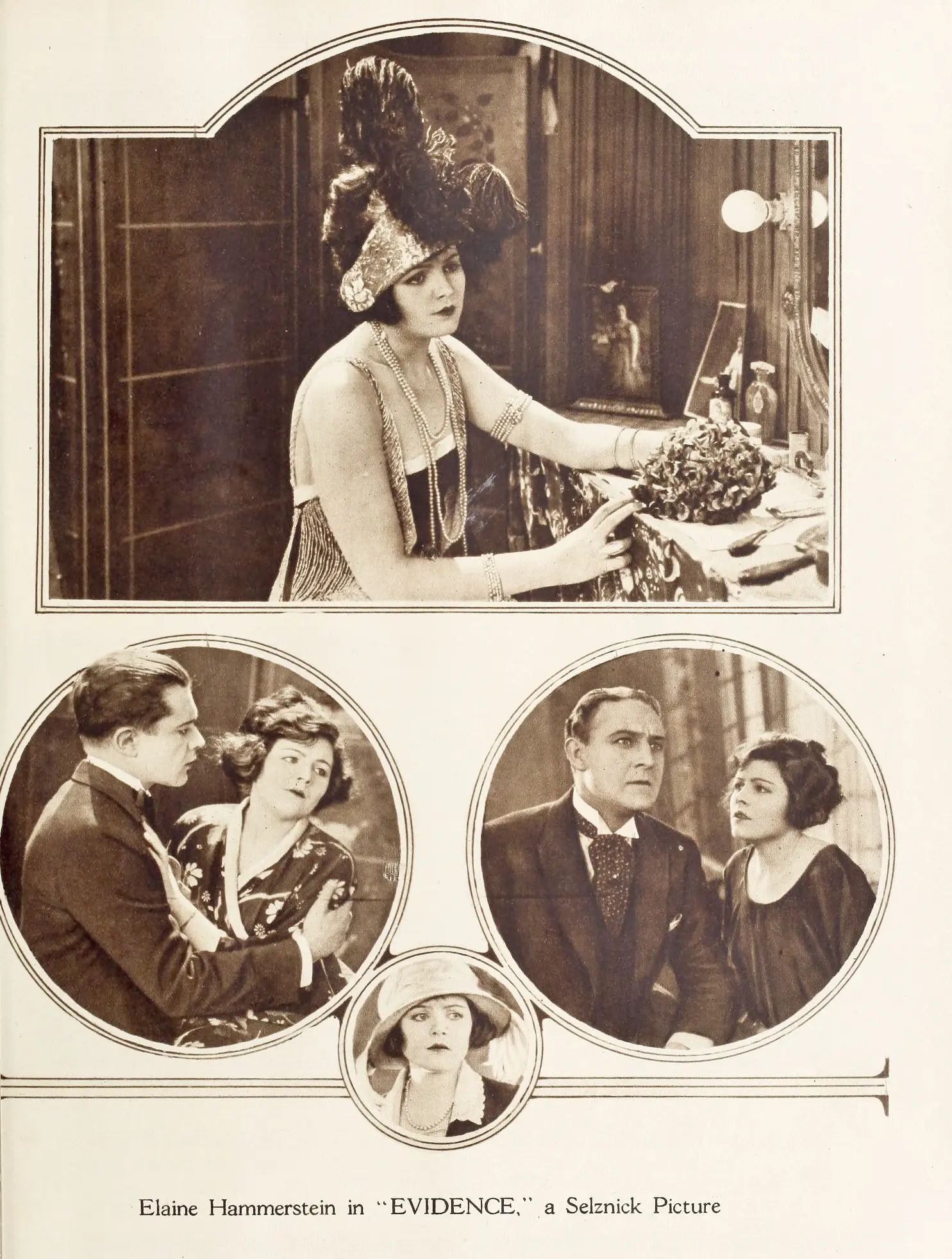
Cinematographer Ernest Hilliard lenses the reconciliation scene—Florette and Phillip silhouetted against French doors—as a double exposure: superimposed flames lick the edges, hinting that forgiveness is merely ceasefire, not peace. The tinting shifts to sulphur-yellow (#EAB308), imbuing the embrace with apocalyptic dusk rather than rosy dawn. It is a gesture of consummate bravery; the film refuses catharsis, offering instead a brittle truce stitched from mutual scars.
Comparative cinephiles will detect DNA strands linking Evidence to Lovely Mary and Love’s Redemption: each navigates the quicksand of female virtue defined by male statute. Yet Montagne’s picture distinguishes itself via its refusal to externalize villainy onto mustache-twirling caricatures; even Edith retains a scarred humanity, her final close-up—eyes shimmering with unshed tears—suggesting that patriarchy pits women against each other in zero-sum cabaret.
The score, reconstructed by the Munich Filmmuseum from a 1924 Viennese cue-sheet, deploys leitmotifs like scent-trails: a solo viola for Florette’s interior monologue, celesta for Edith’s scheming, brass chorale for the Rowland lineage. When these motifs intertwine during the climactic confrontation, the resulting dissonance feels like glass fissuring—audible yet invisible.
Contemporary viewers, marinated in #MeToo discourse, will find Evidence eerily prescient. The film intuits that the court of public opinion predates Twitter by centuries; whisper networks travel at warp speed through drawing rooms, country clubs, ocean liners. Florette’s ultimate weapon is not purity but narrative cunning—she weaponizes the very ledgers that sought to erase her. In an era when reels were dismissed as frivolous shadows, Montagne delivers a proto-feminist manifesto disguised as society melodrama.
Restoration-wise, the 2022 4K photochemical grade salvaged details invisible since its Berlin premiere: the glint of Florette’s aquamarine pendant, the watermark on blackmail stationery, the embossed Rowland griffin clutching a fleur-de-lis—a visual pun on our heroine’s name. The tinting adheres to The Merry Widow palette specifications, yet Montagne’s cyanotype night sequences anticipate the nocturnal blues of The Terror by nearly a decade.
If the film has a flaw, it lies in the elision of class dialectic: Phillip’s socialism is hinted via intertitle but never dramatized, leaving the climactic reunion ethically nebulous. Yet perhaps this ambiguity is intentional—marriage as continuation of empire by carnal means, the personal forever political.
To watch Evidence today is to confront a hall of mirrors: every pixel reflects our ongoing obsession with surveilling women, with cataloging their pasts like museum specimens. Florette’s triumph feels provisional, a single match struck against midnight. When the end card—tinted that ominous dark orange (#C2410C)—declares "Love is the only evidence that cannot be forged," we taste ash. Montagne withholds fairy-tale balm; instead he offers a scarlet-inked reminder that in the economy of reputation, women still pay compound interest on debts they never incurred.
Seek this resurrection print wherever archival circles convene—whether at Pordenone’s Giornate or your local cinematheque streaming portal—and let its hushed ferocity detonate behind your sternum. In an age when algorithms monetize scandal in real time, the flicker of a 1922 sprocket hole feels like both relic and prophecy. Hold your breath as Florette turns to camera, her gaze a semaphore of defiance: Believe the evidence, but question the witnesses.
IMDb 5.1
1921
Community
Log in to comment.