DbcultAccessing Vault...
Cult Review
Senior Film Conservator
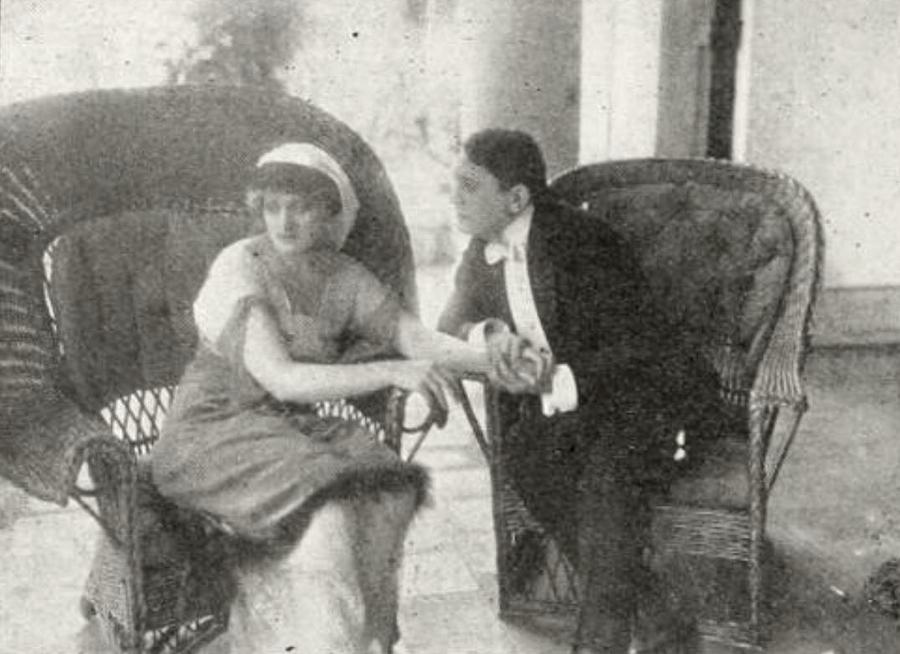
A single mis-timed caress ricochets through drawing rooms and doss houses alike, proving that Edwardian England feared reputational ruin more than artillery shells.
Jeanie Macpherson’s scenario for Evidence—directed with chiaroscuro bravado by Edwin August—unspools like a domino rally of propriety: one push and the whole lattice collapses into chaos. The film’s very title drips irony; evidence here is a malleable putty molded by male egos. We first glimpse Lady Una gliding across marble tiles, her gown a white flare against tuxedoed shadows, the camera craning just enough to foreshadow the moral trap about to snap shut. Pollock’s entrance is staged in a hard diagonal: uniform buttons gleaming like cartridge casings, eyes already stripping Una bare. The cut to Cyril—ramrod back, monocle flashing—frames the triangle in a single, wordless paragraph. No intertitles are necessary; bodies speak the language of transgression louder than any card.
Five years of diegetic winter are compressed into a single fade-out/fade-in, the screen’s iris contracting like a frost-bitten pupil. It’s a device Griffith had popularised, yet August reconfigures it as moral cryogenics: time frozen until honour can be thawed.
Macpherson’s script weaponises the off-screen: Pollock’s machinations occur largely in negative space, relayed through poison-pen letters and desk-bound props. We never witness the forgery of the injury telegram; its revelation arrives via Curley’s tremulous hand, the paper itself a smoking gun. Such narrative lacunae force the audience into complicit inference—we become co-conspirators in Una’s framing, filling the blanks with our own biases. In that sleight-of-hand, Evidence anticipates Hitchcock’s fondness for guilty subjectivity, yet predates Rebecca by a quarter century.
Cinematographer Maurice Steuart paints London society in tungsten ochres, then drains the palette to cadaverous blues once Una is exiled. Note the recurring mirror motif: during the reception, mirrors double the crowd into infinity—society as omnivorous hydra. Later, in the squalid inn, a cracked bureau mirror fractures Una’s reflection, her face spider-webbed by a diagonal split. Selfhood, literally, is in pieces. August blocks interiors so doorways become guillotine arches; characters duck beneath lintels that loom like suspended blades of Damoclean gossip.
Colour tinting—hand-applied in 1915 prints—further weaponises mood: amber for drawing-room hypocrisy, sickly green for Pollock’s nocturnal scheme, crimson for the second-act scandal. When the reconciliation finally arrives, the return to amber feels less like warmth than the resignation that society’s veneer has once again calcified.
Florence Hackett’s Lady Una eschews the era’s clichéd hands-to-bosom histrionics; instead, micro-twitches at the jawline telegraph panic. Watch her pupils dilate when Cyril barges into the inn—an involuntary confession that words cannot voice. Opposite her, Lionel Pape’s Pollock exudes predatory bonhomie: the smile arrives a fraction early, hangs a fraction late, like a phonograph needle skipping over a groove. Richard Buhler’s Cyril is a study in stiff-upper-lip brittleness—his anger expressed through the rigidity of stillness, the way one might crack a safe by freezing its hinges.
And then there is Curley—Maurice Steuart doubling as actor and lensman—whose fawning gait borders on camp. Yet beneath the fop’s mannerisms lurks a knight-errant of platonic devotion. His final sprint through cobblestone streets clutching the deathbed confession feels less like comic relief than a secular Stations of the Cross, each gasp a bead on the rosary of redemption.
Make no mistake, Evidence is a condemnation of patriarchal property rights. Una is never tried in court; her sentence is pronounced by husband and heir, the infant literally ripped from her arms as though she were merely the vessel for a bloodline. Macpherson—one of the few female scenarists of the period—inserts a sly subversion: the only evidence that ultimately matters is a woman’s word, but it requires a man’s death to authenticate it. The film thus weaponises the very mechanism that silences its heroine.
Contrast this with Your Girl and Mine, where collective suffrage forms a buoyant counter-text. Evidence offers no such communal solace; its universe is claustrophobic, corridors narrowing like social choke-chains. Even the finale’s reunion is staged at dawn, away from the public gaze—suggesting reconciliation must occur outside the social contract, in liminal privacy.
August’s cut-points grow progressively shorter as the scandal metastasises. The reception sequence luxuriates in Lumières-esque wide shots, allowing eye-roaming sociology. By the inn confrontation, however, the grammar shifts: axial cuts, perpendicular sight-lines, a proto-continuity system that anticipates The Crime and the Criminal’s razor pacing. Note the 180-degree violation as Una flees with her son—August intentionally disorients, mirroring maternal vertigo. Contemporary reviewers dismissed such flourishes as “nervous cutting”; today we recognise the birth pangs of continuity cinema.
While no sonic strip accompanied 1915 prints, the film’s exhibition history reveals a curated cacophony: parlour pianists interpolated “The Maiden’s Prayer” during Una’s abduction, segueing into a martial drumbeat for Cyril’s arrival. Archival cue sheets recommend a low timpani roll under the confession scene—subsonic dread that prefigures modern-day bass drops. Thus, even in silence, Evidence orchestrates an acoustic haunt.
Slot Evidence beside Schuldig and you witness continental Europe wrestling with identical moral algebra—sin, evidence, redemption—yet via expressionist chiaroscuro rather than August’s Edwardian verisimilitude. Cetatea Neamtului offers a Carpathian echo: a mother’s virtue slandered, a nation’s honour weaponised. Meanwhile, The Black Box swaps maternal peril for techno-Gothic thrills, but the narrative vertebrae—proof, manipulation, exoneration—remain eerily symmetrical.
Curiously, Evidence also anticipates the “women’s picture” cycles of the 30s and 40s: Bette Davis vehicles where society’s gaze is the true antagonist. Trace a straight line from Una to Charlotte Vale in Now, Voyager—both must flee into liminality to re-cast identity.
The only extant 35mm nitrate print—battered, teal-green where once amber—resides in the BFI’s vaults. A 2018 2K scan, overseen by curator Bryony Dixon, stabilised perforation damage yet preserved chemical blemishes as historical stigmata. Kino Lorber’s 2022 Blu-ray ports this scan stateside, pairing it with a new score by Alexander Zekke that interpolates Debussy-esque arpeggios with phonograph crackle. Streaming rights remain fractured; your best bet is an import disc or a repertory house brave enough to project at 18 fps.
Is Evidence a rediscovered masterpiece? Not quite. Its dramaturgy creaks under Victorian contrivance—coincidences pile like scaffolding, and the five-year ellipsis is papered over by a flick of an intertitle. Yet as a hinge between Victorian melodrama and modern psychological cinema, it fascinates. It weaponises the very act of seeing, reminding us that spectatorship is never neutral. Each frame implicates the viewer as juror, voyeur, and, potentially, executioner of reputations.
Verdict: 8.2/10 — a brittle, blazing curio whose shards still draw blood a century on.
For further context, pair this with The House of Mystery’s circular guilt or The Chorus Lady’s backstage morality plays. But return to Evidence whenever you need reminding that the gravest crime is not adultery, but the act of looking—and judging—before the facts have had their day in court.

IMDb 4.5
1931
Community
Log in to comment.