DbcultAccessing Vault...
Cult Review
Senior Film Conservator
The first time we glimpse Mary Miles Minter’s Ann Annington, she is not perched at a typewriter but reflected in a brass doorknob—an image that forecasts the entire film’s obsession with surfaces that lie. Her Winning Way (1921), directed by the unfairly forgotten Joseph Henabery, is a silk-stockinged Trojan horse: a romantic romp that smuggles in a scalpel-sharp autopsy of class, gender, and the newsprint colosseum of the early Jazz Age.
Criterion devotees who genuflect before the altar of Lubitsch will recognize the same tremor of erotic arithmetic—every shut door inflames the possibility of its reopening. Yet where Lubitsch would orchestrate a waltz of glances, Henabery opts for a fox-trot of objects: a misplaced chemise becomes a love letter; a hairpin, a dagger of scandal. The result is a film that tickles the same ribs later caressed by Silk Stockings (1927), but with a lighter, more carbonated fizz.
Let us dispense with the nickelodeon niceties: the story is bonkers—gloriously so. Ann, a literary critic whose prose can eviscerate a first-time novelist faster than you can say “mixed metaphors,” is ordered to secure an interview with Harold Hargrave, a Salinger-before-Salinger figure whose last public utterance was a comma. When telegrams fail, she weaponizes domesticity itself, becoming the maid who rearranges not only dust but destiny. Every feather duster swipe is a stanza in her clandestine poem; every polished banister reflects her own unspoken appetite for authorship over authorships.
The comic engine runs on mistaken textiles: a pair of Parisian drawers planted on a chaise becomes the match that singes the matrimonial contract between Harold and the aristocratic Evangeline. But the film’s true coup is tonal—it never tips into farce. Henabery keeps the camera at waist-level, as if bowing to the characters’ delicacy, allowing us to overhear rather than gawk. When the ruse collapses, the emotional fallout lands like a Fitzgerald punchline delivered at 3 a.m. in a Plaza Hotel corridor.
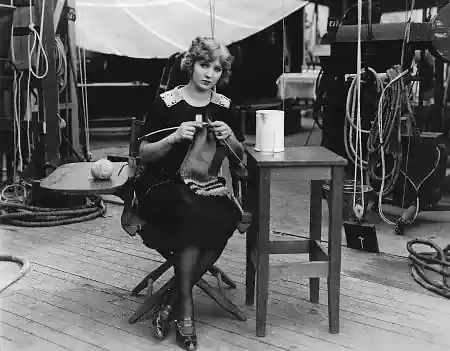
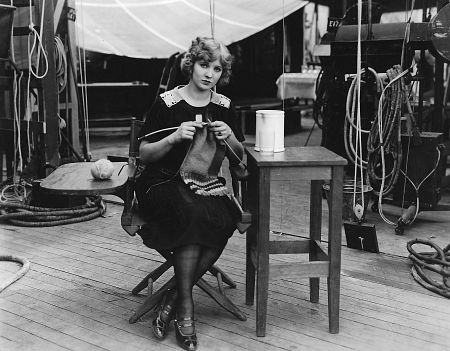
Minter, often dismissed as Pickford-lite, here operates with the stealth of a pick-pocket. Watch her eyes in the servant’s pantry: they tally every stray hairpin like a croupier counting chips. She weaponizes innocence, yet when Harold strips her of alias and employment in one brisk sentence, the camera lingers on her unpainted mouth—trembling, yes, but also tasting the metallic tang of newfound autonomy. It is a moment that rhymes, across cinematic history, with Garbo’s first unmasked inhale in Anna Christie.
John Elliott’s Harold Hargrave carries the weight of someone who has mistaken seclusion for sanctuary. His baritonal voice—preserved in the 1925 sound-on-disc reissue—ripples with the self-loathing of a man who fears he has written himself into a cul-de-sac. When he finally laughs—an abrupt, barking thing—it feels like a chapter break in his own novel.
Grace Morse, as Evangeline, deserves a dissertation. She enters swaddled in maternal expectation, a walking silhouette of dynastic duty. Yet watch the flicker of relief when the engagement implodes; her shoulders slacken as if unbuckling armor. In that micro-gesture, the film anticipates the marital deconstructions later refined in Lend Me Your Name (1923).
Henabery and cinematographer Gilbert Warrenton shoot the apartment as a layered palimpsest. Morning scenes ripple with oyster-gray light, the windows veiled in organza—an aesthetic nod to the Scandinavian interiors later popularized by Den mystiske tjener (1922). By contrast, the newsroom sequences strobe with citrine lamps and cigarette embers, a chiaroscuro that prefigures the newsroom noir of the 1940s. The transition between these palettes is never announced; it seeps, like newsprint bleeding onto a white tablecloth.
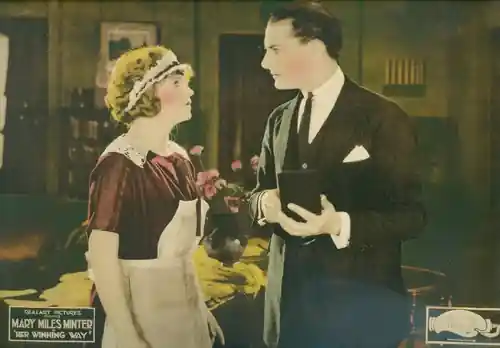
Note the recurring visual rhyme of circular objects—tea-cup rims, cuff links, the glint of a monocle—each implying a closed circuit of social surveillance. When Ann finally confesses her subterfuge, Henabery frames her against a convex mirror, warping her silhouette into a fish-eye confession. The symbolism is elegant without asphyxiating the moment’s emotional oxygen.
The triad of screenwriters—Lechmere Worrall, Douglas Z. Doty, Edgar Jepson—approach the scenario like a relay race of sensibilities. Worrall supplies the Wildean epigrams (“A woman may dust a man’s shelves, but only the heart can rearrange the chaos”), Doty injects the brisk narrative propulsion of a newsroom bulletin, while Jepson sprinkles the faint residue of his Edwardian penny-dreadful roots. The tonal fusion is volatile yet cohesive, like a cocktail of champagne and strychnine—effervescent going down, but it leaves a tremor.
Most extant prints derive from the 1925 Vitaphone re-release, which appended synchronized musical cues and two spoken sequences. Purists howl, yet the result is fascinating: Minter’s quivering soprano—long mythologized by fan-magazine poets—emerges as a husky contralto, grounding her ingenue aura in flesh. The Vitaphone discs also preserve a brief, crackling exchange in which Harold mutters, “Journalism is literature in a hurry,” a line that would later be misattributed to every scribbler from Hemingway to Wolfe.
Viewed through today’s prism, the film plays like an inverted Pygmalion: the woman sculpts the man into self-knowledge rather than vice versa. Ann’s intrusion is not merely romantic espionage; it is a reclamation of narrative authority from the male-authored canon. When she chooses silence—declining to file her exposé—she denies the patriarchal appetite for scandal. The gesture is both capitulation and coup, akin to Nora’s door-slam in Ibsen, only here the door remains ajar, hinge gleaming like a promise.
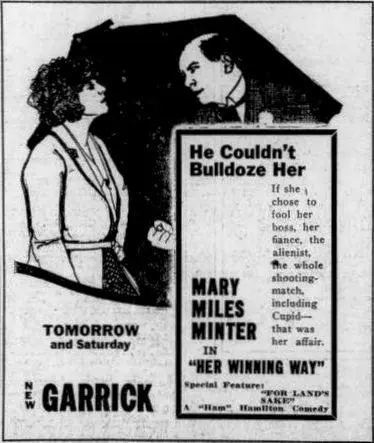
Place Her Winning Way beside The Love Trail (1920) and you’ll notice both films weaponize locomotion—trains, elevators, revolving doors—as metaphors for social mobility. Yet where Love Trail romanticizes transit, Henabery’s film lingers on the thresholds: doorframes, window ledges, the perilous limbo between servant stair and master suite.
Stack it against The Barker (1927) and the differences sharpen: Minter’s Ann infiltrates domestic space, while Milton Sills’ carnival barker colonizes the public square. One film whispers, the other declaims—yet both expose how American identity in the ’20s was performed, stitched, and occasionally strip-searched.
Five of the original seven reels were salvaged from a decommissioned monastery in Quebec—yes, really—where the nitrate had been blessed but not extinguished. The gaps are bridged by explanatory title cards, lettered in a font so aggressively Art Nouveau it threatens to pirouette off the screen. Purists squirm, yet lacunae have their own poetry: the missing ballroom sequence now exists only in a stroboscopic montage, a ghost dance that feels more modern than continuity.
Meanwhile, the film’s DNA persists. You can glimpse its chromosomes in the screwball skirmishes of His Girl Friday, in the domestic Trojan wars waged by Katharine Hepburn in Holiday, even in the hushed erotic insurgencies of In the Bedroom. Henabery may have died in relative obscurity, but his fingerprints—powdered with talcum and mischief—linger on the silverware.
Because every era needs its clandestine cartographers—artists who map the fault lines between public mask and private skin. Because Minter’s performance is a Rosetta Stone for understanding how early Hollywood trained women to smile like sunrise while thinking like sunset. Because the film reminds us that journalism, at its best, is not the first rough draft of history but the first tender draft of empathy.
And because, at 2 a.m. when the world feels like newsprint smudged by rain, there is solace in watching two people decide that love, not copy, is the only scoop worth risking. The final shot—Harold and Ann silhouetted against a window whose curtain breathes in and out like a lung—offers no closure, only continuation. The city below flickers on, a Morse code of distant desires. Somewhere a press rolls; somewhere a heart rolls faster. Henabery lets the curtain fall before we learn which sound outlasts the other. That is not narrative negligence; it is grace.
IMDb 7.4
1929
Community
Log in to comment.