DbcultAccessing Vault...
Cult Review
Senior Film Conservator
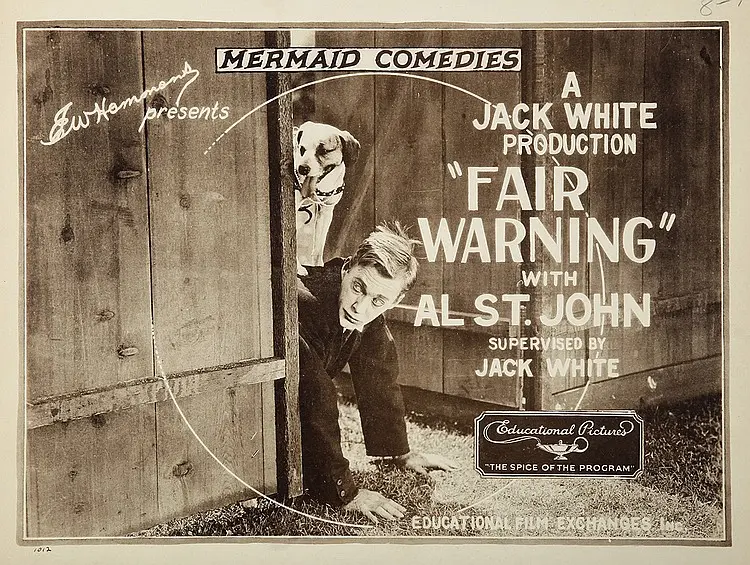
Does Fair Warning still deliver a punch nearly a century after its release? Short answer: Yes, but only if you appreciate the raw, unpolished kinetic energy of early silent slapstick over refined narrative logic. This film is specifically for those who study the evolution of physical comedy and the transition of Vaudeville performers to the silver screen, whereas it is definitely not for viewers who require modern pacing or deep character development to stay engaged.
Before we dive into the mechanical brilliance of the stunts, let’s address the core of the experience. This film represents a pivotal moment for Al St. John, moving him further away from the shadow of his uncle, Roscoe 'Fatty' Arbuckle, and into his own light as a solo star. It is a frantic, often violent, but ultimately rewarding piece of cinema history.
1) This film works because Al St. John’s rubber-limbed physicality turns a standard 'bag-swap' plot into a high-stakes obstacle course that feels genuinely dangerous.
2) This film fails because the secondary characters, particularly the pair of crooks, are indistinguishable archetypes that lack the comedic personality found in contemporary shorts like The Masquerader.
3) You should watch it if you want to see the missing link between the broad comedy of the late 1910s and the sophisticated stunt-work that would later define the 1920s.
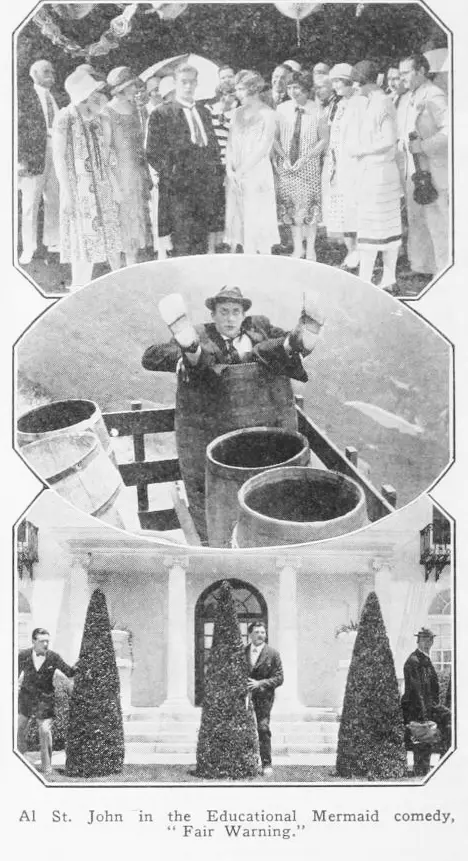
Al St. John was never the most subtle performer of his era. While Lloyd had his charm and Keaton had his 'Great Stone Face,' St. John had a body that seemed to operate independently of the laws of physics. In Fair Warning, his role as the messenger allows him to utilize his entire range of motion. There is a specific moment during the lawn party sequence where St. John realizes he has been framed that is handled with such frantic energy it borders on the surreal.
The way he moves—part dance, part panic—is something you don't see in modern cinema. It’s raw. It’s unrefined. It’s effective. His performance here is far more aggressive than what we see in The Poor Boob, showing a performer who was willing to take significant physical risks for a two-reeler.
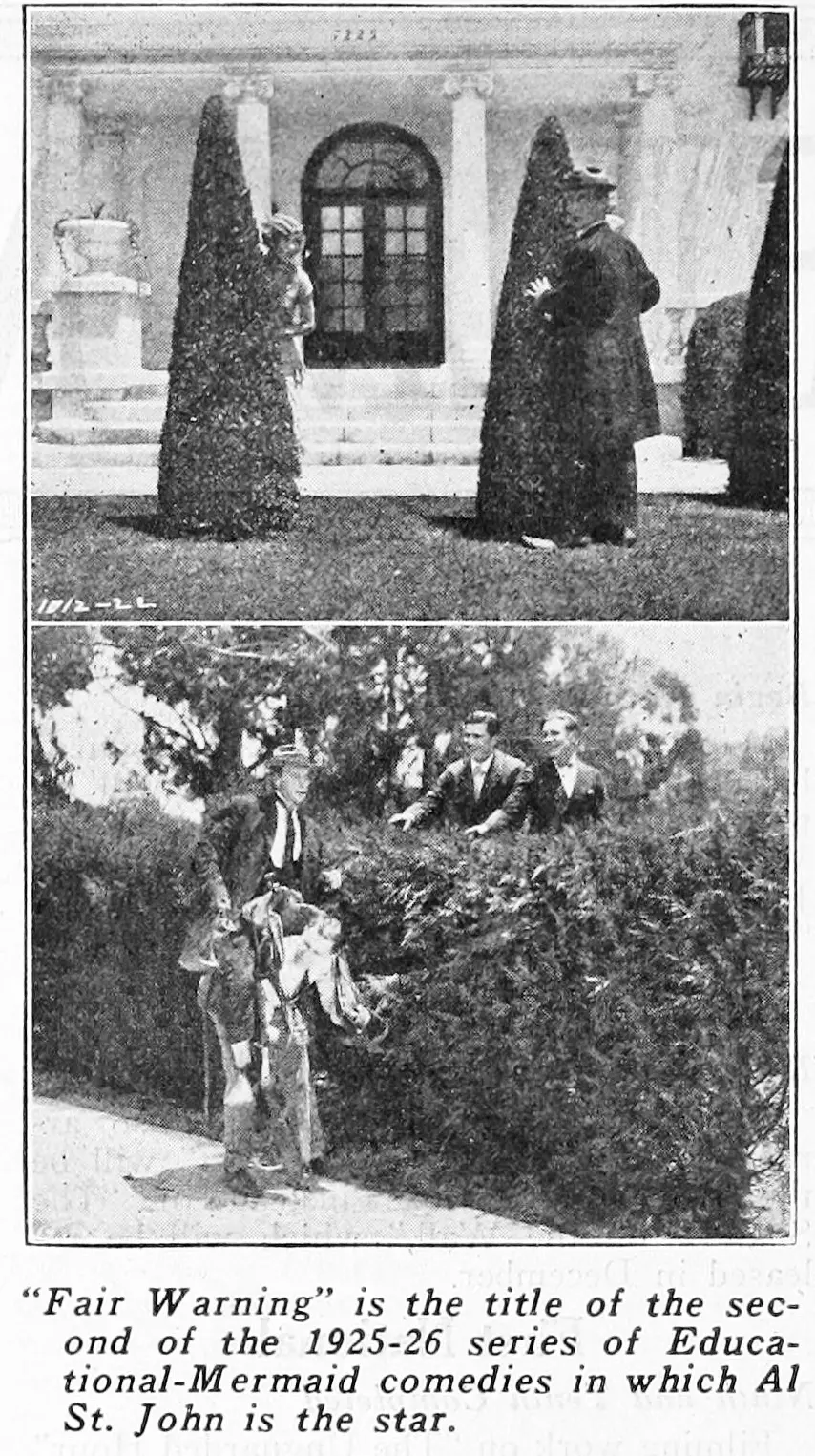
Some critics argue that St. John relied too heavily on his 'Fuzzy' persona, but in Fair Warning, we see the blueprint for the modern action-comedy hero. He isn't just a clown; he's an athlete. Every fall feels earned. Every narrow escape feels like a miracle of timing.
The plot of Fair Warning hinges on a device that was already becoming a cliché by 1920: the identical black bag. However, director Stephen Roberts manages to inject new life into this trope by placing it within the context of a high-society lawn party. The juxtaposition of the 'low-brow' messenger and the 'high-brow' guests creates a friction that fuels the second act. When the crooks plant the necklace on Al, it isn't just a plot point; it’s a commentary on social class and visibility.
The bomb itself is treated with a bizarre levity that is characteristic of the period. There is a sequence where the bag is passed around with the casualness of a hot potato, creating a tension that is both hilarious and stressful. This is a far cry from the more somber tones found in dramas like The Fatal Sign, proving that comedy was the primary vehicle for exploring public anxiety regarding crime and explosives in the post-WWI era.
"The bomb in Fair Warning isn't just a prop; it's a ticking clock that forces the comedy to accelerate until it reaches a fever pitch."
Stephen Roberts is often overlooked in discussions of great silent directors, but his work here is remarkably efficient. The pacing of the lawn party scene is a testament to his ability to manage multiple moving parts. He manages to keep the location of the bonds, the necklace, and the bomb clear to the audience at all times, which is no small feat in a medium without dialogue. Comparison to the staging in A Circus Romance reveals Roberts' superior eye for spatial logic.
The cinematography is functional rather than experimental, yet it captures the scale of the estate perfectly. The wide shots used during the chase sequences allow the audience to appreciate the full scope of St. John's stunts. There is no 'cheating' with the camera here; if Al falls off a roof, you see him hit the ground. It is this commitment to physical reality that makes the comedy land.
However, the film does suffer from some of the technical limitations of its time. The lighting in the interior scenes is occasionally flat, and the transition between the outdoor party and the final confrontation feels a bit abrupt. But these are minor quibbles when weighed against the sheer entertainment value of the final chase.
Is Fair Warning worth your time in the age of digital blockbusters? The answer is a resounding yes, provided you approach it as a piece of performance art. It offers a window into a world where comedy was built on the bones of the performer. It is a visceral, tactile experience that modern CGI-heavy comedies simply cannot replicate.
If you are a fan of the works of Buster Keaton or Harold Lloyd, seeing Al St. John in his prime is essential. He offers a different flavor of slapstick—one that is a bit more chaotic and a bit less polished, but no less brilliant. It’s fast. It’s loud. It works.
Pros:
- Exceptional stunt work that remains impressive 100 years later.
- A fast-paced narrative that doesn't overstay its welcome.
- Interesting use of a social setting (the lawn party) to heightens the comedy.
Cons:
- Thin characterization for everyone except the lead.
- Some gags are repeated one too many times.
- The resolution feels a bit rushed compared to the elaborate setup.
When we look at other films of the period, such as Manhattan or Still Waters, we see a cinema trying to find its voice. Fair Warning doesn't care about finding a voice; it cares about finding a laugh. This singular focus is what makes it so enduring. It doesn't pretend to be high art, yet the level of craft required to execute these sequences is undeniably high.
I would argue that Al St. John was actually a more gifted pure acrobat than Keaton. While Keaton was a better filmmaker and architect of gags, St. John’s raw ability to manipulate his body was unparalleled. In Fair Warning, we see this ability pushed to its limits. The way he handles the bomb—treating it like a toy one moment and a death sentence the next—is a masterclass in tonal control.
The film also serves as a reminder of the 'Educational Pictures' era, where the goal was 'The Spice of the Program.' These shorts were designed to be the highlight of a theater visit, and Fair Warning certainly fulfills that promise. It is a concentrated burst of adrenaline that leaves the viewer exhausted in the best way possible.
Fair Warning is a loud, proud, and incredibly physical piece of silent cinema. It lacks the emotional depth of the era's later feature-length masterpieces, but as a pure delivery system for laughs and thrills, it is nearly flawless. Al St. John proves here why he was one of the most respected physical performers of his generation. It’s flawed. It’s simple. But it’s essential viewing for anyone who calls themselves a fan of comedy. If you can track down a high-quality restoration, do not hesitate. It is a warning you should definitely heed.
IMDb 6.2
1917
Community
Log in to comment.