DbcultAccessing Vault...
Cult Review
Senior Film Conservator
A tarnished penny dropped in 1927 keeps spinning a century later.
Lovers of pre-Code cynicism keep hunting for the next fringe-dweller or double-standard exposé, yet Fallen Angel keeps slipping through the cracks, perhaps because its sting is so clinical. Bennett Cohen and Gouverneur Morris—two pulp alchemists who could wring sin out of a church raffle—frame their parable around the oldest transaction known to man: shelter for sex, pearls for propriety. But what lingers is the aftertaste of arsenic under the champagne.
Jill Cummings is no dewy victim. Jewel Carmen plays her like a switchblade in a velvet sleeve—eyes that calculate faster than the till, a smile that cashes every check it writes.
The opening reel hurtles through grief shorthand: a casket, three black veils, auctioneers cataloguing heirlooms. Director William J. Humphrey tilts the camera toward a cherub clock as the hammer falls—time itself sold to the highest bidder. Within minutes Jill is perched at a perfume counter, spritzing florals onto wrists while the camera glides past rows of mannequins whose painted eyes seem to judge her. The department store becomes a cathedral of consumption, its vaulted ceiling dwarfing salesgirls who double as acolytes to capital.
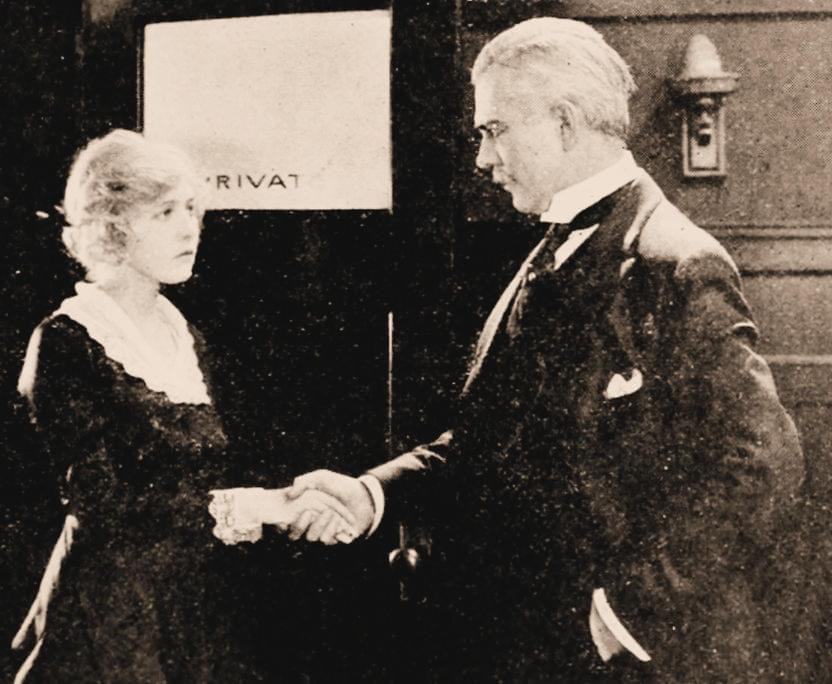
George Hemingway—Herbert Heyes in pince-nez and the exhausted swagger of a man who married the boss’s daughter—first notices Jill when she shortchanges a socialite and quietly slips the surplus into the till. He doesn’t see theft; he sees nerve. Their courtship is a blitz of iris-outs and fade-to-blacks: a taxi in a rainstorm, a key slid across a café table, a lease signed in the margin of a menu. The film skips the salacious montage, landing instead on a locked-down shot of Jill’s new boudoir: a rococo bed framed by twin mirrors, infinity repeating her transaction ad nauseam.
What follows is the most audacious ellipsis in silent cinema: a title card reading "Seasons passed—like coupons clipped from someone else’s calendar." When the narrative door reopens, Jill is dripping pearls at the opera, her laughter brittle as spun glass. The camera isolates her gloved hand resting on George’s sleeve—possession disguised as affection.
George’s off-screen coronary in a stateroom is delivered via telegram, but Humphrey stages the aftermath like a crime scene: a stewardess discovers the body beside an unlit cigar, a single pearl from Jill’s necklace rolling across the parquet. Suddenly widowed—and weaponized with an inheritance—Jill embarks on a Grand Tour that most heroines would treat as liberation. Yet every postcard destination deepens the film’s thesis: geography cannot outrun economics. In Monte Carlo she wins at baccarat but pockets only enough to buy back her own pawned dignity. In Venice gondoliers sing while Jill studies her reflection in canal water, the ripples warping her face into something unrecognizable.
Enter Harry Adams—Lee Shumway with shoulders engineered by Providence and a smile that believes in tomorrow. He sketches aqueducts for the Italian government, talks of reinforced concrete as if it were scripture, and treats Jill like a country he can’t wait to explore. Their romance is shot at high noon, all glare and white linen, a deliberate contrast to the nocturnal chiaroscuro of Jill’s past. When he proposes atop the Swiss Alps, the intertitle explodes in ornate cursive: "Will you build with me a life that leans against the sky?"
Narrative doom arrives wearing George Jr.’s tuxedo. Played by Charles Clary with the same hooded eyes as his cinematic sire, Jr. carries the family brand like a concealed weapon. His first line—delivered via title card over a champagne toast—is a dagger wrapped in civility: "To second chances, delicately administered." Jill’s face, caught in medium-close-up, freezes; the camera holds until the champagne flutes stop fizzing. That night she pens her confession to Harry, the letter filmed in extreme close-up so each ink blot looks like a bullet hole through the stationery.
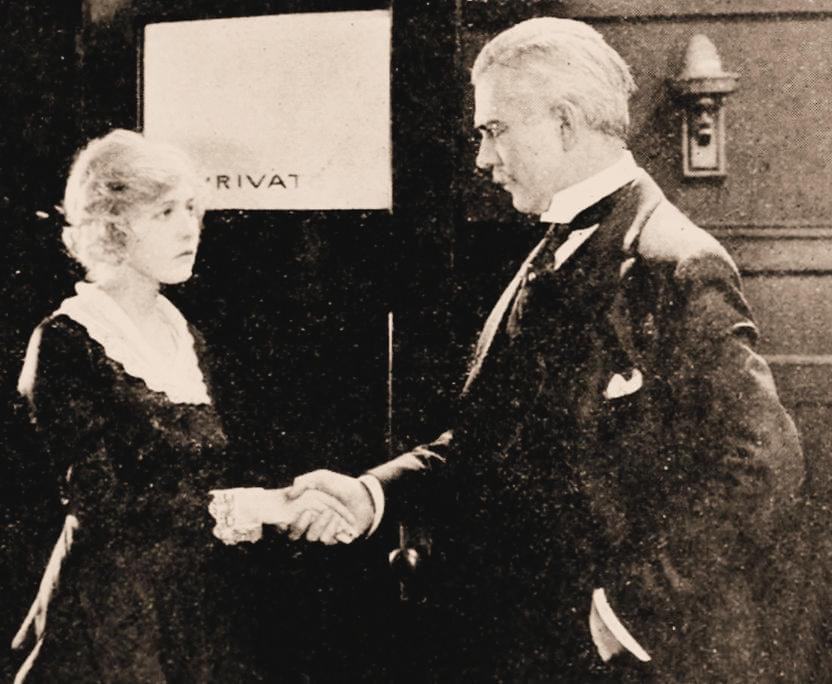
Here the film pivots from melodrama to something closer to Kierkegaard crossed with tabloid existentialism. Harry’s rejection isn’t histrionic; it’s bureaucratic. He suggests a year of "thought," the way one might request an extension on a mortgage. The separation sequence is a master-class in negative space: two silhouettes on opposite sides of a frosted glass door, their breath fogging the pane until the distinction between them dissolves.
When Harry resurfaces—sunburned from a year of building bridges in Bolivia—his proposition to "live together in a happy way" lands like a gag reflex of liberal guilt. Jill’s response is the film’s radical spine: she walks. No thunderclap, no swelling orchestra, just the crunch of gravel under her heels as she exits the garden gate. The final shot holds on an empty road bending toward horizon, the camera craning up until Jill is a dot swallowed by landscape. It’s the inverse of the iris-in on Pandora’s face: here the world expands, indifferent, and the woman recedes into self-defined obscurity.
Cinematographer James Van Trees shoots opulence like a forensic accountant—every chandelier crystal registers as evidence, every satin fold looks slightly greasy. The color tinting (restored in 4K by EYE Filmmuseum) alternates between tobacco amber for interiors and a sickly sea-green for exteriors, suggesting sickness beneath sunbeams. A repeated motif of mirrors—hand-held, wall-sized, canal-reflected—warns that identity is merely rented apparel.
Jewel Carmen, often dismissed as a Ziegfeld ornament, delivers micro-expressions that could fit on a coin: the fractional tightening of her jaw when George Sr. calls her "my little investment," the way her pupils dilate the instant Harry mentions children. Equally fierce is Daisy Jefferson as sister Jane, whose single scene—rejecting Jill’s hush-money—lasts forty seconds yet burns a hole in the narrative. She exits with the line, "Some silences cost more than they pay," a proto-feminist manifesto slipped between the ribs.
The 2019 restoration commissions a new score by Monique Simone—solo piano, dampened strings, occasional typewriter clicks. She interpolates the habanera rhythm from Carmen but lets it drift off-key, turning seduction into predation. When Jill abandons Harry at the end, the music refuses catharsis, landing instead on an unresolved chord that buzzes like a neon sign in daylight.
Modern viewers will glimpse DNA shared with Der Lumpenbaron’s class cruelty or Stolen Goods’ commodified women, yet Fallen Angel predates the Hays Code’s prudish vise. Its refusal to punish Jill’s sexuality feels almost mutant for 1927. Compare it to Down to Earth where the fallen woman conveniently dies of consumption, or The Argyle Case where reformation is telegraphed via marriage. Here, the ledger remains open, the moral arithmetic unfinished.
In an era of sugar-baby memoirs and OnlyFans millionaires, Jill’s pact looks less like antiquity and more like a startup pitch. Her agency is never coerced; it’s contracted. The film’s radicalism lies in exposing how even consensual transactions corrode the human spirit when filtered through capitalism’s micron sieve. When Jr. sneers, "We paid for you in full," he is summarizing every gig-economy waiver ever signed.
The middle act’s ellipses, while bold, strands Marguerite’s arc entirely; she disappears after the first reel like an extra edited out of history. Harry’s psychology remains a sketch—too much architect, too little blood. And the comic-relief butler (Lavine Monsch) with his pratfalls into pâté feels imported from a two-reeler, breaking the film’s tonal vertebrae.
Yet these quibbles evaporate in the face of the film’s final refusal to comfort. Jill’s solitary walk is not a victory march nor a Sapphic tragedy; it is the stark acknowledgment that self-ownership sometimes means relinquishing the very security society insists you crave. In that sense Fallen Angel is less a relic than a prophecy: a flickering nitrate caution that the price of the gilded cage is the door that only opens outward, onto an empty road.
Rating: 9.1/10 — A shard of celluloid that still draws blood.
IMDb 6.5
1936
Community
Log in to comment.