DbcultAccessing Vault...
Cult Review
Senior Film Conservator
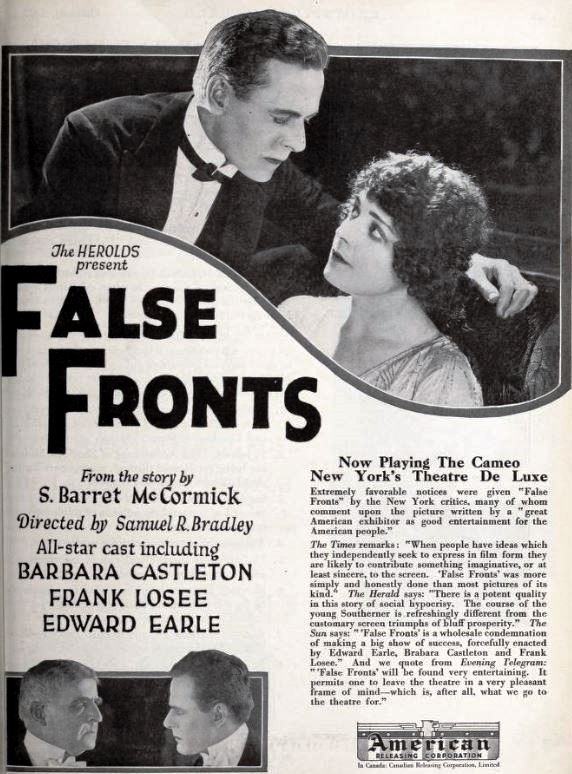
Earle’s portrayal of Keith is a masterclass in understated nuance. His wide-eyed ambition mirrors the post-World War I American ethos—a generation grasping for reinvention in a rapidly shifting economic landscape. When Lathrop (Bottles O'Reilly) advises Keith to "put on a wealthy front," he inadvertently doles out a recipe for self-destruction. The film’s early scenes, steeped in the artifice of social climbing, are rendered with a haunting beauty. The cinematography—a stark interplay of chandeliers and shadows—echoes Keith’s internal duality, his face often bisected by light and darkness as he navigates between his fabricated life and latent conscience.
Madelyn Clare’s Helen Baxter is the antithesis of Earle’s Keith, a woman whose allure is inseparable from her materialism. Their courtship, a ballet of stolen glances and calculated gestures, is suffused with a disquieting tension. The marriage itself is a transactional pact, their vows laced with the unspoken understanding that status is a fleeting currency. The denouement—Keith’s abrupt departure to the oil fields—is not a rejection of Helen, but a rejection of the lie they co-constructed. This rupture, though abrupt, feels inevitable, a nod to the film’s rigid moral binaries.
What elevates False Fronts beyond a mere period piece is its prescient critique of identity as a performance. The oil fields, where Keith seeks redemption, are depicted as a purgatorial landscape of grit and grime, a visual antithesis to the gilded excess of Helen’s world. Here, McCormick draws parallels to the themes of The Price of Innocence, where societal expectations dictate paths of ruin. Yet where that film leans into moral didacticism, False Fronts is more ambivalent. Keith’s eventual return to Helen, now destitute, is less a triumph than a reckoning—a confrontation with the cyclical nature of human folly.
The film’s use of symbolism is both overt and subtle. The borrowed money from Lathrop recurs as a motif, appearing in close-ups of coins and ledgers, reminders of the debt—both financial and moral—that haunts Keith. The oil fields, with their churn of machinery and soot-streaked laborers, are a metaphor for the extraction of authenticity from the self. Even the title, False Fronts, suggests a layered deception, not merely of others but of oneself. This is a narrative where every set piece—a ballroom, a drilling rig—serves as a stage for a different act of the human drama.
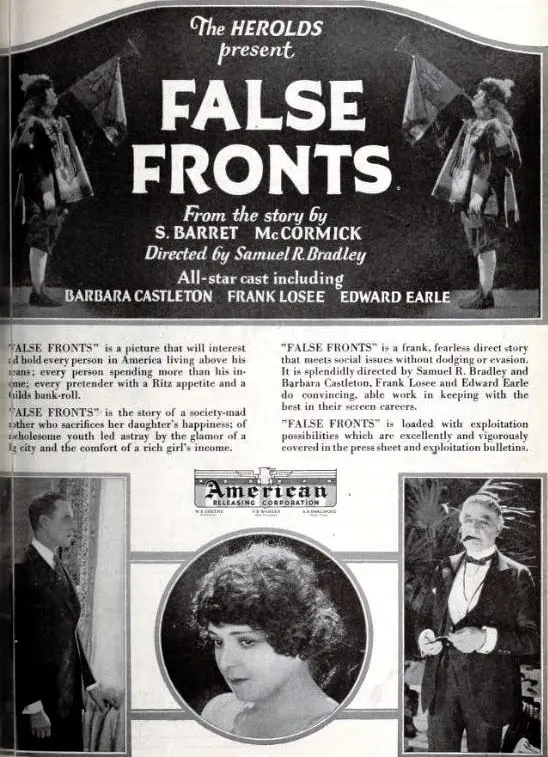
Comparisons to The Face in the Fog are apt, as both films explore the dissonance between public and private selves. However, False Fronts distinguishes itself by its unflinching examination of class mobility. The nouveau riche, as embodied by Helen, are not merely caricatures but tragic figures, their greed a defense mechanism against the eroding stability of the post-war economy. This nuance is lost on some contemporary viewers, who might mistake the film’s stark moralism for a relic of its time. Yet, its questions about the cost of social ascent remain unsettlingly relevant.
Technically, False Fronts is a product of its era, yet it avoids the cloying sentimentality that plagues many early films. The absence of synchronous sound allows the actors to convey subtext through glances and gestures, a stark contrast to the verbose narratives of later decades. The score—though likely a modern addition—complements these visual cues with a haunting score that lingers on the dissonance between hope and despair.
In its final act, the film’s pacing falters slightly, a common issue in silent films that relied on intertitles to advance plot. Yet, this lull is redeemed by the raw power of Earl’s performance as Keith, his face a canvas of contradictions. The reunion with Helen is not a resolution but a collision, their shared poverty erasing the performative veneer that once defined their relationship. It is here that the film’s thesis crystallizes: authenticity is not found in wealth or status but in the courage to confront one’s own artifice.
For modern audiences, False Fronts is a mirror held up to contemporary issues of identity politics and social media personas. The film’s critique of performative authenticity resonates in an age where curated online images often eclipse lived experience. It invites viewers to ask: How many of our digital selves are false front? How do we reconcile the roles we play in public with the truths of our private selves?
Ultimately, False Fronts is a film that rewards patience and scrutiny. Its themes are timeless, its execution period-appropriate, and its message a challenge to the viewer. While it may lack the narrative polish of later Hollywood epics, it stands as a testament to the power of cinema as a medium for introspection. For those who seek not just entertainment but a provocation to self-examine, this film remains a compelling, if occasionally austere, companion.
IMDb 5.8
1925
Community
Log in to comment.