DbcultAccessing Vault...
Cult Review
Senior Film Conservator
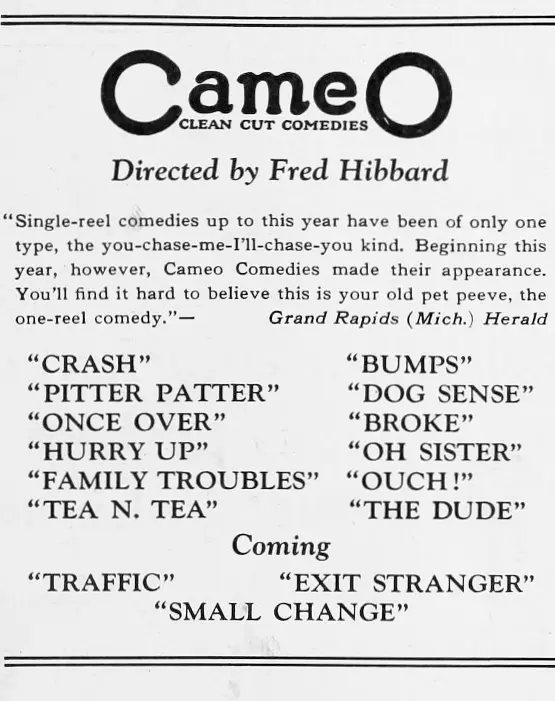
The silent era was often defined by its obsession with the collision between human fallibility and the burgeoning industrial machine. In Family Troubles, this friction is not merely a plot device but the very heartbeat of a narrative that pulses with a frantic, almost desperate energy. Eddie Barry, an actor whose physicality often bridged the gap between the grotesque and the everyman, anchors a story that begins in the mundane world of tax reporting and ends in the literal muck of a quicksand pit.
The film opens with a sequence that feels surprisingly modern in its cynicism: the calculation of dependents. Eddie’s patriarch is a man defined by volume—seven children and a wife—creating a household that feels less like a home and more like a riotous assembly. There is a specific cadence to early silent comedies that deals with the 'crowded house' trope, but here, the density of the family serves as a catalyst for Eddie’s later impulsivity. The desire to escape the cramped quarters of his reality leads him toward the ultimate symbol of 1915 mobility: the automobile.
Unlike the calculated maneuvers seen in films like L'argent qui tue, where financial stakes are treated with a somber gravity, Family Troubles treats money as a volatile substance. Eddie’s mistake—handing sixty dollars to a mechanic who is simply 'fixing' a car—is a moment of pure, unadulterated slapstick tragedy. It highlights a recurring theme in the genre: the working-class man’s fundamental misunderstanding of the mechanisms of the upper class. He doesn't just buy a car; he accidentally steals one through a process of aggressive generosity.
Once the 'lizzie' (the colloquial term for the Model T and its ilk) is acquired, the film shifts gears into a pursuit narrative. The car itself becomes a character, a shuddering, metal beast that seems barely held together by Eddie’s sheer force of will. The sequence where he drives through backyards is a masterclass in location-based comedy. There is a raw, unpolished nature to these stunts that puts modern CGI-laden chases to shame. When Eddie plows through a fence, the splinters are real, the dust is genuine, and the peril feels palpable.
The children’s delight in the car’s near-destruction is a subtle touch of realism amidst the farce. It captures that specific childhood curiosity that views a mechanical failure not as a financial loss, but as a sensory spectacle. This contrasts sharply with the mother’s frantic preparations, a performance that mirrors the domestic anxieties found in My Wife, the Movie Star, though with a more proletarian edge.
The introduction of the 'tribe of policemen' elevates the stakes from a family outing to a criminal escapade. The pursuit is characterized by 'gymnastic accidents,' a phrase that barely does justice to the acrobatic choreography involved. These officers are not agents of justice so much as they are targets for the universe’s slapstick whims. Their repeated interruptions by various obstacles provide a rhythmic counterpoint to the family’s linear journey toward disaster.
One cannot help but compare this chase to the more structured sequences in Double Trouble or the adventurous spirit of Lucille Love: The Girl of Mystery. However, Family Troubles maintains a unique focus on the absurdity of the chase itself. The police are chasing a 'thief' who doesn't know he's stolen anything, creating a dramatic irony that fuels the comedy. It is the quintessential 'wrong man' scenario, stripped of Hitchcockian dread and replaced with the frantic energy of a Keystone-style romp.
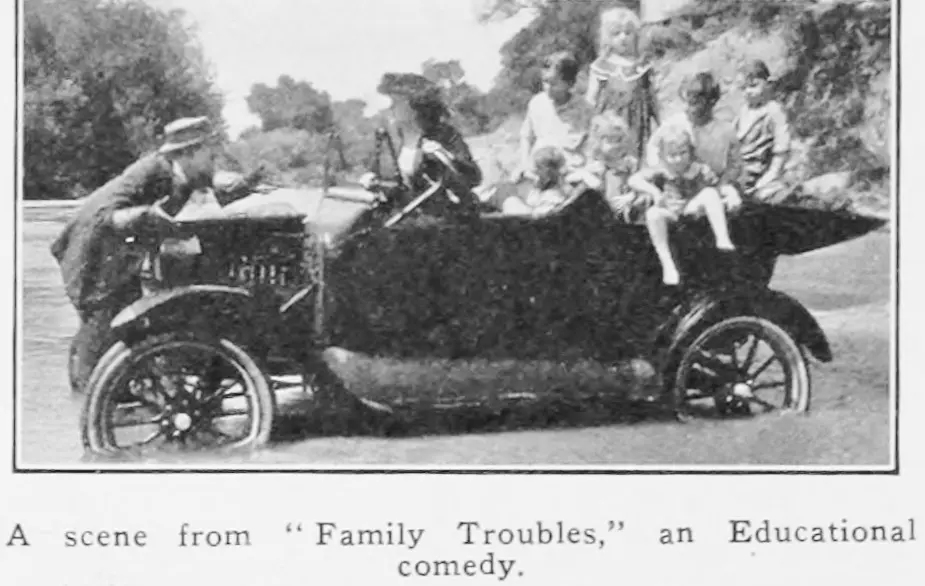
The film’s climax at the closed bridge and the subsequent drive into the stream is where Family Troubles transcends its genre. The decision to drive through the water is born of Eddie’s stubborn refusal to let the landscape dictate his path. When the car begins to sink into the quicksand, the tone shifts from frantic motion to a slow, agonizing descent. The 'women and children first' ethos is played for both laughs and a strange kind of pathos.
There is something profoundly symbolic about a family watching their only luxury item—a symbol of their social climbing—disappear into the earth. It is a literalization of the 'sinking feeling' of debt and failed ambition. The car, which represented freedom and status, becomes an anchor that nearly drags them down. This sequence lacks the whimsical fantasy of Felix in Fairyland, opting instead for a gritty, muddy realism that feels closer to the struggles depicted in Nattens barn.
The resolution of the film is perhaps its most brilliant stroke. The police arrive only to find a family standing by a muddy bank, their 'stolen' property vanished. Without the evidence, the legal threat evaporates. The 'silver lining' is the total loss of the very thing that caused the trouble in the first place. It is a nihilistic conclusion wrapped in a comedic bow.
As the family walks home, accompanied by the mother and the now-peaceful police, there is a sense of restoration. They are back to where they started, but with the weight of the car—and the sixty dollars—lifted from their shoulders. The walk home is a return to the domestic sphere, a recognition that for the working-class patriarch, the dream of the open road is often a detour into disaster. It echoes the grounded sentimentality of Judy Forgot, where the return to one's true self is the ultimate victory.
Family Troubles stands as a testament to the power of early silent comedy to reflect societal anxieties through the lens of the absurd. Eddie Barry’s performance is a whirlwind of manic energy, capturing the essence of a man who is constantly one step behind his own life. The film’s pacing is relentless, its gags are physically demanding, and its ending is surprisingly profound.
While it may not have the epic scale of The Battle of Trafalgar or the high-society intrigue of High Heels, it possesses a grit and a comedic honesty that remains refreshing. It reminds us that the 'troubles' of the title are not just the external forces of the law or the terrain, but the internal drive to possess more than one can manage. In the end, the family is safe, the debt is cleared by the earth itself, and the status quo is restored—on foot.
Reviewer Note: For those interested in more silent era explorations of justice and mechanics, consider viewing Fighting for Gold or the atmospheric The Ghost City. Each offers a different perspective on the themes of pursuit and loss so central to Barry's work here.
IMDb —
1928
Community
Log in to comment.