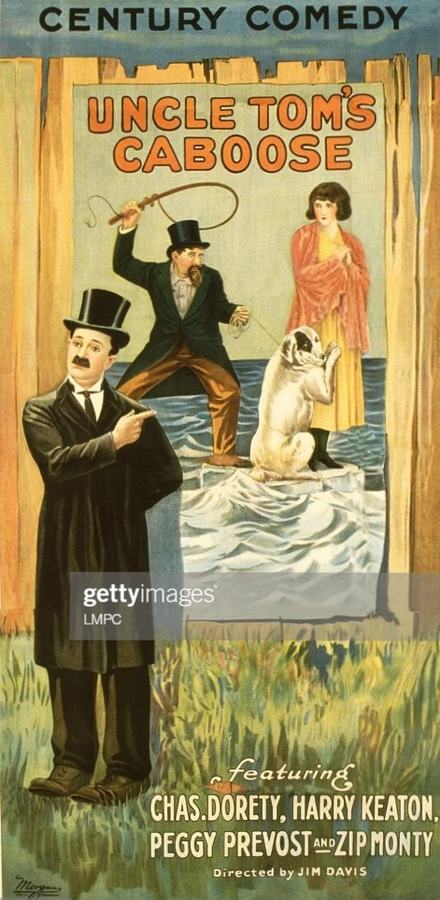
James D. Davis’s 1927 one-reeler doesn’t merely lampoon Harriet Beecher Stowe—it detonates her under the klieg lights, then tap-dances through the ashes wearing spats and a cocaine-grin.
There’s a peculiar thrill in watching a film that refuses to genuflect before its source, that thumbs its greasepaint nose at moral uplift and opts instead for the anarchic calculus of custard pies and collapsing sceneries. Uncle Tom’s Caboose—note the deliberate misspelling that drags the sanctified cabin into the realm of rolling stock—treats America’s most sacred antislavery narrative like a cheap circus poster, sun-bleached, rain-soaked, flapping against a depot wall.
A Moving Theater of the Absurd
The conceit is deliciously simple: a traveling troupe believes the nation still hungers for Eliza’s ice-crossing, for Little Eva’s spectral ascent, for Tom’s beatific expiration. They haul their cardboard Mississippi, their papier-mâché bloodhounds, their Union and Confederate uniforms all dyed the same soot-gray, in a caboose that doubles as greenroom. Every time the train lurches, the melodrama derails; every whistle blast is a director’s cue to improvise catastrophe.
Lois Gibson, whose kewpie-doll eyes could sell soap or salvation, plays the prima swan Madame Celestine LaRue. She enters astride a tricycle designed to look like a steam engine, veil fluttering, bosom heaving, already three beats off the rhythm of dignity. Peggy Prevost is her foil, the supposed ingénue who keeps forgetting to be innocent; her Eva dies with such languid pleasure she practically bills it as a fan dance. Harry Keaton (no relation to Buster, though the genetic pratfall persists) essays both Tom and Legree, swapping a woolly beard for a stovepipe hat in record time, a dialectical somersault that suggests oppression and oppressor are separated only by a whisker and a spotlight.
Chiaroscuro Minstrelsy
What arrests the modern retina is the film’s cavalier racial palette. Blackface is slathered on like tar, then smeared into cubist masks under the strain of sweat and slapstick. Yet Davis refuses to let the stereotype settle; he keeps cracking the icon. A pickaninny chorus line high-kicks into a cakalk that morphs into a Charleston, revealing knees too swift for the lazy Sambo myth to cling. When the fake snow of Eliza’s escape clogs the air, it sticks to the greasepaint, turning every performer into a speckled apparition—black, white, neither, both. The image is uncomfortable, galvanic, oddly liberating: identity as a flaking commodity sold by the yard at the five-and-dime.
Cinematic Reflexivity before it had a Name
Long before the French theorists corked the term mise en abyme, Davis nested plays within plays until the retina quivered. We watch a stage audience (played by the same actors) boo the onstage villain, then rush behind the curtain to change costumes and re-emerge as new spectators. The camera—static by necessity yet curiously sly—lingers on a trompe-l’oeil backdrop of a Southern plantation so crude its perspective warps like a fun-house mirror. The film thus advertises its own fakery, winking at the nickelodeon crowd: We know you know this is humbug; let’s revel anyway.
Compare this self-reflexivity to the more sedate Ring Up the Curtain or the backstage drollery of Three of Many. Those films chuckle at theatrical mishaps; Uncle Tom’s Caboose belly-laughs at the entire American pageant, slavery and salvation included.
The Physics of Slapstick
Keaton, Gibson, Prevost, and the indefatigable Charles Dorety engineer collisions that obey Looney-Tune laws before such laws were inked. A footlight explodes; the flash silhouettes the troupe mid-gesture like a frieze of Pompeiians. A sandbag drops, supposedly killing Little Eva, but the bag bursts into goose feathers—an angelic snowstorm that sticks to tongues and causes a collective sneeze that topples the flat of a riverboat. The cascade is so intricate it feels chamber-orchestrated, yet the surviving continuity notes reveal only three camera set-ups and a lot of faith in gravity.
Gender Acrobatics
Notice how Dolly Stoddard’s Topsy, a whirlwind of cowlicks and curtsy, keeps slipping out of character to flirt with the camera. Her Topsy knows she’s a parody of a parody, and she weaponizes that knowledge with a wink that could pickle cucumbers. She trades hair ribbons with the male Legree; suddenly the villain sports a bow, Topsy a top-hat. The swap lasts three seconds—long enough to destabilize any residual Victorian certainty about who owns virtue, who owns vice.
Temporal Vertigo
Released the same year Al Jolson’s jazz-singer megaphone proclaimed the death of silence, Uncle Tom’s Caboose feels like a vaudevillian last gasp, a raspberry blown against the advent of talk. Yet watch how Davis orchestrates purely visual crescendos: the flicker of kerosene lamps syncopated with intertitle jabs, the iris-in on a single rolling eyeball, the superimposition of a locomotive chimney over a woman’s gaping mouth—an image that predicts the industrial sublime of later Soviet montage.
That modernity also places the film in whispered conversation with contemporaneous social farces like Kitty Kelly, M.D. or the moral panic exposé Why Women Sin. Yet where those narratives sermonize, Caboose cremates the pulpit and sells the ashes as snuff.
The Missing Reel & the Mirage of Restoration
Archivists at MoMA cling to a 9-minute nitrate fragment rescued from a condemned Kansas warehouse; the original ran closer to 20. The extant footage ends mid-chase, legs dangling off the caboose, locomotive whistle screaming like a banshee with laryngitis. Some cinephiles insist the reel was censored for its miscegenation gags, others claim nitrate combustion simply chewed the climax. Either way, the truncation feeds the legend: a film that literally runs away from its own conclusion mirrors a nation that never quite delivered Emancipation’s epilogue.
Performances: A Garland of Eccentrics
Lois Gibson’s Celestine is equal parts Sarah Bernhardt and sack-of-kittens, her diva swoons always undercut by a seismic eye-roll. Peggy Prevost, remembered today for her jazz-age serials, here pirouettes on the cusp of absurdity; her Eva dies, resurrects, dies again, each expiration a fresh burlesque of sanctimony. Harry Keaton’s bifurcated turn—oppressed saint and whip-cracking demon—deserves a thesis on the fungibility of racial iconography. Zip Monberg, credited as ‘comic baggage smasher,’ steals every frame he’s in: his face a topographical map of incredulity, his timing so precise it could calibrate Swiss watches.
Cinematographic Crudities as Virtue
Shot mostly in medium two-shot, the camera allows the tableaux of chaos to unfurl like scroll paintings. The lighting is rudimentary—carbon arcs hiss, shadows swallow half a gesture—yet the chiaroscuro lends moral murk to what might otherwise be mere frippery. When the white snow (read: feathers) blankets the blackface performers, the racial binaries literally dissolve into gray. For 1927 audiences, this was subconscious heresy; for 21st-century eyes, it is an unwitting deconstruction.
Soundless Symphony
Though silent, the film clamors. You can almost hear the canvas flats thud, the goat bleating in patriotic drag, the faint squeak of Collodion on mahogany floorboards. Contemporary exhibitors reportedly accompanied the reel with locomotive sound-effects records—whistles, bells, the clatter of couplings—turning nickelodeons into pop-up rail yards. Today, repertory houses commission avant-jazz trios to improvise alongside, and the result is a polyphonic fever dream that would make John Zorn grin.
A Coda of Contraband Ethics
Is the film racist? Undeniably it trades in tropes that civil-rights eras have rightfully condemned. Yet its manic deconstruction of those tropes—its refusal to let them stand un-satirized—complicates the ledger. Davis doesn’t endorse the iconography; he sets it in motion, lets it collide with itself, then runs away giggling. The effect is less like The Vigilantes’ moral absolutism and closer to the Brechtian alienation of later agit-prop, albeit accidentally.
Still, discomfort lingers. Perhaps that discomfort is the film’s most honest offering: America’s original sin rendered as slapstick, still stuck to our collective shoe a century later.
Where to Catch the Caboose
Streaming rights are a tangle, but the surviving 9-minute print occasionally tours with live scores—check MoMA’s To Save and Project or Pordenone’s Le Giornate. A 2K scan circulates among private torrent trackers; hunt for the file tagged ‘Caboose_MOMA_2K_piano’ for the cleanest contrast. Warner Archive has hinted at a Blu-ray anthology of Pre-Code burlesques; lobby your favorite boutique label. Till then, fragments on YouTube suffice, though compression flattens the feather-snow into murky confetti.
Final Whistle
Uncle Tom’s Caboose is neither elegy nor sermon. It is a runaway train of signifiers, a celluloid firecracker tossed into the temple of American self-myth. To watch it is to feel the axle rattling beneath the republic, to hear the ghosts of minstrelsy giggling in the dark, to realize that every national narrative—no matter how pious—has a trapdoor, and beneath that door a chorus line waiting to pants the preacher. All aboard.