DbcultAccessing Vault...
6.3/10
Senior Film Conservator
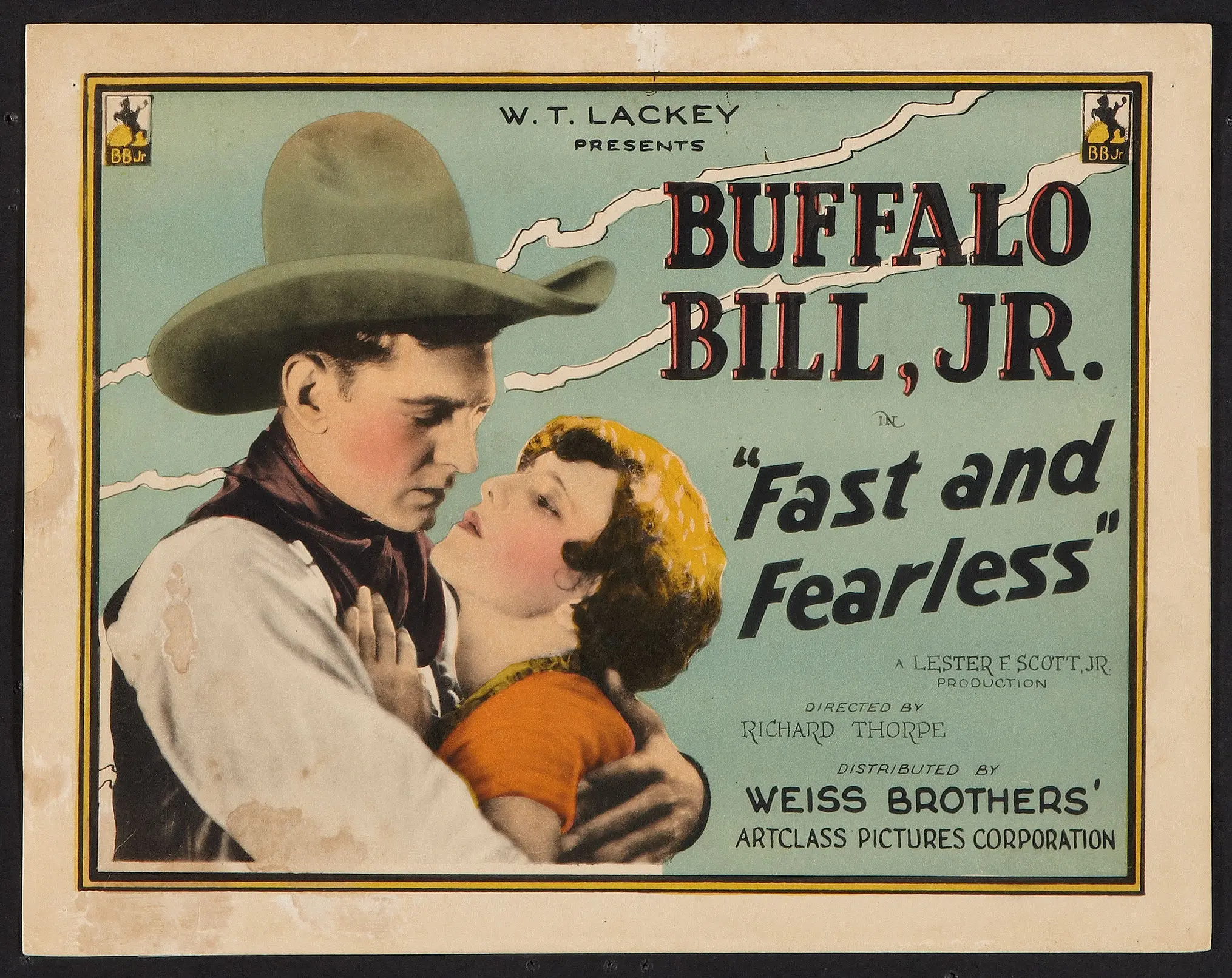
A definitive 6.3/10 rating for a film that redefined the boundaries of cult cinema. Fast and Fearless remains a cornerstone of transgressive art.
There is a specific, tactile quality to the silent Westerns of the mid-1920s that modern digital cinema struggles to replicate. Fast and Fearless, a 1924 production from the prolific Action Pictures stable, serves as a quintessential artifact of this era. It is a film that breathes through its grain, capturing a world where the horizon was the only limit and the horse was the ultimate vessel of narrative momentum. Unlike the more theatrical offerings of the time, such as A Flirt There Was, this film leans heavily into the visceral reality of the outdoors, eschewing drawing-room artifice for the grit of the trail.
At the heart of this whirlwind is Jay Wilsey, performing under the evocative moniker of Buffalo Bill Jr. Wilsey possessed a rugged, unpretentious magnetism that stood in stark contrast to the more polished stars of the period. His portrayal of 'Lightning' Bill Lewis isn't just a performance; it's an athletic feat. In an age before sophisticated safety rigs, the stunts seen here carry a weight of genuine peril that anchors the film’s escapism in a sense of lived-in danger.
One cannot dissect the efficacy of Fast and Fearless without acknowledging the sharp, economical pen of Betty Burbridge. As a female writer in a genre often perceived as a masculine monolith, Burbridge brought a structural integrity to the 'B-Western' that her peers often lacked. Her scripts, including this one, frequently bypassed the lethargic exposition found in contemporary dramas like The Discard, opting instead for a relentless forward motion.
The plot, while superficially adhering to the 'hero saves girl from bandit' trope, is imbued with a rhythmic pacing that mirrors the gait of a galloping stallion. Burbridge understands that in silent cinema, the image must do the heavy lifting of the dialogue. Every intertitle is used sparingly, allowing the physical confrontation between Bill and the nefarious Gómez to articulate the stakes. Gómez is not just a villain; he is a force of entropy, representing the chaos that Bill must tame to bring order to the borderlands.
For modern cinephiles, the primary allure of Fast and Fearless might be the presence of a young Jean Arthur. Long before she became the raspy-voiced, sophisticated icon of the 1930s and 40s, Arthur was honing her craft in the dusty trenches of silent Westerns. Even here, her screen presence is luminous. As Mary, she provides more than just a prize to be won; she offers a soulful counterpoint to Wilsey’s stoic bravado.
Comparing her work here to the more stylized performances in Beach Nuts or the early comedic timing seen in Jumping Beans, one can see the nascent stages of her legendary charisma. She navigates the melodramatic requirements of the script with a naturalism that was rare for 1924, grounding the heightened stakes of the kidnapping plot in genuine emotional resonance.
"The film operates as a kinetic ballet, where the choreography of the chase is the highest form of dialogue."
Visually, the film utilizes the stark, high-contrast sunlight of its locations to create a naturalistic chiaroscuro. The shadows cast by wide-brimmed hats and the silhouettes of riders against the setting sun are not merely decorative; they are thematic. This is a world of black and white, both morally and visually. The cinematography manages to capture the vastness of the frontier without losing the intimacy of the character beats—a balance that even more prestigious films like Bucking Broadway sometimes struggled to maintain.
The pursuit sequences are particularly noteworthy. There is a raw, unedited quality to the way the horses navigate the rocky terrain. You can almost feel the heat radiating off the screen and smell the kicked-up alkali dust. This verisimilitude is what separates Fast and Fearless from the more studio-bound adventures of the era. It shares a certain spiritual kinship with the ruggedness of The Blue Streak, yet it possesses a unique elegance in its execution.
When placed alongside other 1920s genre exercises, Fast and Fearless holds its ground remarkably well. While A Yankee Go-Getter focused more on the charm of its lead, and The Brute Breaker delved into more primitive archetypes, this film finds a middle path of sophisticated action. It lacks the surrealist undertones of international silent works like Iwami Jûtarô or the political density of Dzhymmi Hihhins, but within the American Western tradition, it is a masterclass in efficiency.
The inclusion of Captain Duerta and the Mexican military adds a layer of geopolitical flavor that was often absent in simpler 'cowboy' tales like Boots. It suggests a world where law enforcement is a collaborative, cross-border effort, providing a slightly more nuanced take on the frontier than the isolationist narratives found in Up in the Air.
The direction (often attributed to Richard Thorpe, though records of this era can be mercurial) displays a keen understanding of spatial relationships. During the climax, when Bill and the soldiers close in on Gómez’s gang, the editing maintains a clear sense of geography. This is no small feat in an era where the grammar of the 'action sequence' was still being written. It avoids the chaotic, sometimes confusing blocking seen in Why Smith Left Home, opting instead for a clean, operatic escalation of tension.
The film’s climax is a satisfying culmination of the 'Fast' and 'Fearless' monikers. The capture of the gang by the Mexican soldiers feels earned, a result of Bill’s persistence rather than mere happenstance. The transition from the violence of the chase to the serenity of the impending marriage is handled with a swiftness that might seem abrupt to modern audiences but was the height of narrative economy in 1924. It is a cinematic exclamation point that leaves the viewer breathless.
In the final analysis, Fast and Fearless is more than just a relic of a bygone age. It is a testament to the power of pure visual storytelling. It reminds us that before the advent of synchronized sound, the 'talkies' of the future, cinema was a language of motion, light, and shadow. Jay Wilsey and Jean Arthur may have gone on to different heights in their respective careers, but in this brief, flickering moment in 1924, they captured the essence of the American mythos.
Whether you are a scholar of the silent era or a casual fan of the Western genre, this film offers a rewarding experience. It lacks the bloated runtimes of modern blockbusters, delivering its thrills with a surgical precision that is both refreshing and deeply impressive. It stands as a vibrant, living example of why the Western remains the most enduring of cinematic genres—a timeless dance of hero and villain played out on the canvas of the infinite West.
IMDb —
1925
Community
Log in to comment.