DbcultAccessing Vault...
Cult Review
Senior Film Conservator
Fauvette’s haunting crescendo: A dissection of artistry as salvation
In the shadow of Montmartre’s faded grandeur, Fauvette emerges not merely as a narrative of a woman’s ascent but as a searing inquiry into the commodification of artistry. The film’s opening sequence—a close-up of Gilberte Haziza’s tear-streaked face as she clutches a moth-eaten shawl—establishes a tone of precarious vulnerability. This is no mere rags-to-riches tale; it is a psychological excavation of a woman whose voice becomes both her armor and her vulnerability.
The director’s choice to juxtapose the protagonist’s initial performances in dimly lit cafés with later grandiose operatic triumphs creates a visceral counterpoint between authenticity and artifice. In a key sequence, the heroine (Haziza) delivers a torch song in a smoke-filled nightclub while the camera pans slowly to reveal a shattered mirror behind her—a visual metaphor for the duality of her existence. The production design, particularly in the opulent yet sterile opera house sets, evokes a world where beauty is both sanctuary and prison.
Clara Faurens’ supporting role as the manipulative socialite introduces a thematic tension that echoes through The Firefly of France’s exploration of female rivalry. However, Fauvette distinguishes itself by refusing to vilify these antagonists; instead, it presents their cruelty as symptoms of a patriarchal system that demands women either exploit or be exploited. The film’s most provocative moment arrives in a wordless duet between Haziza and Charles Mosnier, where choreography and silence convey more about marital desolation than any dialogue could.
The sound design deserves particular scrutiny—it is not merely functional but thematic. The heroine’s voice is recorded with unsettling clarity in early scenes, then gradually muffled as her marriage devolves into chaos. This audio evolution reaches its apex during the film’s climactic aria, where layered harmonics burst forth like a dam breaking. Such technical choices elevate the film beyond conventional melodrama into the realm of audiovisual poetry.
Comparisons to Her Greatest Performance are inevitable, yet Fauvette diverges by embedding its heroine’s growth within the sociopolitical upheaval of pre-war France. The recurring motif of train journeys—each one marking a transition from provincial innocence to Parisian corruption—serves as a subtle yet powerful narrative device. One particularly striking scene has the protagonist purchasing her ticket to Paris with a trembling hand, the close-up of coins clinking against the conductor’s palm amplifying the transaction’s symbolic weight.
The film’s color palette evolves in tandem with the protagonist’s metamorphosis. Early scenes are awash in sepia tones, evoking memory and stagnation. As she gains fame, jewel-toned costumes clash with sterile backdrops, visually externalizing her internal conflict. The final act’s use of blue lighting during her triumphant concert is a masterstroke—both cold and transcendent, reflecting the paradox of having achieved success yet remaining emotionally unmoored.
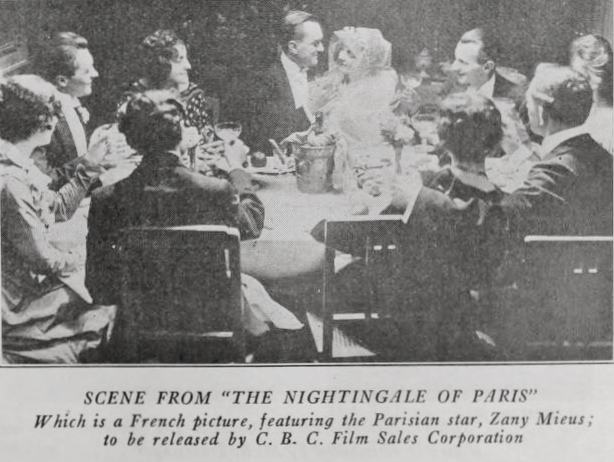
Jacques Normand’s cinematography deserves special mention for its innovative use of negative space. In one of the film’s most memorable compositions, the heroine stands silhouetted against a Parisian dawn, her face obscured by the rising sun. This image, repeated in subtly altered forms throughout the film, becomes a visual leitmotif of rebirth and resilience. The decision to frame key emotional beats through reflections in mirrors and windows adds layers of psychological depth, suggesting that the protagonist is always performing—even for herself.
The supporting cast’s performances are uniformly exceptional. Madeleine Guitty’s turn as the aging diva who serves as reluctant mentor is particularly noteworthy, her scenes with Haziza crackling with unspoken history. The chemistry between Haziza and Joffre in their brief but explosive romantic subplot demonstrates the director’s skill at mining tension from minimal screen time. Even minor characters are granted moments of nuance, such as Henri Valbel’s conductor whose rigid posture gradually softens as he recognizes the protagonist’s artistic integrity.
Where Fauvette falters, if at all, is in its handling of the romantic subplot involving Zany Miéris. While the character offers a potential path to emotional stability, their relationship is underdeveloped compared to the meticulously crafted professional arc. This imbalance feels less like a flaw and more like a deliberate choice to prioritize the heroine’s autonomy over narrative convenience—a bold stance for its era.
The film’s final act is a masterclass in visual storytelling. As the protagonist stands atop the Eiffel Tower, her final aria is intercut with memories of her journey: a trembling debut, a tearful divorce, the cold glare of a dressing room mirror. These flashbacks are not presented chronologically but in a spiraling, dreamlike sequence that mirrors the protagonist’s fractured psyche. The decision to end not with a triumphant curtain call but with the heroine walking away from the stage is audacious—one that cements Fauvette as more than just a biopic of a singer, but a meditation on the cost of transformation.
For modern viewers, Fauvette offers a fascinating juxtaposition with Guarding Old Glory in its treatment of legacy. While the latter film romanticizes static tradition, Fauvette embraces change as both necessary and painful. The recurring image of the protagonist singing to an empty auditorium in early scenes—contrasted with the crowded, indifferent crowds of her later fame—captures this duality. It is a film that understands that true artistry cannot exist in isolation, yet often requires sacrificing connection to achieve.
Technically, the film’s use of sound bridges is revolutionary. The transition from live musical accompaniment to synchronized sound marks a pivotal moment in the protagonist’s career and the film’s aesthetic. This innovation is mirrored in the narrative—just as the heroine must adapt to new technologies to remain relevant, the film itself is a testament to the evolution of cinematic language in the late 1930s.
In conclusion, Fauvette is not merely a film about a singer’s journey—it is a symphony of visual and aural elements that explore the paradox of self-invention. Its legacy lies in its refusal to sanitize struggle, instead presenting growth as a series of contradictions. The final image of the heroine’s hands—calloused yet graceful—lingers as a powerful metaphor for the physical and emotional toll of reinvention. For those seeking a film that lingers in the soul like a half-remembered melody, Fauvette delivers in spades.
IMDb —
1931
Community
Log in to comment.