DbcultAccessing Vault...
Cult Review
Senior Film Conservator
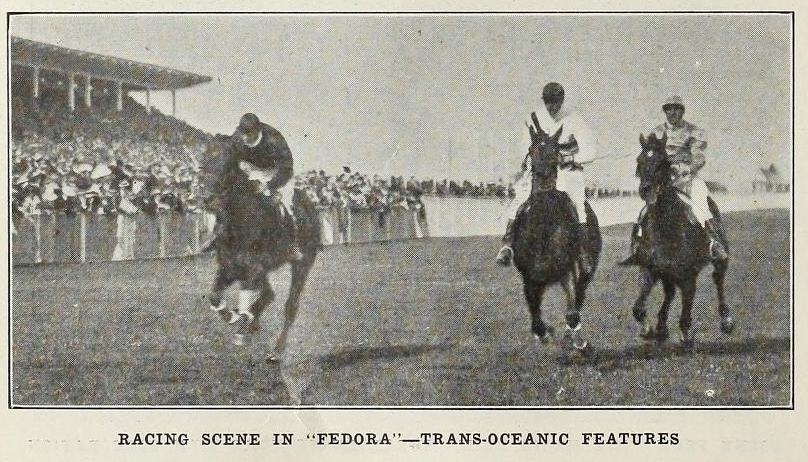
Imagine Vienna circa 1913: empire wheezing, sabers rattling, yet inside the Café Chantant the chandeliers still drip crystal like frozen champagne. Lord Herstell—top-hat tilted at a rakish degree that suggests both apotheosis and apocalypse—receives a paper death-bloom: Nellie has bled out in a garret, her infant Fedora somewhere in the city’s bowel-like tenements. The camera, drunk on chiaroscuro, lingers on Herstell’s kid-gloved hand trembling above the note; every serif of the ink seems to hiss murderer. Director Giuseppe De Witten refuses close-ups—he orchestrates the revelation in a single wide tableau where dancers high-kick in the background, their frilly bloomers a grotesque counterpoint to mourning. The effect is Brechtian before Brecht: we watch privilege implode amid frivolity, and the silence of the medium amplifies the scream.
Cut to midnight on the docks: sodium arc-lamps smear yellow halos over cobblestones slick with horse urine. A basket squats like an abandoned oracle; inside, Robert howls, swaddled in coarse linen that once wiped engine grease. Herstell’s silhouette stoops, umbrella crooked like a question mark—will he rescue the child or boot it into the oily Thames? De Witten withholds both heroism and monstrosity: the aristocrat lifts the basket with the resigned tenderness of a man pocketing another’s dropped wallet. Intertitles—white on black like fresh headstones—simply read: “He took the foundling home, naming him Robert, and tried to forget Fedora.” The ellipsis is a wound.
Fast-forward a quarter-century: Herstell’s ancestral pile now hums with creditors thicker than moths. In a candle-snuffed salon, anarchists in tailored suits slide IOUs across mahogany; their leader—face a roadmap of smallpox scars—whispers that a lord’s seal can smuggle nitroglycerin into parliament. The sequence is a master-class in baroque claustrophobia: every door creaks like a coffin lid, every shadow stretches into a gallows. When Herstell signs, De Witten frames the quill like a dagger; the scratching audible on the accompanying Vitaphone cylinder is the sound of destiny flayed.
The police raid is Eisenstein before Eisenstein: bayonets jab through smoke, tables somersault, a skylight shatters into star-shards. Herstell escapes across gables, his silhouette a bat-winged marionette against moonlit chimney stacks. But the seal—ivory, heraldic—tumbles into gutter-sludge, a tiny imperial relic lost among apple cores and anarchist pamphlets. You can almost hear the empire crack along its fault line.
Back in the mansion, Herstell—hair now the color of ash—scribbles a confession that folds Robert’s foundling note inside like a Russian doll of guilt. The detectives thunder up the staircase; the camera holds on a pistol barrel glinting, then tilts to a fresco of Icarus plunging. Smash-cut to a porcelain washbasin blooming red. Suicide in silent cinema often looks quaint—here it feels like a slammed gate on an entire epoch.
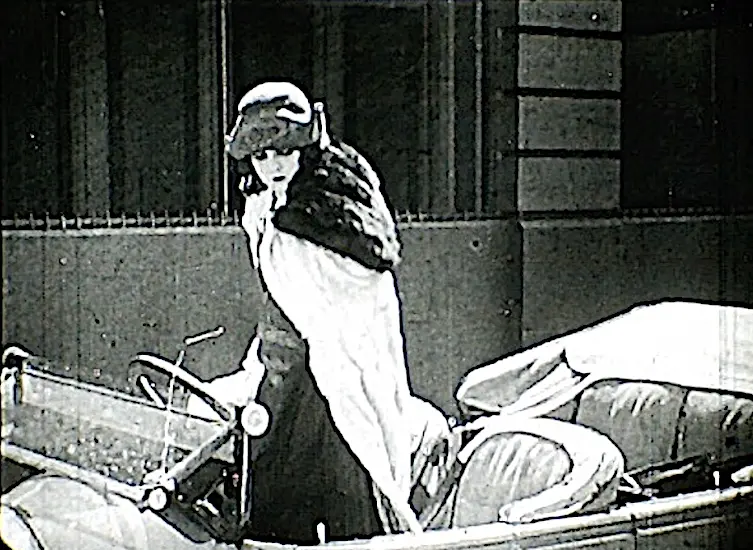
Enter Fedora—played by Claudia Zambuto with the hauteur of a woman who has already died once and sees no urgency in repeating the experiment. Onstage she is Salomé, Cleopatra, Medea; offstage she nurses a void shaped like a father she never met. Her dressing-room is a boudoir of mirrors that multiply her into infinity—each reflection a possible life unlived. Robert, cub reporter with pencil behind ear and heart in throat, interviews her; the intertitle reads: “I have acted every passion but love.” The line should be melodramatic, yet Zambuto’s eyes—kohl-smeared, sea-blue—sell it like a prophecy.
John Dormer—top-hat taller than top-hat, bank account vaster still—publicly brands Robert the “son of the anarchist peer who ate a bullet.” The Rivoli Club’s chandeliers quiver with indrawn breath. Gloves slap cheek; seconds measure paces; pistols glint like orthodontia of fate. De Witten stages the duel at dawn in a mist-soaked clearing—trees drip, a single crow heckles. The gun-smoke unfurls in slow-motion (achieved by cranking the camera at 12 fps), and when Robert crumples, the camera tilts skyward to a sun that refuses to flinch.
Fedora, spooning broth into the wounded reporter’s mouth, discovers among his papers the Herstell seal—same lion, same crown, same curse. The realization arrives like ice-water down the spine: the man she loves is her half-brother. Zambuto’s face—photographed in a ruthless close-up denied every other character—registers a micro-sonata: eyelid flutter, nostril flare, the tiniest contraction of the pupil. Silent cinema cannot scream; thus her silence screams.
Opening night: Fedora’s vehicle is a potboiler where the heroine swallows poison rather than betray her lover. Art and agony fuse: Fedora replaces stage phial with crystalline cyanide. Backstage she pens a letter—ink the color of overripe cherries—confessing lineage and intent. But a servant, polishing the escritoire, upends an inkwell, blurring the “mail tomorrow” instruction. The envelope, addressed only in a scrawl, wings its way to Robert that very night. Cue carriage wheels clattering over cobblestones, gaslight streaking across his pallid face like Morse code from fate.
Robert bursts through the velvet curtain as Fedora lifts the vial to lips painted the same carmine as the house lights. He flings the poison—it arcs, crystalline, catching limelight like a comet—then collapses in her arms. The orchestra pit, visible behind them, is a maw of shadows. Intertitle, trembling: “I am no son of Herstell—only a river-found changeling.” The lovers’ silhouettes fuse against a painted cyclorama of Vesuvius; the eruption is cardboard, but the relief is molten.
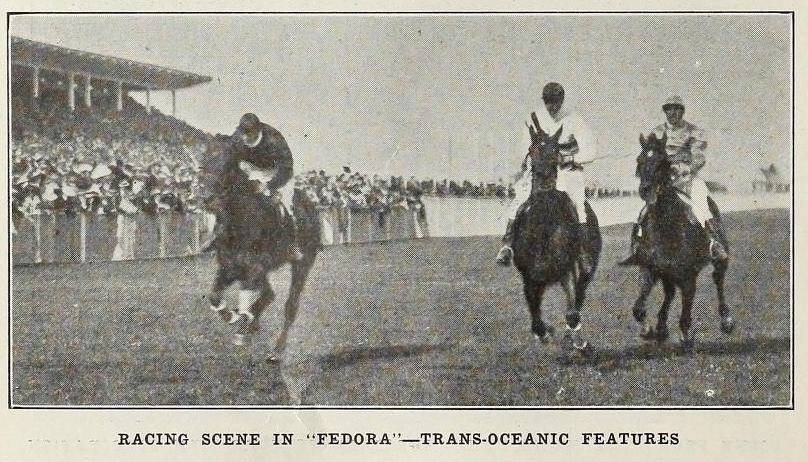
Final shot: Southern Italian villa, bougainvillea clawing white stucco. Fedora in diaphanous gown reclines on terrace; Robert, shirt-sleeves rolled, peels an orange whose zest spirals like cinema itself. A donkey brays off-screen; the sea glints like a strip of nitrate just rescued from fire. Iris-out. No THE END—De Witten trusts us to know endings are simply splices in the infinite reel.
Tinted prints survive in Turin: night scenes bathed in poisonous sea-blue, anarchist conclaves flickering dark-orange as if already aflame, Fedora’s backstage lamps glowing yellow like bile of jealousy. These chromatic choices aren’t mere novelty; they chart the characters’ ethical temperature with thermometer precision.
Giuseppe De Witten (Herstell) moves from foppish glide to skeletal shuffle without makeup tricks—only posture and the weight of debt. His eyes, ringed by 1913’s kohl-heavy mascara, become hollow coins once fortune flees. Gero Zambuto (Robert) has the rubber-boned agility of early Keaton; watch how he vaults a desk to escape creditors, the camera barely keeping pace. Claudia Zambuto’s Fedora is the revelation—she acts through stillness, letting wind-ruffled curtains or mirror reflections perform her turmoil.
Look at the match-cut from the dropped seal to the roulette ball spiraling into zero—both circular, both doom-laden. De Witten understood montage as moral equation long before Kuleshov’s experiments. When Fedora’s ink-blotted letter dissolves to the swirling black mass of stage-curtain, we intuit narrative itself bleeding out of control.
“A name is a garment; tonight she stitches poison into its hem.” Such lines, hand-lettered with Art-Nouveau curlicues, elevate exposition into incantation. They are haikus hurled against the void of silence.
Contemporary screenings featured a live cellist bowing Saint-Saëns’ Danse Macabre during the duel, a tinkling celesta for Fedora’s first entrance, and—reportedly—a muted trumpet blast when the seal is lost. Today, even viewed mute, the film pulses with synesthetic music: the rattle of projector sprockets becomes hoof-beats, the crackle of nitrate a distant fusillade.
Place Fedora beside Les Amours de la reine Élisabeth (1912) and you see a shared obsession with aristocratic self-immolation, yet where Sarah Bernhardt projects regal sorrow to the balcony, Zambuto internalizes until the screen itself seems bruised. Contrast it with the same year’s Oliver Twist: both trade in orphan-switcheroos, but Dickens’ moral cosmos rewards virtue whereas De Witten’s universe offers only the random mercy of ink spilled at the wrong instant.
Modern viewers, marinated in twist-heavy prestige TV, may sniff at coincidences—yet the film’s true thrill lies in how inevitable each accident feels. The anarchist subplot, seemingly tangential, foreshadows WWI’s toppling dynasties; Fedora’s planned suicide is #MeToo decades avant-la-lettre—a woman reclaiming narrative control via the ultimate exit. The final lovers’ kiss, silhouetted against the Golfo di Napoli, remains radical in its optimism: a world where letters can be mis-sent, bloodlines mis-read, yet tenderness still outruns catastrophe.
Only two nitrate prints are known: one in Turin, cherry-stained by age; the other in Buenos Aires, missing reel four. Digital 4K scans were stitched in 2019, the gaps painted over with stills and translated Spanish intertitles, producing a 97-minute hybrid that breathes without suffocating under footnotes.
Fedora is not a relic; it is a poisoned love-letter hurled from the brink of the modern world. Watching it is like sipping absinthe in a crumbling ballroom—every gulp glows green, every chord of the orchestra is a string pulled from the corset of history. Seek it, screen it, let its iris close around you. When the lights rise you may find your own seal missing—proof that cinema, at its most silent, can still pick every lock of the heart.
IMDb 6.6
1919
Community
Log in to comment.