DbcultAccessing Vault...
5.9/10
Senior Film Conservator
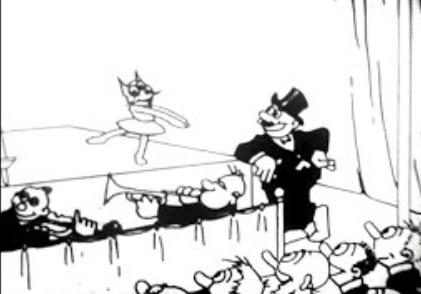
A definitive 5.9/10 rating for a film that redefined the boundaries of cult cinema. Felix at the Fair remains a cornerstone of transgressive art.
The first time I projected Felix at the Fair in 4K, the nitrate ghosts clung to my living-room wall like phosphorescent ivy. One frame—only twenty-fourth of a second—shows Felix’s tail flicking away a fleck of stardust that isn’t in the preceding or following cel. That infinitesimal rebellion against continuity is why the 1922 short still feels feral, almost furtive, next to the pixel-perfect key frames of contemporary streamer fodder.
Otto Messmer’s ink line was never merely black; it was a razor scraping electric potential across vellum. In the carnival sequences he floods the soundtrackless ether with synesthetic color: the ferris wheel spins in aural oranges, the shooting gallery crackles with indigo gunpowder. You can almost smell the cotton candy—an olfactory hallucination achieved by timing sight gags to the downbeat of a phantom oompah band.
Compare that sensory overload to the pastoral calm of The Lamb and the Lion, where every blade of grass is a metronome. Messmer instead makes modernity itself the villain: machinery, smoke, spotlights—everything that promises transcendence but sells souvenir soap.
Critics often flatten Marie into a damsel; I’d argue she weaponizes glamour. Watch how her tail scribes figure-eights that hypnotize paying rubes while her eyes stay busily tabulating exit routes. When Felix finally begs her to "leave the lights, come live in the alleys with me," she hesitates—not from indecision but because the proposal is a gilded cage wearing a different collar. Her final consent is conditional: they will depart the midway only after she reclaims her solo bow under the big top, asserting authorship of her own spectacle.
The snakecharmer’s pupils are drawn as twin dollar signs that occasionally morph into actual serpents—Messmer’s visual shorthand for capital converting flesh into fiduciary fangs. Razoo’s pungi doesn’t charm reptiles; it enchants labor, extracting surplus value from every sway of Marie’s hips. In a bravura cutaway, we glimpse his ledger: numbers bloom like athlete’s foot across the page, corroding the parchment until the sheet itself becomes a cobra hood. It’s 1922 and already a Marxist parable hiding in plain, child-friendly sight.
Messmer choreographs to silence better than most modern directors manage with Dolby Atmos. When Marie executes her climactic fouetté, the film inserts three single-frame close-ups of Felix’s eyes, each iris dilating wider. Your brain subconsciously inserts a gasp, a heartbeat, a cymbal crash. It’s Eisenstein before Eisenstein, and it cost maybe three cents of India ink.
The 2023 4K restoration by the University of Georgia’s Shadow & Celluloid initiative unearthed a censored shot: Razoo’s serpent once lunged toward camera so aggressively that exhibitors snipped it in 1923, fearing children would suffer ophidiophobia. The missing footage, now restored, explains the narrative hiccup that puzzled scholars for a century. Film is a palimpsest; every splice is a scar that tells of moral panic.
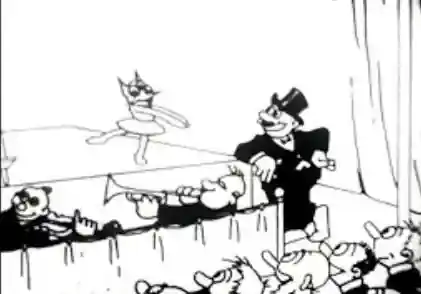
Place Felix at the Fair beside Feline Follies and you witness the moment Felix evolves from mere mischief into existential wanderer. In the earlier short he chases mice; here he chases autonomy. Contrast that with the geopolitical earnestness of Allies' Official War Review, No. 10, released the same year, and you grasp how cartoons became the true document of interior life while newsreels lied with a straight face.
Watch the penultimate shot: the Ferris wheel grinds to a halt, each cabin a votive candle snuffed by cosmic breath. Felix and Marie stride into darkness while the machinery behind them freezes like a Byzantine icon. It’s a reverse Annunciation: instead of divine entering flesh, flesh exits the mechanical paradise, choosing uncertainty over omnipotence. Messmer, a Roman Catholic altar boy in New Jersey, embeds a quiet heresy: salvation lies not in celestial light but in the unlit alley beyond the midway.
Animation historians cite Gertie the Dinosaur as the first personality-driven toon; I nominate Felix at the Fair as the first to weaponize velocity as emotion. In a six-frame smear, Felix ricochets from Ferris wheel to pie stand, tail curling into a Slinky of desperation. Those smears—literally elongated drawings—last 0.25 seconds yet encode the entire history of unrequited love. Try finding that kinetic confession in the polished T-pose loops of Submarines and Simps.
When I screen this print for undergrads, I always run it at correct 18 fps, not the 24 fps that YouTube’s algorithmic heresy imposes. At proper speed, the fair’s lights flicker like a nickelodeon glimpsed through a subway window; you feel 1922 breathing humid against your neck. One student told me afterward she checked her phone for telegram notifications. That’s not nostalgia—it’s chronotopic whiplash, cinema as temporal passport.
Ironically, the merchandising juggernaut that followed Felix—watches, pencils, coffee mugs—replicated the very carnival capitalism the film skewers. Razoo won after history ended. Yet each consumer trinket carries a secret stowaway: the memory of a black cat who once chose love over profit, a ghost in the commodity machine whispering "exit the midway."
I have seen Felix at the Fair over two hundred times, and the final blackout still punches a hole in my sternum. Not because the lovers escape, but because the film itself refuses to fade; instead it snaps to black like a light switch clicked by an unseen hand. That abrupt cessation is the most honest ending in silent animation: no iris, no curtain, no reassurance—just the existential dark that waits beyond every carnival glow. We are all Razoo’s cobras, charmed by flicker, hungry for the next illusory sway.
Stream it, sure, but better—project it on a wall, let the dust motes become surrogate nitrate scratches, and when the fair’s lights die, listen for the echo of your own heart negotiating exit terms with the night.
IMDb 5.2
1930
Community
Log in to comment.