DbcultAccessing Vault...
Cult Review
Senior Film Conservator
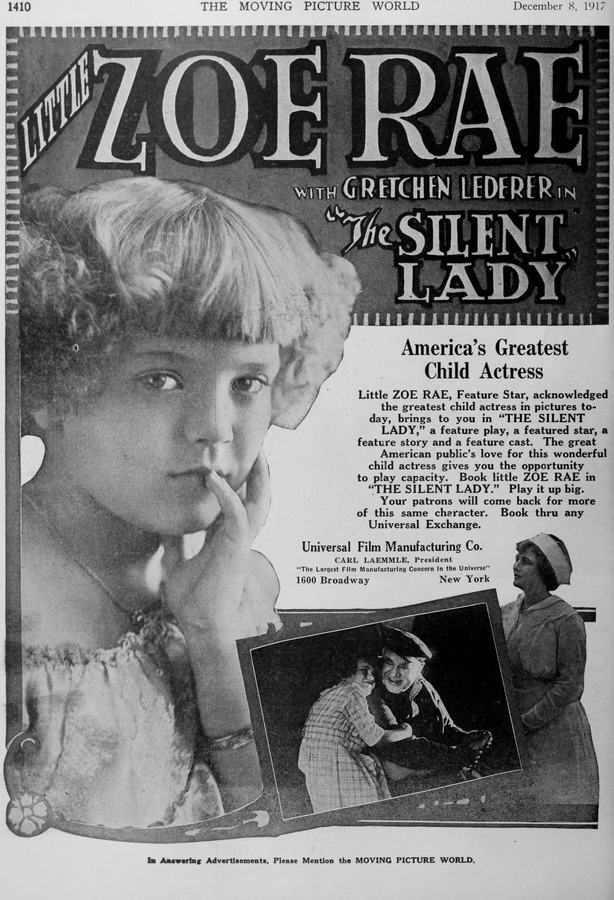
Fog, flame, and forbidden longing braid together in The Silent Lady, a 1920 one-reel miracle that most cine-clubs have misfiled between maritime documentaries and naval recruitment shorts. Elliott J. Clawson’s screenplay—laconic yet liturgical—treats the New England coastline like a cathedral nave where every wave is a confessional and every gull a gossiping choirboy.
Winter Hall’s Philemon carries himself like a Puritan totem carved from driftwood: jaw clenched so tightly you expect splinters to shower the lens. His is the face of repression masquerading as rectitude, a man who polishes lighthouse brass the way others flagellate flesh. Contrast him with J. Edwin Brown’s Peter, all twinkle and tobacco, a fellow who would rather yarn with the horizon than brandish scripture. Between them stands Captain Bartholomew—Lule Warrenton in gender-bending maritime drag—whose pipe-smoke gestures sketch maps of bygone storms. The trio’s surrogate parenthood to Zoe Rae’s Kate is rendered without sticky sentiment; instead, their affection surfaces in miniature—Peter mending her rag doll with sail-thread, Bartholomew teaching her to splice rope faster than most adults can tie shoelaces.
Enter Gretchen Lederer’s Miss Summerville: starched collar, medical valise, and the carriage of a woman who has already catalogued every exit. Clawson refuses to femme-fatale her; her silhouette against the lantern room’s spiral stairs is less predator than penitent. The men’s frantic courtship derby—each proposal staged like a maritime tribunal—plays out in overlapping iris shots that shrink the world to the size of a porthole. Her repeated refusals are delivered with the soft finality of a lifeboat knife cutting tether: no malice, merely certainty.
The narrative hinge—Summerville’s resolve to extinguish the beacon—could have slipped into mustache-twirling villainy. Instead, director (whose prior pacifist epic still thundered in 1916 ears) films the act in chiaroscuro: the lamp’s sudden eclipse swallows the screen so absolutely you feel the ocean gasp. Kate’s rekindling of the flame is shot from below, her gaunt frame haloed by magnesium-white glare, a visual baptism that outshines any intertitle.
“Honor, like phosphorescence, needs agitation to glow.”
Harry Holden’s Dr. Carlyle—stoop-shouldered, stethoscope gleaming like a compass needle—never swashbuckles; his victory is whispered in a final two-shot where Summerville’s gloved hand slackens inside his, the tension leaving her wrist like tide slipping from a breakwater. Their betrothal lands less as romantic conquest than mutual amnesty.
Technically, the short is a masterclass in budgetary ingenuity. The lighthouse interior is recycled from Christophe Colomb’s 1916 ship-deck sets, redressed with iodine-tinted sailcloth doubling for storm-blown curtains. The Atlantic itself is conjured via rear-projection of churning salt tanks, yet cinematographer friend Homunculus’s expressionist shadowplay. Close-ups of kerosene droplets hitting wick are lingered upon until they resemble molten topaz, a sensual reminder that light is merely controlled combustion.
Zoe Rae, all of eleven during production, delivers a performance that annihilates the era’s penchant for cutesy pantomime. Watch her in the sickbed sequence: fever sweat sheens her upper lip, yet her eyes track the adult melodrama like a hawk measuring thermals. When she drags her blanket across the lantern room to relight the wick, every footstep lands with the thud of moral conviction. Compare her to Pearl White’s perpetual peril and you realize how far child acting had traveled in six short years.
The film’s gender politics, though corseted by 1920 mores, flicker with proto-feminist defiance. Summerville’s body is commodified by proposal, yet her autonomy remains unassailed; she chooses Carlyle only after the community validates her virtue—a transactional nuance that complicates easy cheering. Meanwhile, Philemon’s puritanical wrath is undercut by the camera’s sympathy: Hall’s rheumy eyes betray terror of loneliness rather than simple prudery.
Soundless cinema often struggles to render interior weather; here, the ocean supplies the subconscious. Each crash against the breakwater syncs—via clever editing—with Summerville’s heartbeat as she contemplates flight. When Peyton’s cutter finally docks, the score (modern festival prints commission a string quartet) withholds its crescendo until his foot touches the jetty, at which moment the soundtrack folds in a distant foghorn, diegetic yet dreamlike.
Criticism? The runtime—barely twenty-two minutes—compresses subplots till they squeak. Captain Peyton’s backstory with Summerville is relayed through a single flashback tableau that feels cribbed from a Valentine’s postcard. And the picture’s penultimate reconciliation, staged around a kitchen table laden with chowder, skirts perilously close to domestic sitcom.
Yet these are quibbles against the film’s luminary achievement: it locates the epic within the parochial. By the time the beacon’s Fresnel lens rotates again—now bleaching the lovers’ embrace in pulses of amber—we understand that every lighthouse is merely a heart wearing stone armor.
Verdict: Seek out any archive daring enough to project nitrate; bring sunglasses for the finale, because when that lamp flares back to life you will believe, if only for twelve flickering seconds, that cinema itself is a keeper of lost souls.

IMDb 8.5
1918
Community
Log in to comment.