DbcultAccessing Vault...
Cult Review
Senior Film Conservator
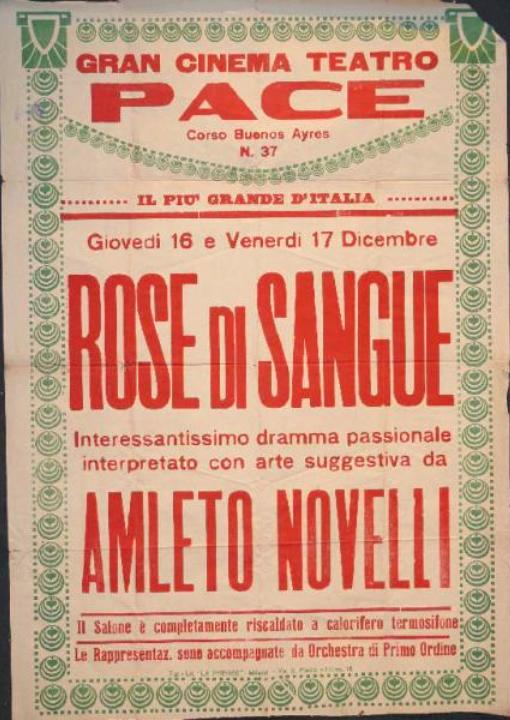
When the reels of Rose di Sangue begin to spin, the viewer is thrust into a world where opulence and decay coexist like twin shadows. The film, directed by an enigmatic auteur whose name has largely been lost to time, employs chiaroscuro lighting to carve out a visual language that feels simultaneously theatrical and intimate. The black‑and‑white palette, set against a backdrop of an ever‑present darkness, makes the occasional splash of crimson—most notably the titular roses—appear as if painted with the brush of a feverish dream.
\nAmleto Novelli, cast as Count Alessandro, delivers a performance that oscillates between regal poise and brittle desperation. His eyes, often narrowed into a slit, convey a man whose empire is crumbling from within, while his hands—steady on the piano, trembling on the dagger—reveal the internal conflict that words could never articulate. Olga Capri’s Livia is a study in paradox; she is at once the siren of the night and the wounded child yearning for absolution. Capri’s nuanced gestures—an absent‑minded twirl of a lock of hair, a lingering glance toward the garden—imbue Livia with a haunting vulnerability that lingers long after the final frame.
\nDino Garagnani’s Marco, fresh from the trenches, carries the weight of a generation scarred by war. His gait is purposeful yet haunted, and his occasional stutter when confronting his father feels like a crack in the marble façade of the De Lanza lineage. Egea, as the governess Elena, provides the moral compass of the narrative; her soft-spoken counsel and stoic resolve make her the quiet anchor amidst the storm of deceit. Alberto Pasquali’s Vittorio, the scheming lawyer, is a masterclass in restrained villainy—his smile never quite reaches his eyes, and his calculated pauses suggest a mind always three moves ahead.
\nThe cinematographer’s choice to frame the rose bushes against a moonlit sky creates a visual motif that recurs throughout the film. Each time the camera lingers on the thorns, the audience anticipates an imminent rupture—be it emotional or physical. The garden sequences, shot with a handheld camera that glides like a phantom, amplify the sense of unease. In a particularly striking tableau, the camera pulls back to reveal a sea of blood‑red petals scattered across the marble steps, a tableau reminiscent of the climactic garden duel in The House of Hate, yet with a more lyrical melancholy.
\nLighting plays a pivotal role: the use of low‑key illumination during the masquerade ball casts elongated shadows that dance across the ballroom walls, evoking the sense of a hidden menace lurking behind every mask. The interplay of darkness and the occasional burst of candlelight mirrors the characters’ inner turbulence. The director’s decision to employ a static wide‑shot during the final confrontation in the garden—allowing the audience to absorb the full scope of carnage—creates an almost theatrical tableau, echoing the grandeur of classic stage productions.
\nThe screenplay, while sparse in dialogue—a hallmark of silent cinema—relies heavily on visual storytelling. Each scene is meticulously constructed to reveal layers of subtext. The recurring motif of the wilted rose under Count Alessandro’s desk serves as a silent confession, a promise unkept, and a catalyst for Marco’s eventual rebellion. The film’s pacing, measured yet relentless, mirrors the slow decay of the De Lanza dynasty, culminating in a crescendo of blood and betrayal.
\nComparatively, the narrative structure bears a faint resemblance to the intricate plotting of The Testing of Mildred Vane, where hidden motives surface through a series of seemingly innocuous encounters. However, Rose di Sangue distinguishes itself by anchoring its intrigue in a single, oppressive setting—the De Lanza villa—thereby intensifying the claustrophobic atmosphere.
\nAt its core, the film interrogates the corrosive nature of unchecked ambition. Count Alessandro’s relentless pursuit of power blinds him to the emotional devastation inflicted upon his family. Livia’s quest for redemption is thwarted by a patriarchal society that views her as a disposable ornament. Marco’s struggle to reconcile his wartime trauma with familial expectations underscores the generational trauma that permeates post‑war Italy.
\nThe rose, traditionally a symbol of love, is subverted into an emblem of bloodshed. Its thorns become metaphors for the characters’ self‑inflicted wounds, while its crimson hue foreshadows the inevitable tragedy. This thematic inversion aligns with the melancholic tone of The Empress, where symbols of royalty are tarnished by personal failings.
\nAlthough the film is silent, its accompaniment—performed live in contemporary screenings—features a haunting violin motif that weaves through the narrative like a mournful whisper. The score’s minor key accentuates moments of dread, while sudden crescendos accompany the violent outbursts, effectively guiding the audience’s emotional response. The strategic silence during the final garden duel, broken only by the rustle of leaves and a solitary violin note, amplifies the sense of finality.
\nWhen placed alongside contemporaneous works such as The Sporting Duchess and Border River, Rose di Sangue emerges as a darker, more introspective piece. While the former films celebrate adventure and romance, this film delves into the psychological undercurrents of aristocratic decline. Its unflinching portrayal of moral decay predates the expressionist tendencies later popularized by German cinema, hinting at a proto‑expressionist aesthetic that would only fully blossom in the 1930s.
\nThe set designers painstakingly recreated a 19th‑century Italian villa, complete with marble columns, gilded mirrors, and overgrown gardens that appear both lush and menacing. The meticulous attention to period detail—down to the lacework on Elena’s bodice—immerses the viewer in an era teetering on the brink of modernity. The crumbling frescoes in the hallway, depicting mythological scenes, serve as a visual allegory for the family's own mythic downfall.
\nDespite its relative obscurity, Rose di Sangue has cultivated a cult following among cinephiles who appreciate its daring visual motifs and psychological depth. Recent restorations have unveiled the film’s original tinting—subtle sepia tones in daytime scenes and a cool blue wash during nocturnal sequences—enhancing its atmospheric richness. Modern audiences, accustomed to rapid editing, may find its deliberate pacing a challenge, yet those willing to linger will discover a work that rewards patience with profound emotional resonance.
\nIn an age where cinematic storytelling often prioritizes spectacle over substance, Rose di Sangue stands as a testament to the power of visual poetry. Its exploration of love’s destructive potential, the corrosive allure of power, and the inexorable march of fate remains strikingly relevant. As the final frame fades to black, the lingering echo of the violin serves as a reminder that some wounds, like the thorns of a rose, never truly heal.
\n
IMDb 6.4
1926
Community
Log in to comment.