DbcultAccessing Vault...
6/10
Senior Film Conservator
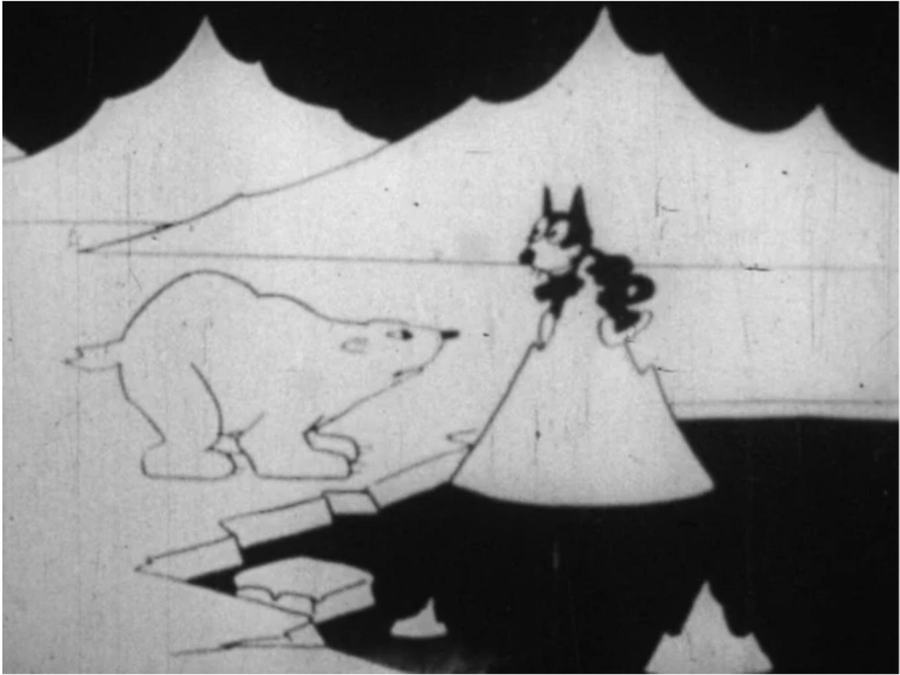
A definitive 6/10 rating for a film that redefined the boundaries of cult cinema. Felix Hits the North Pole remains a cornerstone of transgressive art.
Two minutes of frost-bitten celluloid—yet the mercury of modernity soars.
Flicker, hiss, and the curtains part like frost splitting on glass. What greets us is not narrative but contagion: Felix the Cat, that rubber-limbed sigil of 1920s acceleration, sprinting northward on a conveyor belt of headlines. The newsreel—Felix Hits the North Pole—never asked for plot; it demanded spectacle, a kinetic poster slapped across the globe’s bald pate. In the wake of Salambo’s gilded debauchery and the Expressionist chill of Die Gespensterstunde, this snippet feels like a snowball hurled in a crowded theatre: brief, rude, unforgettable.
Ink versus Ice: a duel staged in the public’s retina.
Watch the cat’s contours—drawn by Otto Messmer’s night-shift hand—bleed into headlines announcing polar flights, marathon dances, bathtub gin. The animators splice Felix atop real footage of ice shelves, his tail curling around flappers who brandish autograph books like passports to the now. There is no dialogue track; the silence itself becomes a drum, beaten by the projector’s 18-frame clatter. Each viewer supplies the scream, the giggle, the capitalist vertigo.
Compare it to Broken Barriers, where melodrama kneels before moralism; here, morality has been fed to sled dogs. Felix’s journey is purely circular: he departs the consumer, loops through the planet’s extremity, and returns as merchandise—plush, pinned, printed on coffee mugs that clink beneath chandeliers. The North Pole is merely the brightest billboard available.
Celebrity before Instagram: a graphite grin conquers the last white space on the map.
Technically, the reel is a ransom note from the future. Animators rotoscope naval footage, then overlay a cel of Felix waving at a walrus that, in another cut, appears stuffed in a Fifth Avenue window. Perspective shears; scale riots. One moment the cat perches on a zeppelin’s tailfin, the next he dwarfs an icebreaker, his whiskers riveted like steel cables. The viewer’s eye, trained on Renaissance depth, must now surf collage. It’s the same visual panic that De mystiske z straaler would weaponize for sci-fi dread, yet here it’s played for merchandising chuckles.
Sound? Absent. But not silent. The orchestra pit—often a lone pianist in a provincial house—would vamp Everybody Step while Felix moon-walked on berg crystals. Syncopation between ragtime and raster equals the first pop-music video, predating MTV’s birth by six decades. When the final frame freezes on the cat winking, the audience hears what it wants: the cash register’s ding.
Colonial undertones, wrapped in celluloid snow.
Look past the charm and you’ll spot the imperial shrug. Inuit silhouettes cheer Felix as if he were the reincarnation of Helene of the North minus the tragic undertow. The Pole becomes property, annexed by syndicate. The walrus—indigenous titan—reduced to comic stooge. Even the aurora borealis is rebranded: Felix’s tail slashes through it like a neon signature. One senses the same cultural bulldozer that Under the Crescent applied to Saharan dunes, now crunching permafrost.
Yet the short revels in its own ephemerality. It knows tomorrow the headlines will swap polar hysteria for Wall Street numbers. So it compresses eternity into a snowball: throw, laugh, melt, forget—until nostalgia re-freezes it.
Conservation status: nitrate flirts with immolation.
Most prints languish in vinegar syndrome, bubbles eating Felix’s face like frostbite. A few archives—MoMA, BFI—house 35 mm ghosts. Streams? Forget it. YouTube offers thumbnail rips sampled from VHS off-air, the colors bled to bruise. To witness the original tints—arctic cyan, marquee amber—you must attend a nitrate screening, preferably in a bunker where the projectionist wears fireproof mitts. The risk intensifies the myth: cinema as forbidden glacier.
Critical reception then: Variety dismissed it as “kidstuff on ice.” The New York Times sidebar sniffed at “feline hubris.” Yet letters to the editor—archived in Rutgers—tell another tale: children naming their sleds Felix, shopgirls pinning newspaper cutouts inside lockers, a Kansas boy demanding his dad repaint the barn to match the cat’s inky silhouette. In 1923, that barn became the first piece of fan-cosplay architecture.
Modern parallels: a meme wearing mittens.
Swap the zeppelin for a rocket, swap newsprint for Twitter, and Felix’s jaunt mirrors today’s influencer pilgrimages to Antarctica. The same hunger for unclaimed backdrop, the same sponsorship grin. The difference? Otto Messmer’s team drew every frame by kerosene lamplight, no undo button. Their wrists ache across the century, reminding us that virality once cost blisters.
Gender optics: flappers frolic, but Felix remains the eternal bachelor. Compare Wuthering Heights where Cathy’s moors reflect feminine tempest; here the ice plain is a blank page awaiting masculine doodle. Yet the female spectators seized agency anyway—knitting Felix scarves, organizing sorority fund-raisers to ship earmuffs to polar explorers. The reel’s gender politics may flunk 21st-century seminar, but its reception history complicates any top-down reading.
Aesthetic legacy: the first cinematic sticker pack.
Without this two-minute throwaway, would Look Pleasant Please dare fracture the fourth wall? Would The Flying Twins risk collage flight? Animation historians trace the elastic cut-out gag—later perfected by UPA—back to Felix’s ice-capades. And every time a TikTok creator slaps a cartoon emoji atop live footage, they owe nickelodeon rent to Messmer’s frostbitten cat.
Emotional aftertaste: like licking a sled runner—metallic, nostalgic, faintly dangerous.
You leave the screening both elated and culpable, implicated in the same consumerist vortex Felix lampoons. The North Pole, once a cartographic ultimatum, now feels like a mall at closing time: lights dim, tinsel shivers, security guards jangling keys. Yet in that wink—hand-drawn, imperfect—survives the human fingerprint, a smudge no algorithm can sanitize. The cat vanishes, the lights come up, the snowball melts into the projector’s mechanical sigh. What remains is the irrepressible grin, etched on the inside of your eyelids, refusing to melt.
Final arithmetic: two minutes, zero chill, infinite reverberation.
IMDb 4.8
1928
Community
Log in to comment.