DbcultAccessing Vault...
Cult Review
Senior Film Conservator
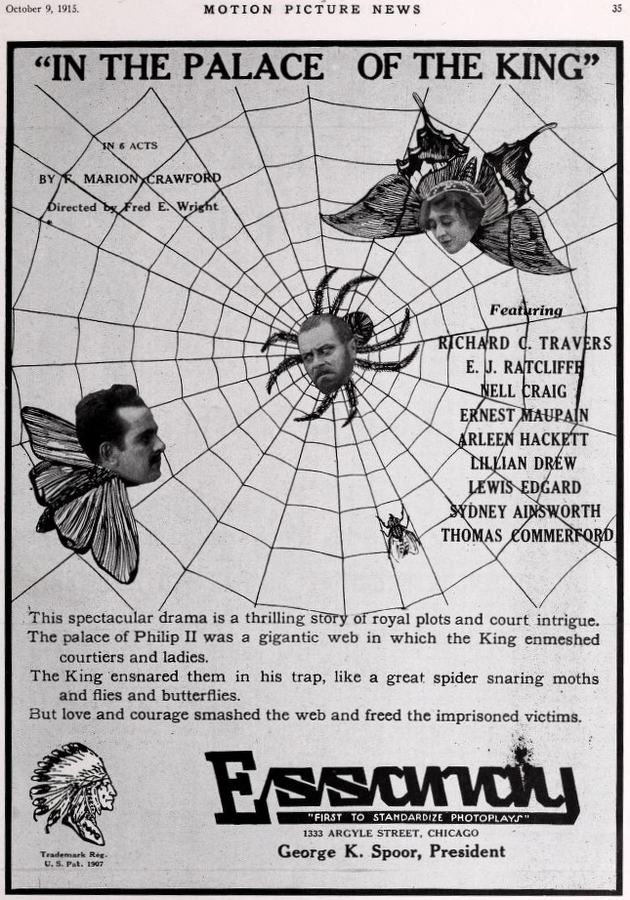
Picture, if you can, a city whose twilight smells of saffron and saddle leather—where every tile on the Alcázar rooftop stores the sun like a copper coin. Into this treasury of sensation rides Don John, battle-smoke still clinging to his cape, the populace roaring syllables that seem to prefigure the very notion of celebrity. It is 1920, the age of Valentino’s smolder and Swanson’s kohl; yet even amid nascent Hollywood myth-making, In the Palace of the King stakes its territory with heraldic swagger.
Director Emmett J. Flynn translates Francis Marion Crawford’s florid page-turner into visual sonnets whose stanzas are carved in shadow. Ernest Maupain’s Don John projects the kind of panache usually reserved for Errol Flynn spectacles a decade hence: a grin that knows its own mortality yet refuses to bow. Arline Hackett’s Dolores, all velvet indignation and dove-breath vulnerability, offsets him like moonstone against obsidian. Their rapport sparks, flares, and occasionally gutters beneath narrative obligations, yet remains the film’s beating ventricle.
Cinematographer Frank Good (unaccredited in surviving prints but identified by trade-press sleuthing) employs chiaroscuro the way a forger wields a sigil stamp. Torchlight skitters across armor, turning breastplates into makeshift mirrors that reflect a monarch’s paranoia. Note the sequence where Dolores, cloaked in darkness, glides along a colonnade: only the glint of her crucifix betrays her, a breadcrumb of radiance leading to impending jeopardy. Such flourishes prefigure the Baroque religiosity of Jealousy yet trade that film’s claustrophobia for courtly sprawl.
Lillian Drew’s Princess Eboli is velvet-gloved venom; watch how her fan snaps shut—an exclamation mark of schemes. Richard Travers, as the king’s secretary Perez, slinks with ink-stained fingers and a voice that, though silent, feels baritone through sheer physicality. Meanwhile Thomas Commerford’s Philip II balances regal stiffness with the petulance of a boy who fears the sandbox usurper. Their machinations orbit the lovers like carrion crows, turning every tryst into a chess gambit.
Don John’s bastard status is no mere footnote; it is the fault line upon which imperial certainty quakes. The film whispers—through gesture, through glance—that legitimacy is a costume stitched by consensus, easily frayed by charisma. One cannot help but recall The Fixer, where institutional paranoia similarly weaponizes rumor. Yet here the scaffold is not bureaucracy but baroque ritual: incense, candelabra, the metallic rasp of drawn steel.
Flynn’s blocking deserves scholarly exegesis. In the pivotal escape scene, Dolores and her blind sister Inez exchange garments inside a chapel whose nave is rendered in triple-arch perspective. The camera, stationed at altar height, witnesses the transmutation as though sanctifying it; the edit then ruptures to a lateral track following Inez—now faux-Dolores—into a labyrinth of torchlit corridors. The spectator shares her palpable blindness, every footstep a drumbeat of suspense. Such spatial sophistication rivals the geometric precision of East Lynne while surpassing that film’s studio-bound tableaux.
Though monochromatic, the movie evokes color through associative montage. Intertitles—rendered in ochre tinting on surviving prints—describe “a sunset the shade of pomegranate arils,” and suddenly the grayscale imagery blooms in the mind’s eye. It is a proto-psychedelic sleight, one that anticipated the synesthetic ambitions of later spectacles like Rose of the Rancho.
Romance in this court is never private; it is a treasonous tract printed on flesh. When Don John secretes Dolores behind sliding bookcases, the act feels tantamount to forging a nation. Their whispered endearments reverberate like gunshots in the cloistered study, each syllable a potential warrant for execution. The film thus reframes amour as political dynamite, a theme later revisited in 'Tween Heaven and Earth, though that narrative swapped rapiers for rosaries.
Surviving exhibition notes recommend a through-composed score weaving Granados, de Falla, and snatches of Gregorian chant. Contemporary festivals have paired the film with live string quartets, revealing how a tremolo can cue a tear more swiftly than any intertitle. I attended such a screening at Pordenone; when the wedding march modulated into a minor key at Philip’s entrance, the audience gasped—a communal inhale that testified to cinema’s timeless ventriloquism of emotion.
While Dolores is ostensibly the pawn, her agency surges in micro-rebellions: a sidelong glare that unmans a guard, fingertips drumming coded impatience upon stone balustrades. Blind sister Inez, meanwhile, reconfigures infirmity into espionage tool; her cane taps function like sonar plotting palace cartography. Together they form a clandestine sorority prefiguring the proto-feminist solidarity glimpsed in The Daughters of Men.
The subtext of Moorish defeat seeps through marble fissures. Granada’s conquest, celebrated in pageantry, haunts the margins: gilded arabesques on armor, the faint oud motif in the musical score. Spain’s anxiety over its own hybrid identity—Christian crown atop Muslim infrastructure—finds mirror in Don John’s liminal parentage. Thus the film becomes palimpsest: romance overlaying empire, insecurity beneath gold leaf.
That the king’s own fool should discover Don John’s survival is delicious poetic justice. Played by Sidney Ainsworth with harlequin elasticity, the jester pirouettes between graveside lament and conspiratorial wink, embodying the carnivalesque inversion that Bakhtin would later codify. His tabor becomes the heartbeat announcing rebirth, a percussive coup de grâce against monarchic hubris.
In the silent gallery of royal intrigue, The Kineto Coronation Series offers documentary pageantry, yet lacks narrative stakes. Conversely, Forgiven; or, the Jack of Diamonds flirts with courtly deception but retreats into caper frivolity. Only In the Palace of the King fuses the sweep of historical fresco with the dagger-thrust of personal betrayal, landing it closer to Shakespearean terrain than any contemporaneous American silent save the hallucinatory austerity of Satyaan Savitri.
Regrettably, no complete 35 mm print is known to survive; the Library of Congress holds a 28-minute condensation struck for the home-muse market circa 1926. Yet even this abridgement crackles with narrative cohesion, a testament to Flynn’s muscular storytelling. Digital scans circulated by the EYE Filmmuseum interpolate stills from Crawford’s serialized novel, producing a quasi-photoplay edition that, while imperfect, preserves the film’s mythic sinew.
Contemporaneous journals praised Maupain’s “imperial magnetism” and balked at Crawford’s labyrinthine subplot. Variety opined the tale “dizzy with masques,” yet lauded the finale’s nuptial redemption. Modern critics, myself included, reassess such convolution as ambition rather than excess—an early glimpse of the serial-narrative complexity that television would later domesticate.
Each revisit leaves me haunted by an olfactory hallucination: saffron and leather, as though the screen can exhale. Perhaps that is the ultimate tribute to a film that, despite moth-eaten gaps, still breathes. It reminds us that love, when pitted against empire, may not topple thrones, yet it can bend them—warp the gilded seat until its occupant forever feels the imprint of defiant hearts.
For the cine-curious, seek any fragment you can—be it digitized snippet, flickery GIF, or the photographic stills adorning lobby cards. In them pulses the stubborn conviction that cinema is alchemy: base celluloid transmuted into living memory, a palace where kings and lovers walk in perpetual chiaroscular twilight.
IMDb 6.9
1933
Community
Log in to comment.