DbcultAccessing Vault...
6.6/10
Senior Film Conservator
A definitive 6.6/10 rating for a film that redefined the boundaries of cult cinema. Felix in Love remains a cornerstone of transgressive art.
The year 1922 remains a watershed moment for the medium of animation, a period when the rhythmic possibilities of the frame were being explored with a fervor that bordered on the revolutionary. At the epicenter of this creative maelstrom stood Felix the Cat, a character who transcended his status as a mere inkblot to become a vessel for the burgeoning surrealist movement. In Felix in Love, directed by the unsung architect of the character’s soul, Otto Messmer, we witness a profound synthesis of domestic melodrama and high-concept fantasy. This isn't merely a cartoon about a cat; it is a meditation on the lengths to which an individual will go to manufacture a persona worthy of love.
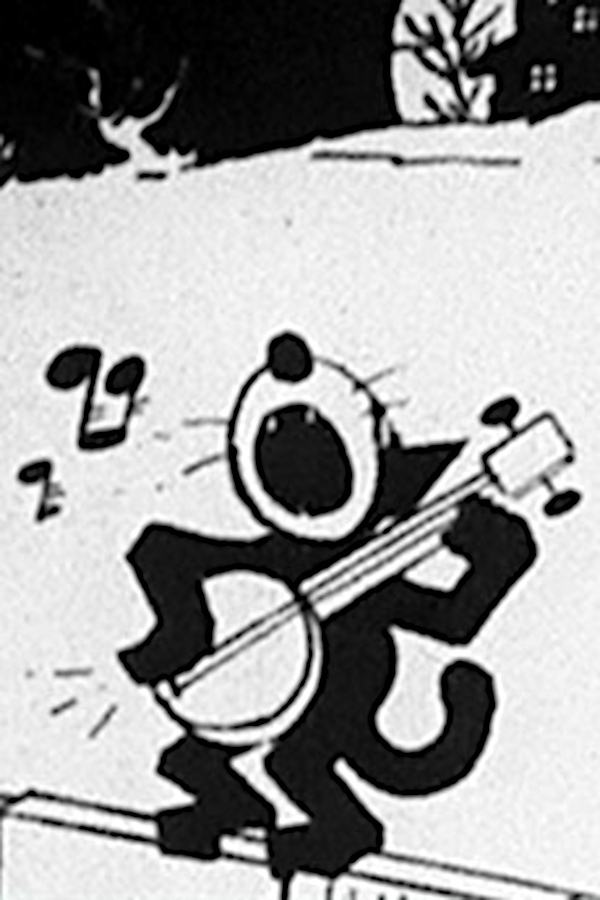
The opening sequence is a masterclass in the economy of visual storytelling. Felix, perched precariously upon a fence, attempts to bridge the distance between himself and Kitty through the medium of song. In the silent era, this 'song' is represented by undulating musical notes that float through the air like physical entities—a hallmark of the Messmer style where abstract concepts take on tangible form. This scene echoes the thematic yearning found in live-action contemporaries such as The Garden of Resurrection, where the pursuit of an idealized romance often leads to a confrontation with harsh reality.
However, reality in the Felix universe is rarely static. The interruption of his aria comes not from a verbal rebuff, but from the violent intervention of a lamp thrown by an unseen antagonist. This transition from the romantic to the slapstick is seamless, yet it carries a weight of existential irony. The very tool used to silence him becomes the instrument of his liberation. When the lamp strikes Felix, the animation shifts from the mundane to the magical. The genie that emerges is not the sanitized version we might expect from later decades, but a mercurial spirit that facilitates Felix’s descent into a dreamscape.
Felix’s choice to visit Africa is a fascinating glimpse into the 1920s zeitgeist. Much like the characters in Mr. Opp, who harbor delusions of grandeur that far outstrip their social standing, Felix believes that a change in geography will result in a change in character. He doesn't wish for Kitty to love him as he is; he wishes for the experiences that he believes will make him lovable. This pursuit of 'exotic' prestige was a common trope, yet Messmer handles it with a visual inventiveness that defies the era's limitations.
The depiction of Africa in Felix in Love is less a geographical reality and more a playground for graphic experimentation. The lions, elephants, and landscapes are extensions of Felix’s own psyche—pliant, transformative, and occasionally threatening. The fluidity of the line work here is staggering. While live-action films of the time, such as Judge Not, were bound by the physical constraints of the camera and the set, Messmer’s pen was liberated. Felix can detach his tail to use as a cane, a question mark, or a weapon. This metamorphic quality suggests that identity itself is a construct, a theme that resonates through the ages.
In analyzing Felix’s trajectory, one cannot help but draw parallels to His Royal Highness. Both films deal with the sudden elevation of a commoner into a world of heightened stakes and foreign intrigue. However, while the former often relies on the absurdity of the situation, Felix in Love grounds its absurdity in the emotional core of its protagonist. Felix is a striver. He is the animated equivalent of the protagonists in The Tattlers, navigating a social minefield where one’s reputation is the only currency that matters.
The film’s pacing is relentless. Each gag serves as a stepping stone toward the ultimate goal of romantic conquest. Yet, there is a subtle melancholy beneath the surface. The genie’s intervention is a shortcut, a 'deus ex machina' that underscores Felix’s inadequacy. This sense of trying to prove one's worth through artifice is a recurring motif in silent cinema, often seen in the struggles of characters in You Can't Believe Everything, where the facade of success is frequently at odds with the internal reality.
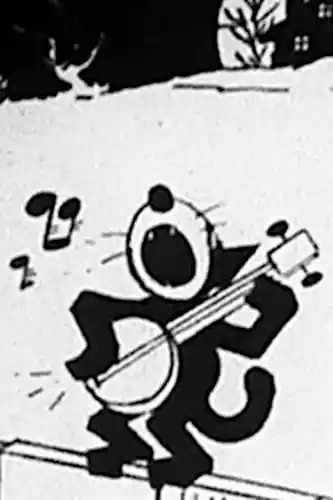
Technically, the short is a marvel of high-contrast composition. The use of solid blacks and crisp whites creates a visual clarity that is essential for the fast-paced visual puns. Messmer understood the power of the silhouette better than almost any of his peers. By stripping away unnecessary detail, he forced the audience to focus on the movement and the 'acting' of the character. This approach is far more effective than the cluttered frames found in some of the lesser-known dramas of the era like Skippers and Schemers.
The animation of the genie is particularly noteworthy. It lacks a permanent skeleton, shifting its volume and shape with a grace that predates the sophisticated liquid animation of the 1930s. This fluidity serves as a counterpoint to Felix’s more structured, though still flexible, movements. It represents the chaos of the supernatural intruding upon the structured world of the alleyway cat. The juxtaposition of these two styles creates a visual tension that keeps the viewer engaged, even when the narrative logic takes a backseat to the spectacle.
To view Felix in Love through a modern lens requires an acknowledgment of its historical baggage. The 'Africa' portrayed is a collection of caricatures and colonial fantasies. However, as a critic, one must also see how these elements were used as shorthand for 'the ultimate adventure.' For Felix, Africa is not a place, but a symbol of the 'Other'—a realm where he can reinvent himself far from the judgmental eyes of his peers. This desire for reinvention is a universal human trait, explored with equal fervor in the social dramas of the period, such as Empty Pockets.
What sets Felix apart from other contemporary characters is his agency. While characters in Stormfågeln or Madonnas and Men are often victims of fate or societal pressure, Felix takes his fate into his own paws. He encounters a magic lamp and immediately formulates a plan. He is an entrepreneur of his own destiny, even if that destiny is built on the shaky foundations of a genie’s whim. This proactive nature is what allowed Felix to become the first true global superstar of animation, overshadowing the more passive figures of the time.
Ultimately, Felix in Love is a testament to the power of the imagination. It suggests that love is the catalyst for all great adventures, and that even a lowly alley cat can dream of being a hero. The film ends not with a grand resolution, but with the sense that the journey itself is what defines the character. Whether he wins Kitty’s heart or not is almost secondary to the fact that he was willing to travel to the ends of the earth to try.
In the grand tapestry of silent film, this short stands as a vibrant, ink-stained thread. It lacks the cynicism of Die Dreizehn aus Stahl and the heavy-handed moralizing of Mr. Goode, Samaritan. Instead, it offers a pure, unadulterated glimpse into the joy of creation. Otto Messmer didn't just draw a cat; he drew a spirit of resilience and whimsy that continues to captivate audiences over a century later. For those seeking to understand the roots of visual comedy and the evolution of the anthropomorphic hero, Felix in Love is an essential, intoxicating watch.
As we look back at the 1920s, a period often characterized by its excesses and its tragedies, films like this provide a necessary lightness. They remind us that even in the face of rejection—or a flying lamp—there is always the possibility of a genie, a wish, and a world waiting to be explored. Felix remains the eternal optimist, the black-and-white philosopher of the fence, forever in pursuit of a love that is just one magic lamp away.

IMDb —
1918
Community
Log in to comment.