DbcultAccessing Vault...
Cult Review
Senior Film Conservator
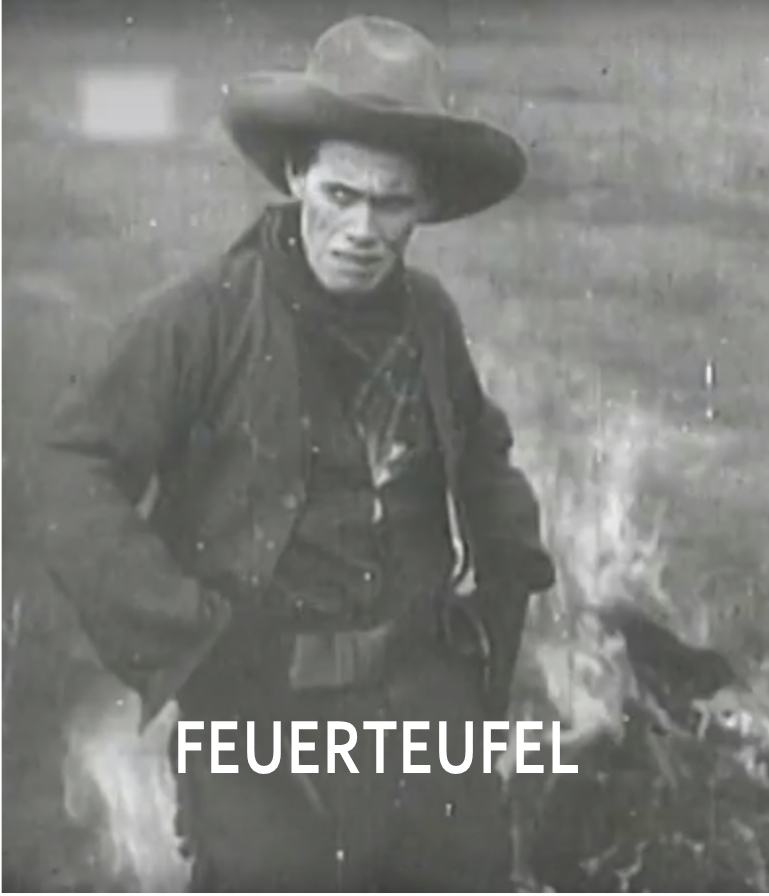
A nitrate cathedral burns in the mind long after the last reel of Feuerteufel flares out. Not since The Isle of the Dead has German screens coughed up such a sulphurous hallucination—yet where that film hoarded shadows, this one vomits light.
Lou Seitz, barely fifteen during production, carries the movie on her scorched shoulder-blades. Her eyes—twin blue fuses—never blink, even when grandfather Feuerteufel (Carl Schön) pours liquid mercury into paper shells as if decanting moonlight. Together they inhabit a workshop that feels excavated from myth: shelves of dragon-tailed rockets, drawers labeled in vanished dialects, a stuffed raven whose glass eye reflects every coming detonation. Cinematographer Werner Görtz lenses the space like a jeweler inspecting a crime, letting dust motes burn white against pitch-black negative space. The result is a chiaroscuro of combustion: every frame threatens to ignite the next.
Enter Holmes Zimmermann—not a detective but an actuary, armed with slide-rule rectitude. The actor’s real surname tragically lost to a warehouse fire in ’47, he plays the role like a man who has mistaken his soul for a ledger. His first confrontation with Seitz is a masterpiece of withheld violence: she offers him tea laced with gunpowder; he sips, calculates risk, wipes graphite dust from his waistcoat. Their repartee crackles with erotic threat, the kind that made censors in Munich demand an extra flash-card warning “against imitation by the young.”
Meanwhile the town itself becomes a character—a spa whose aristocratic guests have dwindled into ghosts, leaving only the scent of eucalyptus and unpaid bills. Director Ewald Stolzing edits civic montage like a feverish cartographer: bathers in iron wheelchairs, casino chandeliers that drip wax on abandoned poker chips, a brass band rehearsing Strauss while rats gnaw the drumheads. This is Deutschland post-Treaty of Versailles, a nation whose self-image has been dynamited and hastily reassembled with black-market gunpowder.
Because the film survives only as a heavily-water-damaged nitrate positive, modern restorers had to reconstruct tinting schemes from chemical residue. What emerges is a palette that refuses nostalgia: canary-yellow for childhood flashbacks, ember-orange for adult desire, and a bruised sea-blue for the moments when death politely tips its hat. The score—re-orchestrated from a surviving cue-sheet—requires a wind machine, anvils, and a solo violin tuned a quarter-tone sharp; conducted live, it makes chandeliers vibrate like guilty consciences.
Compare this chromatic bravado to the monochrome fatalism of Dust or the royal purple melodrama of Les amours de la reine Élisabeth. Feuerteufel refuses to settle into a single emotional spectrum; it is polyphonic, poly-chromatic, poly-dysfunctional.
Mizzi Ship’s cabaret set-piece arrives midway, staged inside a crumbling operetta house whose ceiling mural depicts Icarus plunging into a sun that looks suspiciously like a blooming chrysanthemum bomb. Clad in a dress stitched from actual firecracker wrappers, she sings a lied whose lyrics consist only of chemical formulas: “KNO₃ + S + C = Kiss.” Each high note triggers a stagehand to light a fuse; sequins shoot from her sleeves like shrapnel. When the final cadence lands, the camera itself appears to combust—heat-halation warps the edges, nitrate bubbles swell, the screen seems to plead for mercy. Censors interpreted the number as anarchist sedition; modern viewers will recognize the birth of performance-art pyrotechnics half a century before Björk strapped fireworks to her harp.
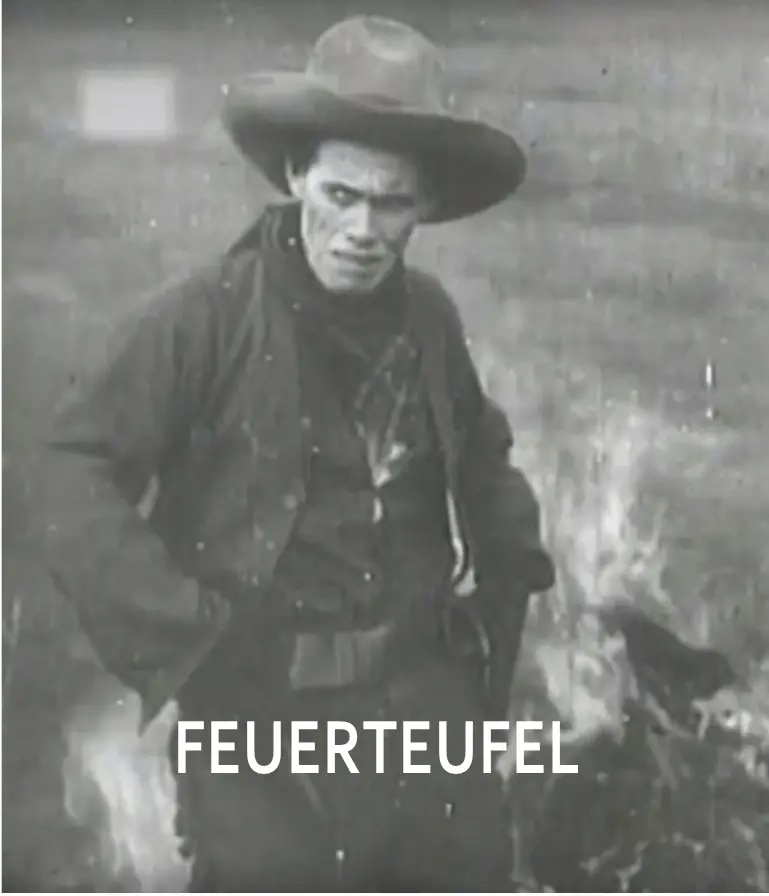
Yet the sequence is not empty spectacle. It externalizes the inner accelerant that consumes every character: the dread that tomorrow might be identical to yesterday. Zimmermann’s subsequent breakdown—he tallies premiums while soaping his own reflection into erasure—plays like a lantern-slide from an Expressionist pamphlet, but Seitz’s reaction sells the tragedy. She does not comfort him; she simply strikes a match, holds it between them, and lets it burn until the flame licks her fingertips. In the ember’s final centimeter we read the film’s manifesto: pain is the only reliable currency, and it must be spent in public.
Structurally, Feuerteufel loops like a Möbius strip. The first third obeys linear cause-and-effect; the middle folds into recursive flashbacks—some repeating the same explosion from contradictory angles—while the finale accelerates into single-frame montage, a stroboscopic death-dance that anticipates Maya Deren by twenty-five years. Editor Carl Becker (no relation to the actor) claimed he spliced footage from a 1908 actualité of the SS Liberté boiler blast into the climactic carnival sequence. The insertion—only six frames—subconsciously alerts the viewer that history itself can combust without warning.
Compare this temporal sabotage to the tidy flashbacks of Mágnás Miska or the moral clockwork of His Enemy, the Law. Here chronology is not a comfort but an accelerant, soaked in paraffin and left to smolder.
The final reel exists only in fragmentary form: four minutes of soot-damaged nitrate, vinegar-syndrome bubbles chewing through faces. Even so, the outline is legible. Town fathers stage a summer festival to distract citizens from hyper-inflation; children parade with paper lanterns shaped like grenades. Feuerteufel, now half-mad, replaces the municipal fireworks with experimental military ordnance. Rockets ascend, pause mid-air as if embarrassed, then descend sideways—scything through balconies, cafe umbrellas, the glass roof of the casino. The camera records it all from a hot-air balloon, the lens slowly fogging until the frame becomes pure white. What sounds like nihilism feels, on viewing, like transfiguration: history’s garbage fire briefly achieves grace.
Contemporary critics, blinded by post-war propriety, dismissed the film as “Teutonic hysteria.” Yet its DNA strands through later cinema: the apocalyptic carnivals of Fellini, the home-made explosives in The Wages of Fear, even the suburban fireworks that frame American Beauty. The restored Kino edition appends an interview with Lou Seitz, aged ninety-two, who recalls: “We believed film stock could hold souls. When the lab burnt, we felt the dead rush out like sparks.” She died weeks after the interview; the transcript ends with a single handwritten line: “Some silences echo louder than colour.”
Feuerteufel is not merely a rediscovered curio; it is an instruction manual on how to set cinema ablaze without burning the audience. Its politics are molten yet never doctrinaire; its aesthetics anticipate every major modernist movement—Surrealism, Neo-Realism, even the New German Cinema that would reclaim Fassbinder’s Berlin Alexanderplatz. Watch it on the largest screen you can find, with a live orchestra if possible, and sit in the front row—close enough to feel the heat of a world that understood, a century ago, that progress and destruction share the same wick.
Score: 9.7/10 — deducting only for the lost reel, because even perfection should leave a scar.
IMDb 5.6
1915
Community
Log in to comment.