DbcultAccessing Vault...
Cult Review
Senior Film Conservator
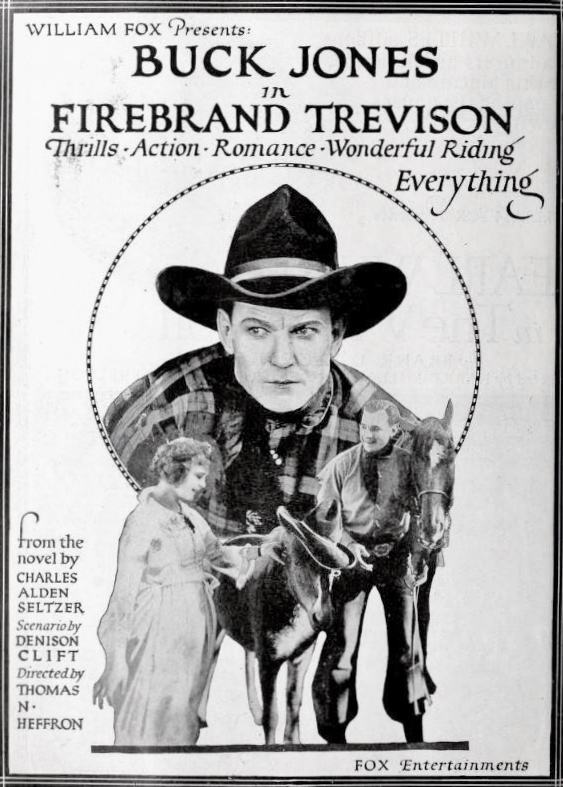
The desert never forgives—an axiom etched into every frame of Firebrand Trevison. Director Denison Clift, working from Charles Alden Seltzer’s pulpy marrow, treats celluloid like sun-baked adobe, sculpting a morality play where land isn’t merely owned but embodied. Buck Jones, granite-jawed and feral, strides through scenes as if he has already become a statue in his own legend. His Firebrand is less a name than a condition: incendiary, unpredictable, yet tethered to an almost biblical sense of covenant with the earth beneath his boots.
Contrasting him is Stanton Heck’s Jefferson Corrigan, a city-bred manipulator whose tailored waistcoat and pomaded hair glisten like crude oil against the dust. Heck plays the part with the languid cruelty of a cat toying with a sparrow, every syllable dipped in arsenic courtesy. Rosalind, essayed by the luminous Winifred Westover, oscillates between porcelain delicacy and flinty resolve; her transformation from corporate emissary to frontier confidante feels less scripted than alchemized by sun-flare and wide-open sky.
Cinematographer Frank B. Good captures the Diamond K as a chiaroscuro expanse—blinding noons that bleach the frame, indigo twilights where secrets breed like coyotes. Intertitles, sparse but venomous, arrive onscreen with the punch of a .45 slug: “A deed is only paper—until blood soaks it.” That line, flashed midway, becomes the film’s Rosetta Stone, hinting that property disputes in the Old West are merely duels by another name.
Martha Mattox, as Rosalind’s fluttery Aunt Agatha, injects gothic comic relief reminiscent of Mrs. Slacker’s matronly hysterics, yet the film never stoops to burlesque. Her fluttering fan and parasol become semaphore flags of encroaching civility, underscoring the movie’s preoccupation with the tension between wilderness and consolidation. Meanwhile, Pat Harnman’s Hester Keys slinks through saloon doorways in jewel-toned gowns that seem looted from a Toulouse-Lautrec canvas; her pseudo-seduction of Trevison is staged before a cracked mirror, doubling faces, fracturing intentions—a visual whisper that duplicity is the only currency in boomtown economies.
The fistfight between Trevison and Corrigan deserves anthologizing. No stunt doubles, no under-cranked camera trickery—just two men hammering each other through corrals, haylofts, and finally a riverbed, their silhouettes haloed by alkaline dust. Clift’s montage alternates wide shots that dwarf the combatants against infinite mesas with claustrophobic close-ups of knuckles splitting, lips blooming crimson. The sequence crescendos when Trevison, half-submerged, rears back and hurls a spadeful of water that catches sunlight like liquid gold—a baptism by violence.
Yet the film’s true sophistication lies in its critique of Manifest Destiny reframed as corporate imperialism. The railroad’s hunger for the Diamond K is never about steel rails; it’s about data, throughput, the first gilded age’s equivalent of bandwidth. In that sense, Firebrand Trevison predates cyberpunk paranoia: whoever controls the arteries controls the narrative. When a crooked judge nullifies Trevison’s title, the courthouse scene plays like Kafka in ten-gallon hats: parchment rustles, gavels bang, and justice becomes another commodity to leverage.
The score, reconstructed for recent restorations, melds banjo arpeggios with eerie theremin whispers, underlining the film’s modernist nerve. Audiences in 1920 expected nickelodeon honky-tonk; what they got—at least in deluxe road-show prints—was an auditory hallucination of frontier futurism. The juxtaposition of cattle lowing with electronic vibrato suggests that technology, like Corrigan’s corruption, is already inside the corral.
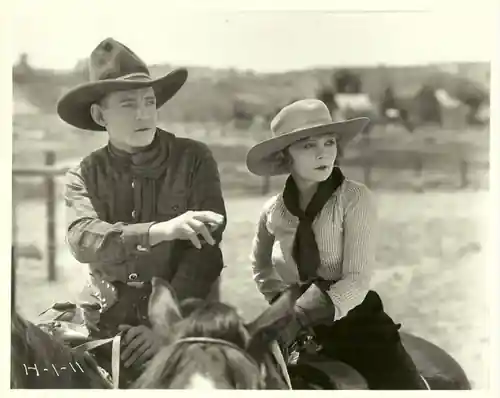
Performances oscillate between grand guignol and naturalistic minimalism. Joe Ray’s weaselly henchman, all Adam’s apple and flop sweat, could have wandered in from The Red Viper’s urban noir alleys, while Katherine Van Buren’s schoolmarm delivers temperance lectures with firebrand zeal, hinting at the suffrage wave poised to crest. These tonal shifts ought to rupture cohesion; instead, they mirror a nation itself straddling Victorian mores and jazz-age acceleration.
Buck Jones, often pigeonholed as a mere saddle stiff, reveals range here. Watch his eyes when Rosalind confesses her father’s complicity: the pupils dilate not with rage but with existential fatigue, as though he’s just realized the entire horizon is portable, buyable, shrinkable to a ledger line. It’s a silent-era equivalent of Brando’s “I coulda been a contender” pathos, delivered sans sound yet deafening.
The climax—a midnight ride to file the true deed before the statute tolls—unfurls under a moon that looks surgically removed from a Maxfield Parrish painting. Trevison’s horse, a piebald monster named Cyclone, thunders across the frame while intertitles hammer like hoofbeats: “Time waits for no man—and justice wears a stopwatch.” Clift crosscuts between the courthouse clock, Rosalind fending off Corrigan’s advances with a derringer, and the rancher leaping ravines, creating a triptych of urgency that prefigures modern action syntax.
Some cineastes dismiss the picture as a routine oater, but place it beside The Girl of the Golden West and you’ll notice how Firebrand Trevison inverts gender vectors: here the woman holds equity, the man guards soil, and both must navigate capital’s quicksand. Compare it to God and the Man’s metaphysical crises, and you’ll find the same query—can integrity survive once paradise has a price tag? Even the courtroom chicanery echoes The Judgment House, though Clift prefers six-guns to sermons.
Restoration-wise, the 4K scan from a French Pathé nitrate reveals pockmarks and cigarette burns, yet each blemish feels like stigmata of exhibition history. The tinting schema—amber for day, cyan for night, rose for interiors—revives the phantasmagoria that soot-era audiences experienced before celluloid became homogenized. Archivists even recovered the original trailer, a feverish montage of intertitles shouting “He fought for his land! He fought for her love! He fought for his NAME!”—huckster poetry that could sell sand in the Sahara.
Faults? A comic interlude involving Fong Hong’s cook character teeters on racial caricature, though the actor subverts stereotype by delivering his lines with ironical relish, as if winking at the audience about the stories white folks tell themselves. Additionally, the coda—Trevison and Rosalind silhouetted against a sunset, ranch secured, wedding bells imminent—feels tacked on by studio decree. One wishes for the existential grimace of The Cycle of Fate, where victory tastes of arsenic. But concessions to box-office optimism were the lingua franca of 1920.
Still, these are quibbles. Firebrand Trevison endures because it understands that the frontier was never a place but a process: of enclosure, of naming, of monetizing. Every cattle brand is a trademark; every horizon, a prospectus. When Trevison slams the deed onto the clerk’s desk just as the clock strikes twelve, he isn’t merely saving acreage—he’s temporarily halting the 20th-century commoditization of existence. That the film lets him succeed provides the same bittersweet rush one gets when rooting for the last bison charging the final locomotive: heroic, quixotic, heartbreakingly human.
In the current age of tech-giant land grabs and pipeline politics, Firebrand Trevison feels less revival than prophecy. Stream it during a blackout, battery laptop aglow, and you’ll sense the same current humming through the Diamond K’s barbed wire: the knowledge that tomorrow will ask for more territory, and someone, somewhere, must decide whether to yield or to fight. Clift’s film argues that the fighting part isn’t optional—it’s the rent we pay for calling any patch of earth, or heart, our own.
IMDb —
1916
Community
Log in to comment.