DbcultAccessing Vault...
Cult Review
Senior Film Conservator
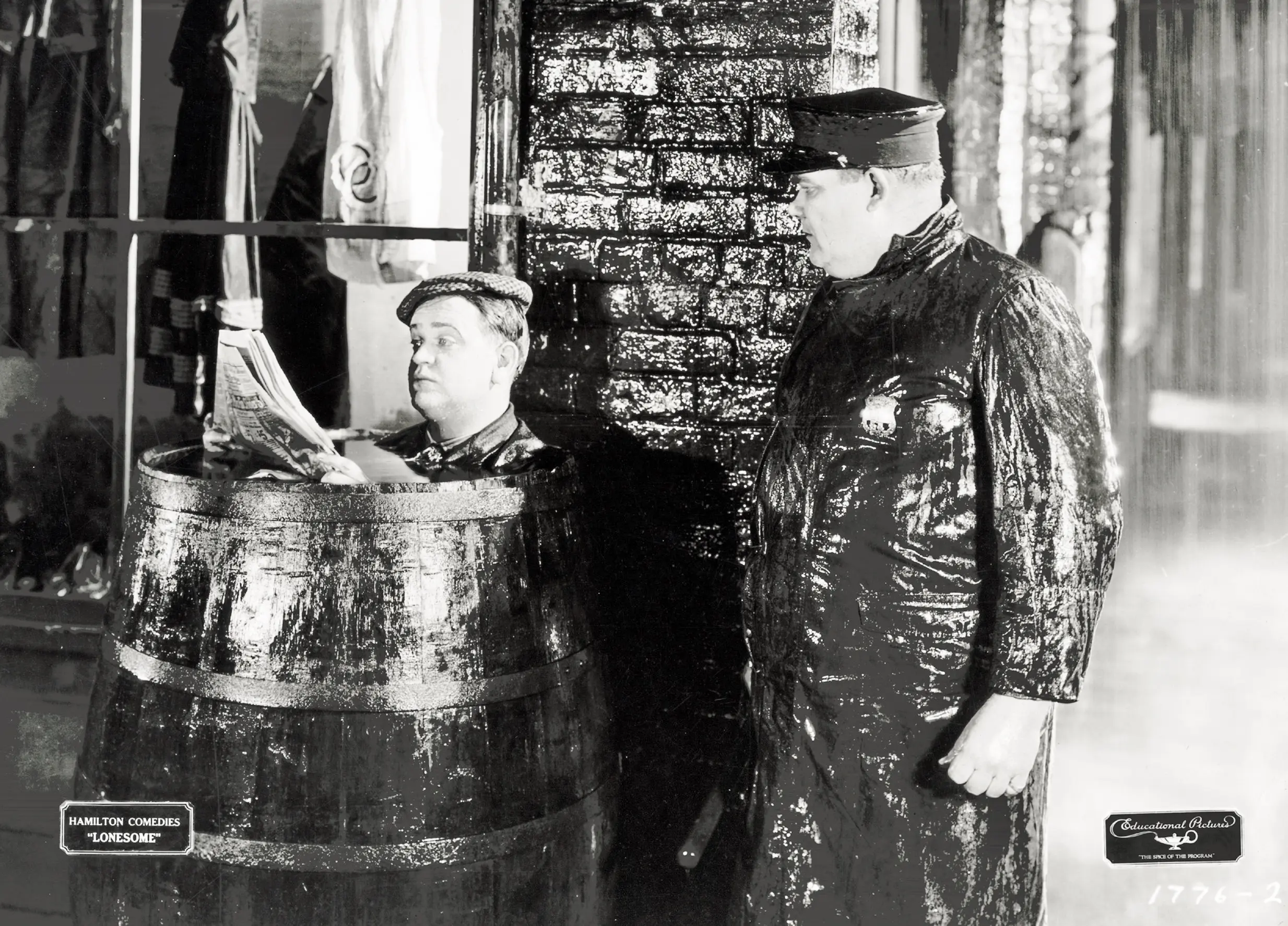
Cinema in 1924 was a landscape of burgeoning visual literacy, yet few performers navigated the delicate precipice between slapstick and existential dread with the finesse of Lloyd Hamilton. In Lonesome (1924), Hamilton crafts a performance that transcends the mere mechanical humor of his contemporaries. While the era was often defined by the kinetic energy of chase sequences, Hamilton’s Lloyd is a figure of static, bewildered dignity. He represents the quintessential 'prodigal son'—not one who returns in shame, but one who is thrust back into the domestic sphere by the sheer, unyielding indifference of the world. The opening premise, describing the world as being 'made of asbestos,' is one of the most evocative metaphors in silent-era storytelling. It suggests a protagonist who is not merely unlucky, but fundamentally mismatched with a reality that refuses to be transformed by his presence.
The narrative pivot involving the 'lead dollar' is a sequence of harrowing comedic brilliance. When Lloyd encounters the affable stranger, the audience is conditioned to expect a moment of genuine human connection—a respite from the protagonist's mounting isolation. Instead, the stranger’s 'generosity' is a calculated cruelty. This scene serves as a biting critique of social mendacity, echoing the darker thematic undertones found in Not Guilty. The subsequent violence of his ejection from the restaurant is not played merely for laughs; it highlights the precarious nature of the individual in an urban environment where economic worth is the only currency of respect. Hamilton’s physical response—a mixture of shock and a lingering, misplaced pride—is a masterclass in character-driven comedy.
The film’s third act shifts from the picaresque to the surreal. The introduction of the 'social crook' provides a mirror to Lloyd’s own desperation. Unlike the protagonist in The Arizona Cat Claw, who might navigate such criminality with a rugged competence, Lloyd is an unwitting accomplice in his own life's unraveling. The sequence where he assists in breaking into his father’s house—under the impression that it has been sold to this stranger—is a masterpiece of dramatic irony. The house, a symbol of safety and heritage, becomes a crime scene. This subversion of the home-coming narrative is far more complex than the straightforward moralism of Polly Ann or the melodrama of Love and Hate.
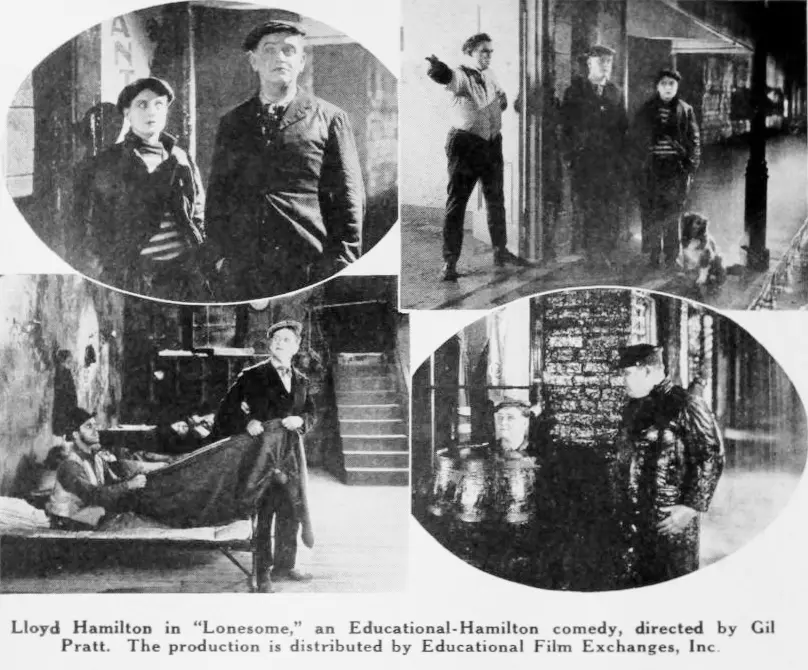
To understand the significance of Lonesome, one must contextualize Hamilton’s 'Lloyd' persona against the backdrop of 1920s cinema. While Racing Hearts leaned into the thrill of modernity, Lonesome is preoccupied with the friction between the individual and the institution. Hamilton does not possess the gymnastic grace of Keaton, nor the sentimental magnetism of Chaplin; instead, he offers a brand of 'eccentric' comedy that feels remarkably modern. His movements are deliberate, his timing punctuated by pauses that allow the absurdity of his situation to marinate. This film, directed with a keen eye for spatial irony, utilizes the lodging house and the family estate as psychological landscapes rather than mere sets.
Consider the visual composition when the safe is finally blown. The explosion is not just a plot device; it is the literal shattering of Lloyd's anonymity. The family's sudden appearance and their subsequent welcome of the 'prodigal' son is handled with a swiftness that borders on the satirical. Is it a happy ending, or is it a condemnation of Lloyd's inability to survive outside the paternal shadow? This ambiguity is what elevates Lonesome above contemporary shorts like Seein' Things, which often relied on more transparent gags.
The cinematography in Lonesome employs a chiaroscuro effect in the lodging house scenes that rivals the atmospheric tension of Through the Dark. The use of shadows to frame Lloyd’s destitution creates a sense of claustrophobia that contrasts sharply with the open, albeit 'asbestos,' world of the film’s beginning. Ruth Hiatt’s presence, though secondary to Hamilton’s central arc, provides a necessary grounding. Her performance style, much like the subtle work seen in Sauce for the Goose, avoids the histrionics common in the early 20s, opting instead for a more naturalistic interplay with Hamilton’s stylized movements.
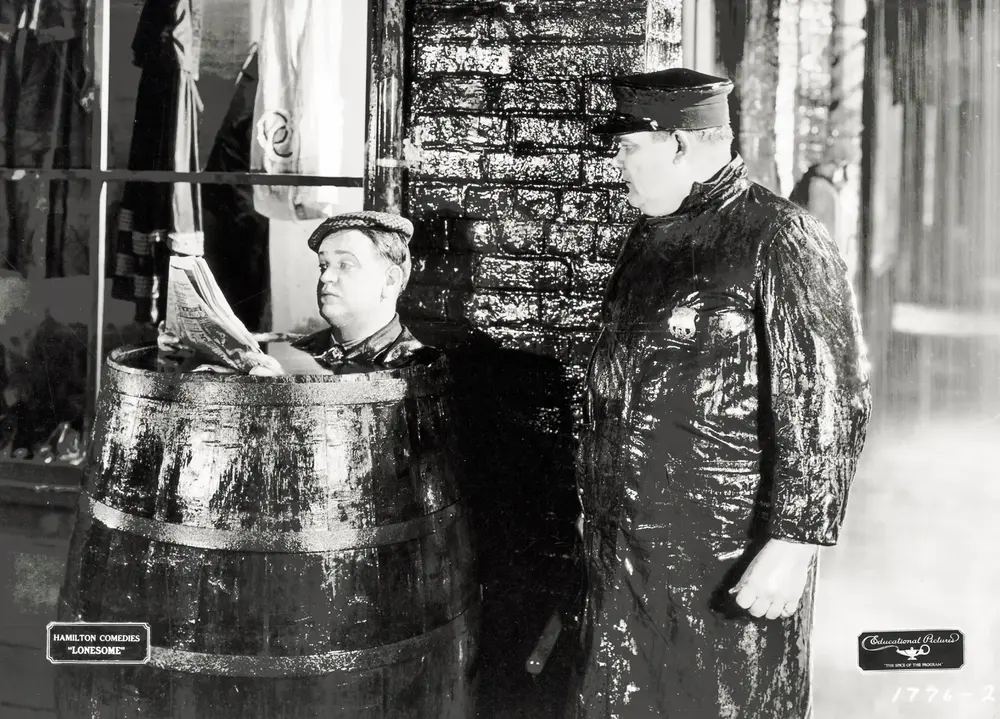
In comparing Lonesome to other works of the period, such as the mystery-laden Mortmain or the aquatic spectacle of Wonders of the Sea, we see a film that is stubbornly human-centric. It does not rely on exotic locales or supernatural twists (as seen in Ipnosi). Instead, it finds the 'wonderful' and the 'terrible' in the mundane act of trying to pay for a meal or enter a room. The film’s pacing is impeccable, building from the slow-burn misery of the street to the explosive chaos of the finale.
The character of Lloyd is a cousin to the lost souls in Outcast (1922), yet he is imbued with a resilience that is uniquely comedic. He is the man who expects the worst and is still somehow disappointed when it arrives. This 'sad-clown' archetype is refined here to a razor's edge. The writing, credited to a team that understood the nuances of Hamilton's 'Lonesome' persona, ensures that every beat of misfortune feels earned. It avoids the sentimentality of Girl of the Sea, opting instead for a gritty, urban realism that was ahead of its time.
Ultimately, Lonesome is a film about the failure of fire. Lloyd wants to burn bright, to make a name for himself, to 'set the world on fire.' But the world is fireproof. This realization could lead to tragedy, but in the hands of Hamilton, it leads to a profound kind of comedic grace. The resolution—the accidental burglary leading to a family reunion—is a stroke of narrative genius that highlights the absurdity of fate. It suggests that we are all, in some way, breaking into our own lives, trying to find a key that we never truly lost.
For those who appreciate the structural integrity of silent comedy, Lonesome is an essential text. It stands alongside The Crimson Gardenia and Keith of the Border as a testament to the versatility of the medium. It proves that a simple story of a boy, a dollar, and a safe can encompass the entirety of the human condition: our pride, our folly, and our desperate, often hilarious, need to go home.
Verdict: A quintessential example of 1920s high-concept comedy that remains as resonant and biting today as it was a century ago. Lloyd Hamilton’s genius is on full display, proving that even in an asbestos world, some performances still manage to catch fire.
IMDb 6.5
1934
Community
Log in to comment.