DbcultAccessing Vault...
4.7/10
Senior Film Conservator
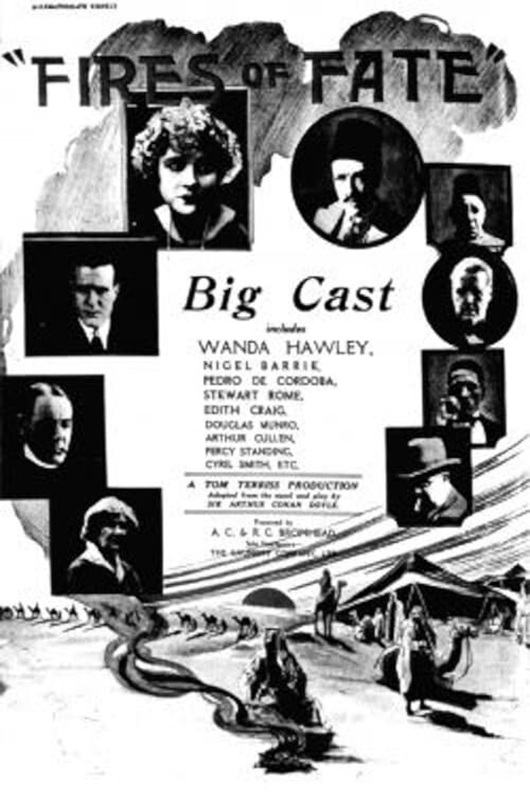
A definitive 4.7/10 rating for a film that redefined the boundaries of cult cinema. Fires of Fate remains a cornerstone of transgressive art.
The year 1923 was a watershed moment for the global fascination with Egyptology, fueled by the previous year's discovery of Tutankhamun's tomb. It is within this feverish cultural milieu that Tom Terriss delivered Fires of Fate, a silent spectacle that attempts to bridge the gap between existential drama and high-stakes adventure. While many contemporary films of the era, such as The Princess of India, leaned heavily into the fantastical elements of the Orient, Terriss’s work—rooted in the prose of Sir Arthur Conan Doyle—maintains a surprisingly grounded, if melodramatic, focus on the frailty of the human condition when stripped of societal comforts.
At the heart of this narrative is Colonel Egerton, portrayed with a haunting, crag-faced intensity by Percy Standing. Unlike the swashbuckling heroes of the early twenties who sought danger for glory, Egerton is a man retreating from a life that has already declared him obsolete. Diagnosed with a terminal illness and given a mere twelve months to live, his journey to Egypt is less a vacation and more a funeral procession in slow motion. This psychological weight elevates the film above the standard fare of the time, such as The Heights of Hazard, which prioritized kinetic thrills over character interiority.
Standing’s performance is a masterclass in silent-era restraint. He avoids the hyperbolic gesticulation common in the period, instead opting for a weary stillness that suggests a man already halfway to the grave. When he encounters the young heroine, played by the ethereal Wanda Hawley, the flicker of life that returns to his eyes is not merely romantic—it is a desperate, final rebellion against the inevitability of his own demise. This thematic depth mirrors the emotional resonance found in Pieces of Silver: A Story of Hearts and Souls, where the internal landscape of the characters dictates the external action.
The cinematography in Fires of Fate is nothing short of revolutionary for 1923. Terriss took his crew to actual Egyptian locations, a feat that lends the film an authenticity that studio-bound productions like A Modern Salome could never replicate. The vast, undulating dunes of the Sahara are not merely a backdrop; they are a character in their own right—indifferent, beautiful, and lethal. The way the light play across the sand creates a chiaroscuro effect that underscores the film’s central conflict between the light of civilization and the dark, untamed forces of the desert.
The sequence involving the Arab prince, played with a menacing charisma by Pedro de Cordoba, showcases Terriss’s ability to handle large-scale choreography. The rescue mission is a frantic, dust-choked affair that feels visceral even a century later. It lacks the whimsical levity of A One Cylinder Love Riot, opting instead for a gritty realism that aligns more closely with the survivalist themes of The Hoosier Schoolmaster.
Arthur Conan Doyle’s source material, "The Tragedy of the Korosko," provides a sturdy skeletal structure for the screenplay. While Doyle is synonymous with Sherlock Holmes, his adventure stories often delved into the friction between British colonial identity and the perceived 'other.' In Fires of Fate, this friction is palpable. The film explores the concept of the 'white man’s burden' through a lens that, while dated, offers a fascinating glimpse into the post-WWI British psyche. The Colonel’s drive to save the girl is a reclamation of his role as a protector, a theme also explored in Forgiven; or, the Jack of Diamonds, though here the stakes are cosmic rather than merely social.
The writing team, including Alice Ramsey and Lewis Waller, successfully translated Doyle’s prose into a visual language that emphasizes the irony of a dying man fighting for the life of another. This existential irony is far more sophisticated than the straightforward moralizing found in Poor Innocent or the domestic simplicity of Bobby's Baby.
Wanda Hawley’s portrayal of the endangered girl avoids the pitfalls of the 'helpless damsel' trope seen in Wanted, a Girl!. There is a resilience in her performance, a quiet strength that suggests she is a woman of her time—the 1920s 'new woman'—caught in an archaic nightmare. Her chemistry with Standing is built on a foundation of mutual desperation, making their eventual bond feel earned rather than manufactured by the plot. This stands in contrast to the more theatrical romances of Paganini, where the emotion often feels like a performance of a performance.
The supporting cast, featuring Nigel Barrie and Edith Craig, provides a necessary social anchor for the film. They represent the world that Egerton is leaving behind—a world of tea, protocols, and rigid class structures. Their presence in the desert emphasizes the absurdity of colonial life when confronted by the raw, primal energy of the Saharan landscape. This thematic clash is a hallmark of the era's better cinema, reminiscent of the cultural tensions in The Way of a Woman.
Tom Terriss utilizes a series of inventive camera angles and editing techniques that were ahead of their time. The use of close-ups to convey Egerton’s internal agony provides a psychological depth that was often lacking in early silent cinema. The pacing is deliberate, allowing the dread of the Colonel’s diagnosis to seep into the very fabric of the desert adventure. Unlike the rapid-fire action of Outwitted, Fires of Fate understands the power of the pause—the silence between the heartbeats of a dying man.
The film’s climax, a masterfully staged confrontation that pits the Colonel's tactical brilliance against the Prince's overwhelming force, is a testament to the era's technical ingenuity. The integration of location shots with studio close-ups is seamless, creating a sense of place that is both expansive and claustrophobic. It evokes the same sense of inescapable destiny found in Lilith and Ly, though through a lens of realism rather than the supernatural.
Ultimately, Fires of Fate is a film about the reclamation of agency. Egerton begins the film as a victim of biology, a man whose fate is written in a doctor’s ledger. By the end, he has rewritten that fate through action. He chooses how he will spend his remaining time, and in doing so, he defeats the nihilism that threatened to consume him. This arc is far more profound than the transactional redemptions often found in silent dramas like The Captive.
The film serves as a vital artifact of British cinema, showcasing the industry's ability to produce epics that rivaled Hollywood’s output in scale and surpassed it in thematic complexity. Terriss’s direction, combined with the gravitas of Standing and the evocative Egyptian setting, creates a cinematic experience that remains hauntingly relevant. It is a reminder that even when the fires of life are flickering out, the heat they generate can still change the course of history—or at least, the course of a single, precious life.
In the grand tapestry of 1920s film, Fires of Fate stands as a singular achievement. It is a work that demands to be viewed not just as a historical curiosity, but as a living, breathing piece of art that speaks to the universal human desire to find meaning in the face of the end. It is a film that, like the dunes it depicts, is constantly shifting, revealing new layers of meaning with every viewing.
IMDb —
1924
Community
Log in to comment.