DbcultAccessing Vault...
Cult Review
Senior Film Conservator
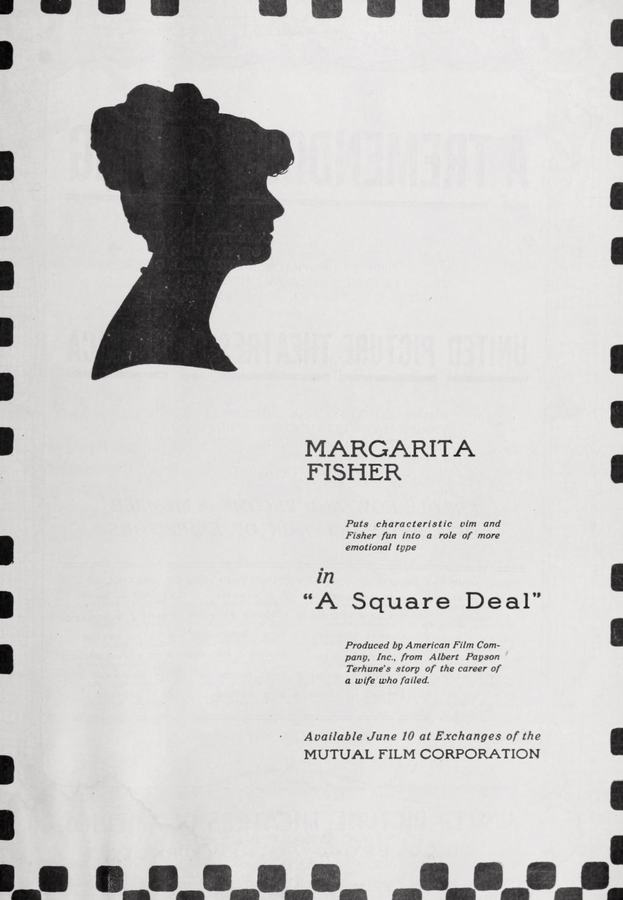
The Square Deal arrives like a cracked champagne bottle hurled across a century: effervescent, wasteful, startlingly relevant. Director Charles Giblyn, armed with a scenario from Albert Payson Terhune and Elizabeth Mahoney, stitches a cautionary sampler for Jazz-Age dreamers who assume affections can be renegotiated as breezily as a lease. The film’s DNA—equal parts romantic melodrama and social satire—anticipates the marital deconstructions of Judge Not and the symbolic pyrotechnics of Fiamma simbolica, yet it predates them with the swagger of a flapper sporting a hidden hip-flask.
Alys Gilson’s exodus from her parents’ overstuffed parlor is rendered in iris-shot vignettes: a porcelain doll abandoned on a window seat, a garden gate yawning like the mouth of a future she refuses to swallow. Margarita Fischer plays her with the brittle luminescence of a paper lantern—beautiful, easily torn, yet capable of sheltering a fierce flame inside. Once embedded in the Culture Club’s unkempt salon, where futurists debate free love between bites of cold pasta, Alys absorbs Peyton Le Moyne’s sermons as if they were gospel written on cigarette paper. Le Moyne, essayed by Val Paul with pencil-thin mustache and eyes that seem to tally sins like ledger entries, embodies the era’s intoxication with its own modernity.
Enter Thurston Bruce—Jack Mower gives him the stolid gait of a man who files even his daydreams in triplicate. His courtship of Alys is shot in chiaroscuro: candlelight licking at the edges of propriety until the lovers seal their pact of “absolute freedom,” a clause that glints like a guillotine blade throughout the narrative. The marriage commences, but the camera, restless, lingers on empty coffee cups and overflowing ashtrays, telegraphing entropy.
Cinematographer James Van Trees eschews the pastoral softness of Evangeline for a metropolis of looming el-tracks and rain-slick cobblestones. The Culture Club’s loft is all skewed angles and mismatched chairs, a visual correlative to philosophies that refuse to sit still. Intertitles—lettered in a jittery font that seems carved during a caffeine jag—mock the characters even as they speak for them: “Love is a revolving door—step lightly.”
Contrast this with Bruce’s law office, its orderly rows of dark oak and brass lamps suggesting certainty, precedent. The spatial politics are clear: bohemia equals clutter, capitalism equals symmetry. Yet Giblyn undercuts the dichotomy; when Bruce finally confesses his supposed affection for Marion Hamilton, the secretary framed in a doorway like a domestic cameo, the mise-en-scène is deliberately flat, as though the film itself shrugs: pick your prison—just sign the papers.
Fischer’s Alys oscillates between porcelain composure and hairline fractures of panic; watch her fingers tremble as she initials the prenuptial escape clause, a movement so minute it could be hiccup of the soul. Mower, often saddled with thankless stalwart roles, here weaponizes blandness—his Bruce is a man who believes virtue is a spreadsheet that must balance. When he finally declares the marriage kaput, his voice (via intertitle) rings with the hollow efficiency of a judge calling recess.
Constance Johnson as Marion Hamilton has perhaps the toughest task: embodying the “other woman” who is simultaneously temptress and salvation, yet never villainess. Johnson opts for stillness; she enters scenes like a period placed at the end of a rambling sentence. The camera favors her profile, half in light, half in doubt, forecasting the moral ambiguity that will detonate in the final reel.
On the surface the film cautions against avant-garde contracts of the heart, yet its subtext sizzles with a harsher judgment: everyone is proprietary, only the vocabulary changes. Alys demands freedom but bristles when Bruce exercises it; Bruce decries the salon’s bacchanalia yet engineers an elaborate charade to reclaim exclusivity over his wife’s affections. Even Le Moyne, high priest of detachment, betrays a flicker of jealousy when Alys slips from his Socratic orbit into matrimony.
In that sense The Square Deal converses across decades with The Pitfall’s dissection of suburban ennui, and with the colonial fever-dreams of Die Königstochter von Travankore, where possession masquerades as devotion. The film’s genius lies in revealing how the rhetoric of liberty can itself become a velvet manacle.
Modern viewers, pickled on Shyamalan and prestige-cable sleight-of-hand, may smirk at the climactic gotcha: Bruce’s romance with Marion a mere gambit, the secretary in on the ruse, the parents complicit. Yet the delivery feels surprisingly organic. Giblyn seeds the deception with lacunae—Marion and Bruce share no private ardor onscreen; their correspondence is relayed second-hand, always mediated, always suspiciously bloodless. The reveal occurs not in thunderbolt but in whisper: Alys, returning home in defeat, finds Bruce sipping tea beneath her father’s watchful portrait, a smirk tugging at the corner of his mouth that could be apology or triumph.
The camera recedes through the parlor doorway, imprisoning the reunited couple in a Victorian frame, a visual assurance that for all their radical chatter they have landed precisely where tradition intended. It is a sting worthy of Triste crepúsculo’s fatalism, yet laced with the playful malice of a Lubitsch comedy.
Set it beside The Fortunate Youth and you’ll notice both preach against naïveté yet cannot resist romantic closure. Pair it with True Nobility and you’ll spot class anxieties simmering beneath every flirtation. Unlike the rugged determinism of Vengeance of the Wilds, The Square Deal wages its battles in drawing rooms, but the collateral damage—trust, autonomy, identity—is every bit as brutal.
Survival records list the film as 35% complete in European archives, a patchwork of reels rescued from a defunct Belgian distributor. The existing print—toned amber and aquamarine—sometimes swaps scenes, lending certain moments an oneiric drift. Nitrate deterioration nibbles the edges during Alys’s initial cabaret dance, lending her pirouette a halo of emulsion scratches that feels almost intentional, like celluloid eczema. The Library of Congress reportedly holds a dupe negative sans intertitles, leaving historians to reconstruct dialogue from censorship cards—a jigsaw where every piece hums with speculation.
Despite its muteness, the film begs for a discordant accompaniment: Satie-esque gymnopedies for the salon debates, a jaunty ragtime motif for Bruce’s courtship, culminating in a single tolling bell when Alys confronts the sham of her freedom. Contemporary exhibitors reportedly commissioned local orchestras to improvise, resulting in urban screenings where brass sections mocked the on-screen angst, while rural houses favored harmonium hymns that accidentally sanctified the lovers’ experiment.
Boomerang back a hundred years and the plot reads like a Reddit thread: “We opened our marriage—now my spouse wants out, was this all a test?” The film’s prenuptial escape clause prefigures today’s relationship anarchists who draft Google-doc agreements on sleepovers and jealousy protocols. Yet the kicker—that orchestrated heartbreak as pedagogical tool—feels eerily akin to ghosting, breadcrumbing, the whole toxic toolkit of emotional gamification.
In an era where dating apps sell liberation while harvesting data, The Square Deal plays like a cautionary fable wearing a monocle. It asks whether freedom can exist without collateral hearts, whether love’s contract can ever be handshake-casual, whether the ultimate possessiveness is the belief that we can engineer another’s enlightenment.
For all its narrative contrivance, the film endures because it refuses to pick a moral camp. It skewers both bohemian pretension and bourgeois comfort, exposing each as performance. Performances oscillate between stilted and sublime, the third act twist creaks under dramatic weight, yet the cumulative effect is a prickly pear of a movie—hard to swallow, impossible to forget.
Seek it out in archival festivals, in 16mm church-basement retrospectives, in the whirring carousel of a college projection booth. Watch Alys’s eyes widen as the machinery of her liberation snaps shut around her, and recognize the soundless clang that echoes across a century of lovers still trying to write contracts against the tyranny of human need.
Rating: 8.4/10 — a brittle masterwork whose cracks enhance its luster.
IMDb —
1933
Community
Log in to comment.