DbcultAccessing Vault...
6.3/10
Senior Film Conservator
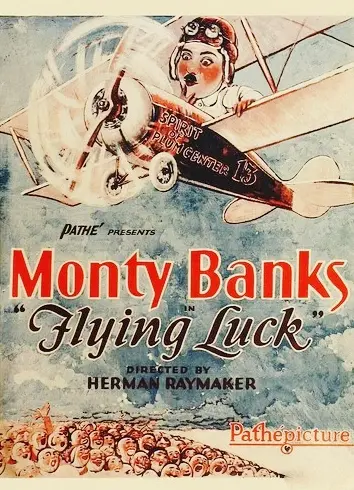
A definitive 6.3/10 rating for a film that redefined the boundaries of cult cinema. Flying Luck remains a cornerstone of transgressive art.
Short answer: Is Flying Luck worth watching today? Yes, but only if you approach it as a fascinating cultural artifact rather than a comedic powerhouse on par with Buster Keaton.
This film is for the silent cinema completionist, the aviation historian, and fans of Jean Arthur who want to see her before she became the definitive voice of the 1930s screwball era. It is not for the casual viewer who expects the high-octane pacing of modern comedy or the existential depth of the era's more celebrated masterpieces.
1) This film works because Monty Banks possesses a frantic, blue-collar energy that makes his desperate attempts to fly feel genuinely earnest rather than purely slapstick.
2) This film fails because it retreats into safe, repetitive military training tropes for the middle act, losing the unique momentum of its aviation premise.
3) You should watch it if you want to witness the specific 1927 'Lindbergh craze' manifested in celluloid, or if you enjoy seeing how silent comedians handled the transition into feature-length storytelling.
Released just months after Charles Lindbergh’s transatlantic flight, Flying Luck is the cinematic equivalent of a 'trending topic.' Monty Banks, an Italian-born comedian who never quite reached the heights of the 'Big Three' (Chaplin, Lloyd, Keaton), was nevertheless a master of the 'thrill comedy.' In this, his final silent feature, he attempts to blend his signature physical desperation with the national obsession with flight.
The opening sequence, where Banks builds his own plane, is a masterclass in the 'tinkerer' trope. Unlike the polished machines seen in Mile-a-Minute Romeo, Banks’ contraption is a rickety death trap. The physical comedy here is sharp, specifically the moment the wings collapse with a timing that feels almost musical. It works. But it’s flawed.
The shift to the Army base feels like a concession to the genre standards of the time. We’ve seen the 'misfit in the military' story a thousand times, from Laurel and Hardy to Abbott and Costello. However, Banks brings a unique 'sweaty' quality to the role. He isn't as stoic as Keaton or as charmingly optimistic as Lloyd; he looks like a man who is constantly one mistake away from a nervous breakdown. This makes the drill sergeant sequences, featuring the hulking Kewpie Morgan, feel slightly more high-stakes than your average slapstick routine.
One of the primary reasons to seek out Flying Luck in the 21st century is the presence of a young Jean Arthur. Long before she was the definitive leading lady in The Woman in Politics or Capra’s favorites, she was a silent starlet finding her footing. Even without her trademark husky voice, her screen presence is undeniable. She possesses a naturalism that many silent actresses lacked, avoiding the overly theatrical gestures common in the 1920s.
In the scene where she first encounters Banks—who is, of course, pretending to be someone he isn't—her reaction shots are the highlight of the frame. She isn't just a 'prize' to be won at the end of the movie; she feels like a character with her own internal life, even if the script doesn't give her much to do beyond looking concerned or charmed. Her chemistry with Banks is surprisingly grounded, providing a necessary anchor for the film’s more absurd flights of fancy.
Watching this film today is a vastly different experience thanks to the rare 35mm nitrate print transfer. The visual clarity is staggering for a film that was nearly lost to time. The textures of the canvas-covered biplanes and the dust of the military parade grounds are palpable. This isn't the grainy, sped-up footage often associated with silent film; it is a crisp, intentional piece of cinematography.
The aerial photography deserves special mention. While it may not have the sheer scale of 'Wings' (released the same year), the 'Air Polo' match at the climax is a technical marvel. The camera placement on the planes provides a sense of vertigo that still holds up. When Banks’ character is dangling from the cockpit, you can feel the genuine wind resistance. It’s a reminder that before CGI, 'thrill comedy' required a level of physical bravery that we rarely see in modern cinema.
If you are looking for a laugh-a-minute experience, you might find the middle section of Flying Luck a bit of a slog. The mistaken identity plot involving a French dignitary is a tired trope that adds length without adding much value. However, if you are a student of film history, the answer is a resounding yes.
The film captures the transition of the comedy genre as it moved away from short-form gags toward more complex, albeit formulaic, feature-length narratives. It also serves as a perfect companion piece to other era-specific films like The Rag Man or Oh, Johnny!, showcasing the breadth of independent comedy production in the late 1920s.
"Flying Luck is a frantic, often beautiful relic that proves Monty Banks was more than just a footnote in the history of slapstick."
Here is a surprising thought: Flying Luck is actually a better 'military' movie than it is an 'aviation' movie. While the flying is the hook, the film’s most successful moments come from the claustrophobia of the barracks. Banks excels when he is trapped. His comedy is built on the friction between a man who wants to be a hero and a world that treats him like a nuisance. In many ways, this film is a precursor to the 'little man' comedies that would dominate the Great Depression era.
Furthermore, the score by Ben Model is essential. In silent film, the music is 50% of the performance, and Model’s work here provides a rhythmic backbone that helps smooth over the narrative lulls. Without this specific score, the film's flaws would be much more apparent.
Flying Luck is a fascinating piece of the silent era puzzle. It doesn't redefine the genre, nor does it offer the timeless genius of 'The General' or 'The Kid.' What it does offer is a vibrant, high-energy snapshot of 1927—a year when the world was looking up at the sky with wonder. Monty Banks might not have been the greatest pilot or the greatest comedian, but in this film, he managed to capture the spirit of an age. It’s a flight worth taking, even if the landing is a little bumpy. It works. But it’s flawed. And that’s exactly why it’s worth your time.

IMDb 5.3
1934
Community
Log in to comment.