DbcultAccessing Vault...
Cult Review
Senior Film Conservator
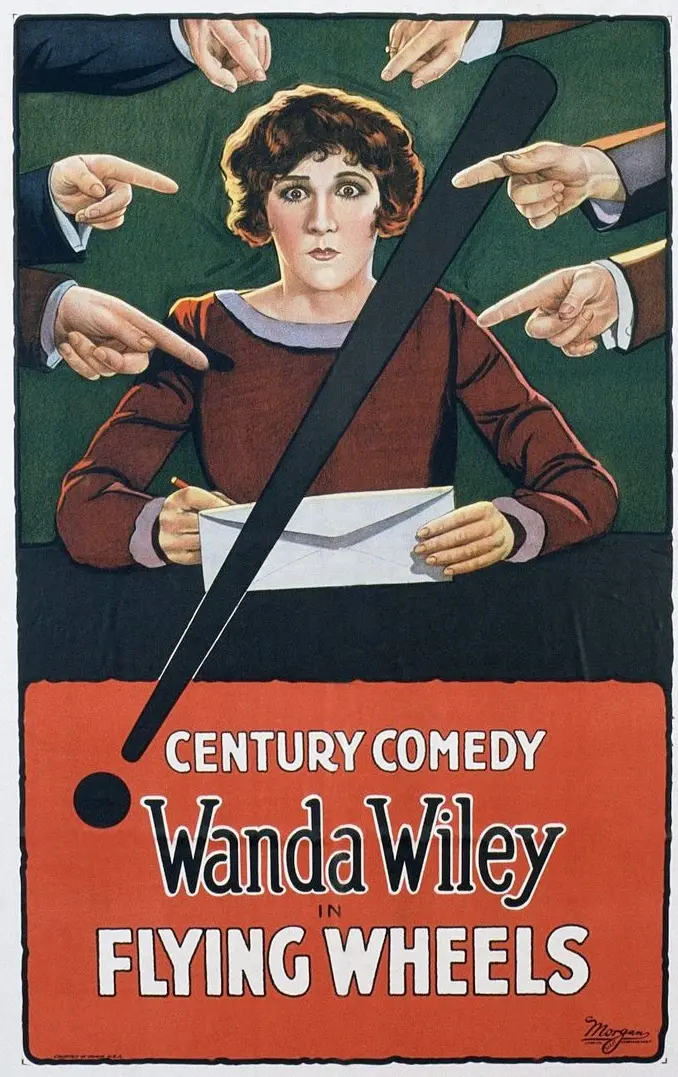
Short answer: Yes, but only if you appreciate the raw, dangerous energy of 1920s stunt work. Flying Wheels is a relic that breathes through its lead actress's willingness to risk her neck for a gag. It is a film for silent comedy purists and automotive historians. It is emphatically not for those who require a complex narrative or high-fidelity production values.
This film works because Wanda Wiley possesses a kinetic charisma that rivals the better-known stars of her era. This film fails because the supporting cast is largely forgettable, serving as mere cardboard cutouts for Wiley to navigate around. You should watch it if you want to see the missing link between circus acrobatics and modern action cinema.
Wanda Wiley was often marketed as the female answer to Buster Keaton, and in Flying Wheels, the comparison is earned. She doesn't just drive the car; she wrestles it. There is a specific moment during the second act where the 'tiny auto' takes a corner on two wheels, and Wiley’s body language remains perfectly calibrated for comedy while her eyes signal a very real awareness of the danger. It’s a gutsy performance.
Unlike the more theatrical performances found in The Forbidden City, Wiley’s work is grounded in the immediate physical reality of her environment. She treats the vehicle as an extension of her own limbs. When she navigates the race track, every bump and jolt is registered in her frame, making the tiny car feel like a living, breathing underdog. It is a masterclass in silent-era physical presence.
Before Edward Ludwig became a seasoned director of features, he was honing his craft in short-form comedies like this one. His direction here is surprisingly modern in its use of camera placement. He avoids the static, stage-like setups common in earlier works like The Life of Moses. Instead, Ludwig places the camera low to the ground to emphasize the speed of the tiny car, making 20 miles per hour look like a breakneck sprint.
The pacing is relentless. Once the race begins, the film sheds any pretense of being a family drama and becomes a pure action-comedy. Ludwig understands that the audience isn't here for the father's reputation; they are here to see a small machine defy the odds. The editing rhythm is snappier than what we see in Nip o' Scotch, favoring quick cuts that mirror the frantic spinning of the car’s wheels.
Yes. Flying Wheels is a compact explosion of energy. While it lacks the emotional depth of something like The Rise of Susan, it compensates with a sheer sense of fun. It is a testament to an era where the stakes of filmmaking were measured in broken axles and bruised shins. It is short, punchy, and visually inventive.
However, if you are looking for a film with a nuanced plot, look elsewhere. The story is a thin clothesline upon which Wiley hangs her stunts. The father’s 'reputation' is barely defined, and the stakes feel artificial until the engine starts. But once that car is in motion, none of that matters. The film achieves its singular goal: it moves.
The use of the 'tiny auto' is a stroke of comedic genius. In the 1920s, the car was a symbol of status and power. By placing a woman in a miniature vehicle, the film subverts the hyper-masculine culture of early racing. It’s a visual joke that doubles as a thematic statement. The car is an underdog, much like Wiley’s character in a male-dominated industry.
Compare this to the more traditional western tropes in Born to the West. While the western relies on the power of the horse and the ruggedness of the landscape, Flying Wheels relies on the absurdity of the machine. There is a sequence where the car gets stuck between two larger vehicles that is choreographed with the precision of a ballet. It’s a sequence that wouldn’t feel out of place in a modern Pixar film.
Pros:
The race sequences are genuinely thrilling, even by modern standards. Wanda Wiley’s performance is a revelation for those unfamiliar with her work. The film’s short runtime ensures it never overstays its welcome. It provides a fascinating glimpse into 1920s car culture.
Cons:
The character development is non-existent. The supporting cast, including Joe Barnes and Alfred Hewston, are given nothing to do. The resolution of the father’s reputation feels unearned and rushed. Some of the humor is dated and relies on broad stereotypes of the era.
The cinematography by the uncredited camera team is surprisingly robust. They utilize tracking shots that were quite difficult to execute with the heavy equipment of 1926. Unlike the more static framing in The Knockout (1925), Flying Wheels feels like it is constantly in transition. The use of natural light during the outdoor race scenes gives the film a gritty, documentary-like texture that contrasts with the staged feel of the indoor scenes.
The film’s tone is a curious mix of earnestness and absurdity. At one moment, we are meant to care about the father's business failure; the next, we are watching a car bounce off a fence like a rubber ball. This tonal whiplash is common in Century Comedies, but Ludwig manages to keep the ship upright through sheer momentum. It works. But it’s flawed.
Flying Wheels is a loud, proud, and fast piece of silent cinema. It doesn't ask for your intellectual engagement; it asks for your adrenaline. Wanda Wiley is the undisputed engine of this production, and her performance alone justifies a viewing. While it may not have the historical weight of The Miracle Makers or the poetic resonance of Songs of Central Europe, it has something those films often lack: a sense of pure, unadulterated speed. If you have twenty minutes to spare, let Wiley take the wheel. You won't regret the ride, even if you forget the destination five minutes after the credits roll.
IMDb 6.6
1927
Community
Log in to comment.