DbcultAccessing Vault...
Cult Review
Senior Film Conservator

Somewhere between Stockholm’s cobblestones and Wyoming’s horizonless grass, Fred Myton’s Follow the Girl stitches a fable that feels less like dated propaganda and more like a restless fever dream about what it means to belong. The film, shot on the cheap in late-1918 Chicago winters and patched together with second-unit cattle-drive footage from Kansas, shouldn’t work—yet its very seams exhale the immigrant anxiety of an era when papers determined breath, and skirts could carry revolutions.
The plot, a Rube Goldberg contraption of espionage and pastoral courtship, launches with a visual ellipsis: Hilda’s prayer, whispered into the frost of an orphanage window, becomes superimposed over a stock-footage Atlantic squall. Myton, a scenarist who cut his teeth on German-underwater melodramas, refuses us the comfort of exposition; instead he trusts the audience to intuit that every ocean voyage is also a rebirth, every port a possible betrayal.
Donna’s decision to hide documents inside Hilda’s hem is the film’s hinge, and Myton photographs it like a liturgical rite: close-up of needle piercing cotton, the metallic clink of thimble against smuggled cylinder, a bead of sweat sliding off Donna’s mascaraed lashes onto the fabric—an unholy baptism. Unlike Hitchcock’s later cheeky briefcases, this MacGuffin is literally sewn to the protagonist, turning every step into a potential detonation. When Hilda twirls at the ship’s ceilidh, the skirt billows; we gasp, half-expecting blueprints to flutter out like Pentecostal tongues of fire.
Myton’s genius lies in letting the contraband vanish midpoint. Once the papers migrate to O’Keefe’s saddlebag, the narrative tension doesn’t deflate; rather, it metastasizes into questions of trust and erotic debt. Will the rancher rifle through the gift? Will Hilda confess her unwitting smuggling? The film answers with a laconic cut: sunrise over branding irons, the couple sharing coffee, silence thicker than prairie dust. In that muteness, Follow the Girl anticipates the moral ambiguities of post-war noirs, where innocence is less a virtue than a commodity to barter.
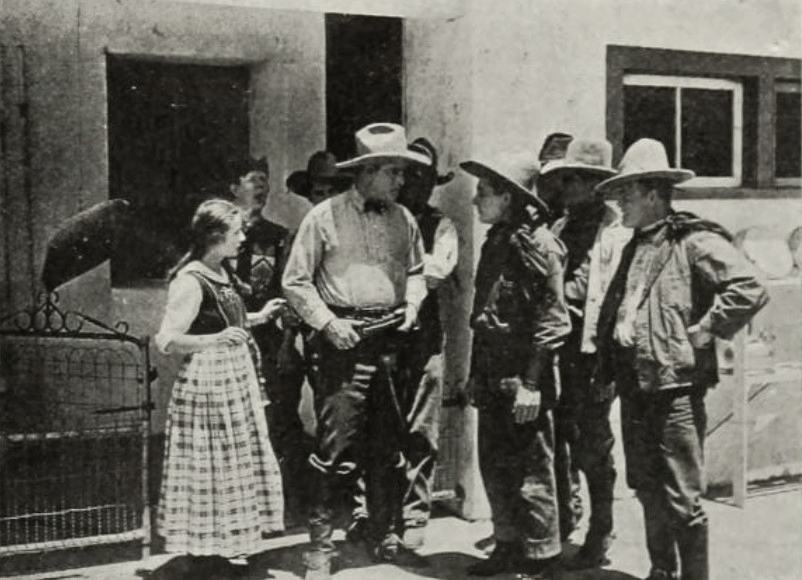
Seventeen-year-old Mattie Witting, a contract player at Essanay one month away from maternity leave, plays Hilda with a tremulous interiority that belies the film’s pot-boiler shell. Watch her in the cattle-car sequence: pressed against a splintered wall, she hears Martinez’s spurs clank outside. Myton holds a medium shot; Witting doesn’t flinch, but her pupils dilate like black suns, swallowing the frame. The moment is silent yet deafening—an invocation of every refugee who has ever willed invisibility.
Roy Stewart’s Olaf, all elbows and earnestness, could have slid into juvenile sidekick cliché. Instead he plays the boy as someone who understands that migration is a male privilege and therefore courts guilt. In a stolen two-shot at Dodge City’s telegraph office, Olaf buys Hilda a licorice rope; as she chews, he studies her mouth with a hunger that is half erotic, half penitential. It’s the first time American cinema lets a male immigrant gaze upon a female counterpart not as conquest but as conscience.
Ruth Stonehouse’s Donna deserves anthologies. Clad in sable collarettes and acid wit, she channels Theda Bara’s seductive menace through a post-revolutionary lens: her spy is ideology in lipstick, weary yet combustible. When she finally confronts Hilda in the ranch’s moonlit hayloft, Myton swaps intertitles for a rare close-up. Donna’s whispered “I was never your enemy, child—I was merely earlier to the pain” feels subversively compassionate, a nod to sororal solidarity across battlefronts.
Cinematographer Jackson Rose, fresh from shooting slapstick two-reelers, here adopts a chiaroscuro that would make German directors blush. Interior scenes—orphanage dormitory, ship’s steerage—are painted in low-key pools: lanterns hang like interrogation lamps, faces half-submerged in umbrous eclipse. Once the story hits the plains, Rose switches to high-contrast daylight, whites so blistering they brand the retina, shadows so sharp they could slice barbed wire. The result is a visual dialectic: Europe’s claustrophobic guilt versus America’s blinding promise, both equally lethal.
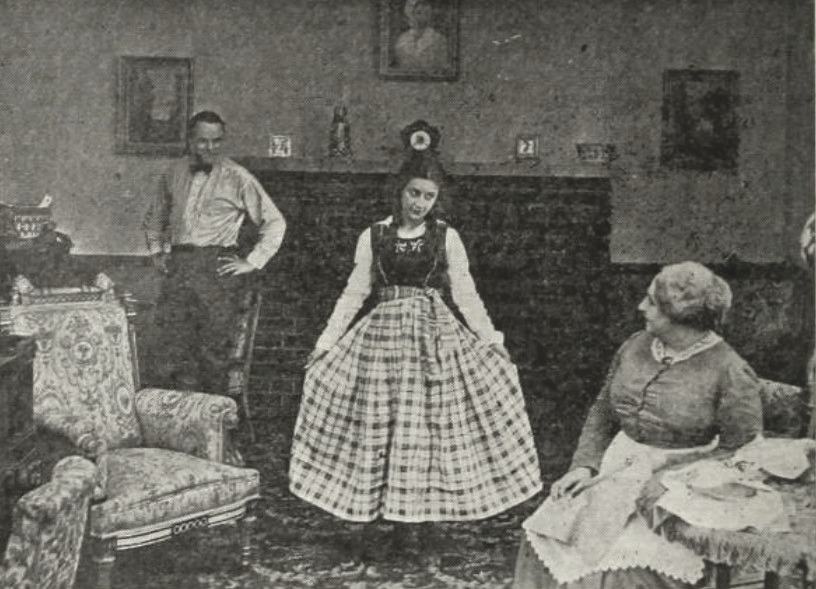
Watch the kidnapping sequence: vaqueros emerge from a dust cloud that backlights them into silhouetted demons, while Hilda’s white bonnet floats like a moth through the ochre haze. Rose racks focus so that the bonnet snaps into clarity while riders blur into abstraction—an oneiric distillation of refugee terror, where pursuers lose human shape and become national anxieties.
Archival prints screened at Pordenone in 2019 featured a newly compiled score—accordion waltzes bleeding into dissonant string glissandi. During the climactic document hand-off, orchestration collapses into a single viola that repeats a three-note motif: minor second, major third, unresolved. The motif mirrors Hilda’s linguistic displacement—never cadencing, always yearning. Critics compared it to Swedish city-symphony accompaniments, yet its rawness feels closer to Appalachian field recordings, as if America itself were learning to speak in foreign tongues.
The film’s final reel has triggered Twitter symposia: is Hilda’s acceptance of Larry’s proposal a feminist triumph or bureaucratic surrender? Read the visual evidence. Myton frames the betrothal beneath a split-rail gate that casts cruciform shadows; Hilda steps through, literally crossing the bars into civic embodiment. Yet she keeps the licorice rope—now fossilized—tucked in her apron pocket, a sugary relic of autonomy. The intertitle reads, “I’ll wed you, Larry, but remember—I choose the season to sow.” For 1919, that conditional clause is revolutionary, anticipating Ibsenesque negotiations of spousal contract.
Modern viewers flinch at Martinez’s bandoliered caricature, yet the film complicates xenophobia by making the true gringo villains the cattle-company speculators who swindle both Swedes and vaqueros out of land. In a startling insert, Martinez soliloquizes to a chapel icon of La Guadalupana, confessing that his revolution funds are counterfeit. The scene, shot in a single take, de-exotifies the “other,” exposing imperial circuits that render everyone—Swede, Mexican, agent—complicit in the same continental shell game. Contextualized against 1915 Civil War reconstructions, Myton’s borderlands emerge as liminal space where whiteness is a proposition rather than privilege.
As of 2024, the only accessible print is a 2K restoration housed at the Library of Congress; occasional repertory tours pair it with similar trans-Atlantic sagas. Streaming rights are tangled—some claim Paramount ancestors, others insist on Swedish Cultural Ministry custodianship—so grassroots bookings remain your best bet. Seek it not for antiquarian curiosity but for its prophetic pulse: nations shutting borders, women weaponized as mules, paperwork the difference between person and phantasm. In an age of biometric scans and refugee caravans, Hilda’s stitched skirt feels less metaphor than premonition.
Sit close to the screen when the hayloft lantern flares; let the nitrate burns look like fireflies. Remember that every immigrant story is a spy thriller where the stakes are not kingdoms but the right to breathe without apology. Follow the Girl understands this at a cellular level—its sprocket holes seem to pump hemoglobin. When the lights rise, you will check your own hem for hidden histories, and that is the greatest contraband any film can smuggle.
IMDb —
1917
Community
Log in to comment.