DbcultAccessing Vault...
Cult Review
Senior Film Conservator
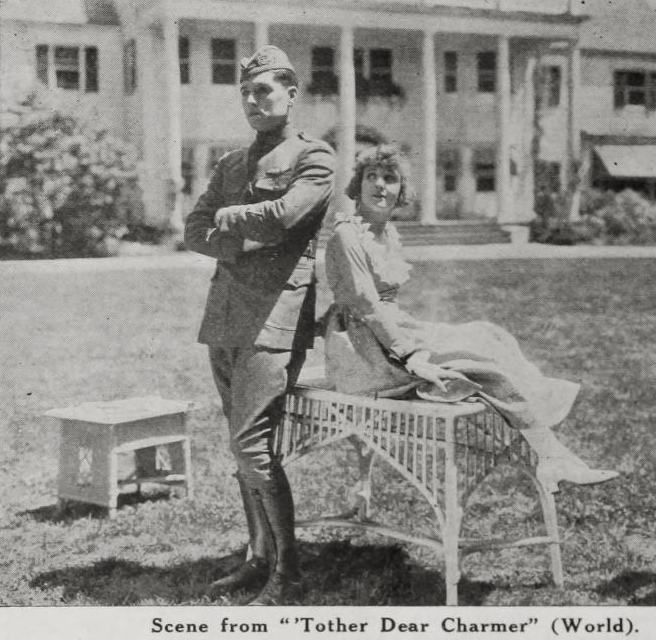
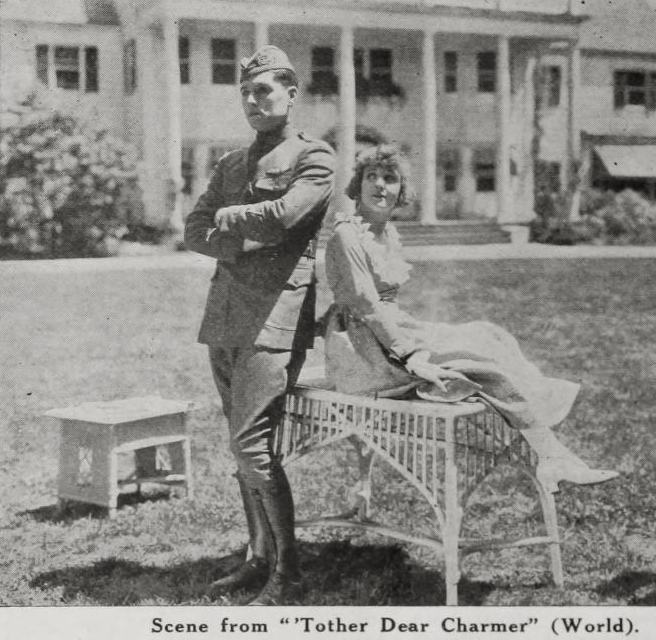
The celluloid of 1917 is brittle, yet T'Other Dear Charmer crackles alive like a thorned rose pressed between munitions ledgers. Shot in the lambent interstice between newsreel carnage and home-front hymnals, this six-reel whisper from World Picture Corp. distills the entire war neurosis into one sun-dappled drawing room.
Betty’s bazaar flops not from stingy townsfolk but from collective shell-shock: even charity feels like complicity when boys are gassed in Ypres. Her pivot—monetizing the manor—turns philanthropy into realpolitik, a transaction scented with lavender furniture polish and guilt. Once inside the maid’s mobcap, she trespasses class, gender, and national boundaries; the wig is her tin helmet against recognition, her accent a bayonet of displacement.
Louise Huff’s Betty vibrates on two frequencies: the porcelain graciousness of the hostess and the feral alertness of the impostor. Watch her hands—lace mitts fluttering over a silver teapot, then raw knuckles scrubbing flagstones at dawn. The oscillation is so minute you could miss it between flickers, yet it seeds the third-act heartbreak. Opposite her, John Bowers plays Tom like a man tasting morphine in every memory; his limp is less wound than existential stutter, a refusal to rejoin the ranks of the definitively living.
Director Tom Ricketts and cinematographer James Diamond triangulate their mise-en-scène around three leitmotifs: the candle that gutters between servant and master, the Venetian mirror that doubles every desire, and the blackout curtain that falls like iron over the terrace. When Tom first kisses “Bettina,” the camera dollies back until the candle flares into solar eclipse—an iris-in that feels less romantic than forensic, as though sealing evidence of a crime.
Unlike The Eyes of Julia Deep where the shop-girl ascends, here the aristocrat descends, proving identity as pliable as crepe de Chine. The film anticipates The Pretenders by suggesting that class itself is a form of drag; Betty’s corset stays identical beneath silk or calico. Yet the narrative refuses to punish her trespass—instead it rewards her with a doubled erotic sovereignty: loved as both fantasy and proprietress.
Wallace Clifton’s intertitles detonate in Courier font: “A heart may wear two nametags and bleed the same crimson.” The cadence is half-poetry, half-propaganda, recalling the aphoristic barrage of Les Misérables, Part 2: Fantine but stripped of religiosity. Each card arrives with the hush of a field telegram, underscoring that every romantic utterance is wartime correspondence.
Betty’s choice of Gallic disguise is no accident; France in 1917 is both battlefield and fetish. The wig’s noirness summons the chanteuse of the Marne, the munitionette of the Somme. Yet the film never travels east of the Channel; the war is a rumor, a newspaper lithograph glimpsed in the pantry. Thus Bettina becomes a ventriloquized trauma, a way to import frontline pathos into the Cotswolds without the mud.
Where Chimmie Fadden Out West lampoons class through slapstick, T'Other Dear Charmer anatomizes it with surgical empathy. Its nearest sibling is The Little Patriot, yet that child’s-flag-waving tale resolves into univocal nationalism, whereas here patriotism is a cracked gramophone record spinning in the next room.
Modern viewers may scoff at the “happy” ending—Tom’s polyamorous logic accepted without a Twitter storm. Yet the film’s leniacy feels radical in hindsight: a woman’s deception forgiven, a soldier’s inconstancy framed as emotional pluralism. In our era of identity politics, Betty’s wig is both cosplay and survival; her oscillation prefigures contemporary discourse on performative selfhood.
Only a 35 mm dupe negative exists at the UCLA Film & TV Archive, marbled by rain-gauge streaks. The damage amplifies the film’s thesis: identity as fragile as silver halide. Restoration funding stalled in 2019; hence most cinephiles know the movie via a 480p bootleg on YouTube, where compression artifacts bloom like mustard gas. Even so, Huff’s micro-smile at the 73-minute mark—when Tom calls her “my twice-born darling”—shines through bit-rate decay like a signal flare.
T'Other Dear Charmer is less escapist confection than a battlefield report smuggled inside a lover’s glance. It argues that war does not merely mangle bodies; it liquefies identity, forcing every man and woman to become their own ghost-writer. In the final iris-out, Betty and Tom share a kiss framed by a Red Cross banner fluttering in the garden—charity and carnality fused into one tremulous hyphen. The film doesn’t end; it demobilizes, leaving the viewer to stand at attention long after the lights have risen.

IMDb —
1919
Community
Log in to comment.