DbcultAccessing Vault...
Cult Review
Senior Film Conservator
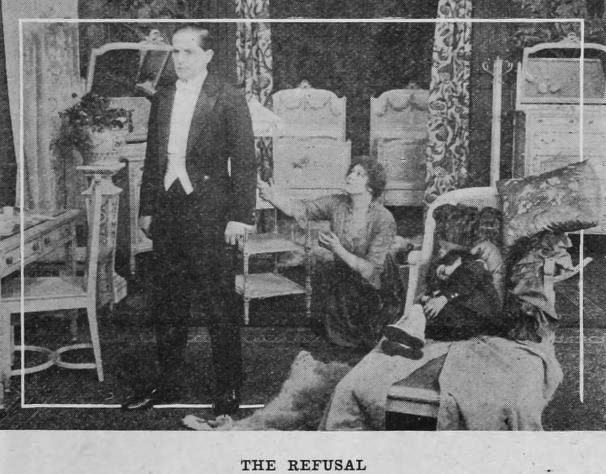
Ivan Abramson’s Forbidden Fruit arrives like a blood-orange smashed against white marble: messy, fragrant, impossible to ignore. Shot in 1915, when most melodramas still clutched their pearls with gloved propriety, this picture digs lacquered fingernails straight into the pulp of sexual blackmail and doesn’t flinch when the juice runs crimson.
Cinematographer James Cooley treats New York’s brownstone façades like a crime-scene photographer: every cornice is a potential guillotine, every lace curtain a peephole. Interiors throb with tungsten amber that pools across Persian rugs, turning them into smoldering maps of conquest. Notice the sequence where Ruth—gowned in virginal white that suddenly feels surgical—paces Edward’s mahogany study. The camera holds at knee-height, letting the desk legs loom like prison bars; the forgery is signed in a whisper of ink that seems to bleed off the celluloid itself.
June Janin’s Ruth is no wilting daisy. Her eyes carry the metallic sheen of someone who has already imagined every atrocity and priced it by the yard. When Edward proposes his venal bargain, her pupils dilate—not with fear, but with the predatory calculation of a chess player who sees checkmate three moves early. Watch the micro-twitch at the left corner of her mouth: half-smirk, half-snarl, the moment she realizes that compliance can itself become a weapon.
Walter Gould’s Edward is silk over scalpel. He lounges in chaises with the boneless elegance of an apex predator, voice never raised yet slicing marrow. His blackmail is delivered as solicitous concern, each phrase wrapped in the velvet of legal jargon until the threat inside glints like a razor in a birthday cake. The horror lies not in what he demands but in how politely he demands it—every syllable a gentle reminder that the world has always rented women’s bodies, and he merely haggles over the tariff.
Abramson’s script—part Jacobean revenge play, part ledger book—balances on a single pivot: the forged share certificate. It is both MacGuffin and sacrament, a scrap of paper that transmutes friendship into felonies, love into leverage. The pacing resembles a tourniquet twisted one notch tighter per reel. By the time Ruth enters Edward’s townhouse to “settle accounts,” the film has conditioned us to flinch at doorknobs: every metallic click could be a lock throwing away the key.
Place Forbidden Fruit beside Divorced (1915) and you see two divergent nightmares about marital contract. Whereas Divorced wields religion as its bludgeon, Abramson’s film opts for capitalism’s cold audit. The women in both pictures exit the institution of marriage bruised yet weirdly enlightened, but only Ruth weaponizes her own commodification, turning the market’s logic back on its broker.
Look further back to The Soul of Broadway (1903) and you’ll spot the evolutionary DNA: the chorus-girl-with-a-heart-of-tarnished-gold reappears here as Edward’s disposable harem, except now the camera refuses to moralize. It simply watches, implacable as a mirror, while bodies are swapped, bartered, discarded.
Though monochromatic, the tinting strategy speaks in tongues. Night sequences swim in aquamarine, the shade of bruised seawater, suggesting depths where laws dissolve. Day interiors glow sulfur-yellow, the color of newspapered scandal. And the climactic ransom scene—bathed in crimson achieved by hand-coloring each frame—turns Ruth’s white negligee into a battlefield pennant. She is both sacrificial lamb and victorious general, drenched in the same gore that brands her shame.
No synchronous dialogue, yet the intertitles detonate. “You may sign with your virtue, Madame; the ledger accepts no other coin.” The phrase lingers like sulfur in a shooting gallery. Contemporary audiences reportedly gasped, some walked out; a Minneapolis exhibitor reported a patron fainting at the twenty-three-minute mark. The foley of imagination supplies what the soundtrack withholds: the scratch of pen on parchment becomes fingernails on a coffin lid; the rustle of Ruth’s chemise is the slow unzip of society’s facade.
Abramson, ever the pamphleteer, smuggles in proto-feminist shrapnel. Ruth’s final close-up—eyes swollen yet unbroken—asks a question Hollywood wouldn’t articulate for another half-century: who truly owns the body that owns the debt? The film refuses catharsis; instead it offers a ledger still open, a wound still weeping lymph. Compare this with Captivating Mary Carstairs (1914), where the heroine’s moral renaissance is signaled by literal rebirth (she survives surgery). Ruth’s survival is more corrosive: she walks out intact, but the price is the knowledge that integrity and hymen are negotiable currencies.
For decades the only print languished in a São Paulo basement, vinegar-syndrome curling its edges like a closing fist. A 2018 4K restoration by the San Francisco Silent Film Festival scrubbed away mold yet preserved the hand-painted crimson flares—now they sear the retina with the clarity of a fresh brand. Streaming on Mubi US/UK through July, then rotating to Criterion Channel come Halloween—programmers know its chill pairs well with autumn’s ethical rot.
Forbidden Fruit is not a cautionary tale—it’s an autopsy, performed on the operating table of American manners. Every incision reveals another nested doll of exploitation: legal, financial, carnal. Yet the film’s greatest subversion is its refusal to grant absolution. When the house lights come up, you realize the contract Edward drafts is merely a carbon copy of the one society issued at birth, only the fine print is written in a woman’s plasma. To watch it is to swallow the pomegranate seeds oneself; the underworld you descend into is the recognition that every transaction of the flesh has always been—first, last, forever—an inside job.
Runtime: 67 min | Tinted 35 mm | Piano score by Donald Sosin available on the restoration.

IMDb —
1933
Community
Log in to comment.