DbcultAccessing Vault...
Cult Review
Senior Film Conservator
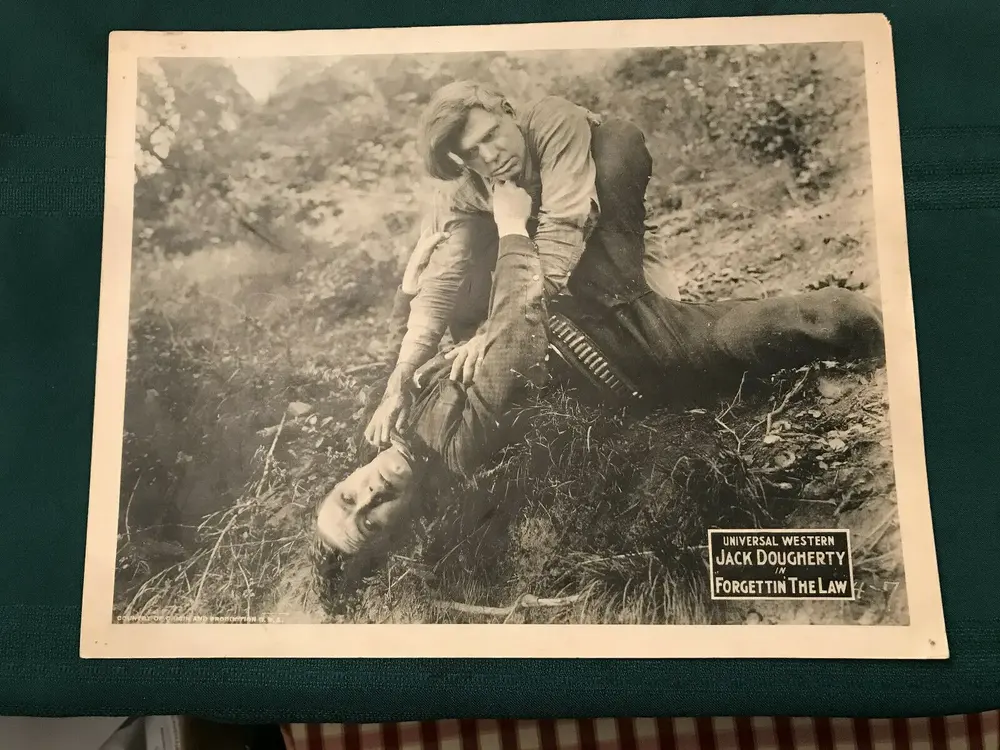
The silent western is often dismissed as a monolith of dusty tropes and binary moralities, yet within the archives of the 1920s lies Forgettin' the Law, a film that challenges the primitive expectations of the genre. Directed with a keen eye for spatial dynamics and written by the astute George W. Pyper, this feature serves as more than a mere vehicle for the rugged Jack Dougherty; it is a cinematic meditation on the fragility of authority and the transformative power of the emerging telecommunications network. While many contemporary features like The Road Demon focused on the sheer velocity of the nascent machine age, Forgettin' the Law finds its tension in the intersection of traditional grit and modern coordination.
Jack Dougherty delivers a performance that eschews the flamboyant heroics seen in Rip Roaring Rivals. His portrayal of the sheriff is one of quiet competence suddenly shattered by an overwhelming force. There is a palpable sense of pathos in the scene where he is overpowered; the camera lingers on his realization of failure, a moment of profound human frailty that was rarely afforded to western protagonists of the era. This vulnerability makes the subsequent pursuit not just a legal obligation, but a personal quest for ontological restoration. Unlike the protagonist in The Man Unconquerable, who seems to possess an innate, unshakeable power, Dougherty’s sheriff must earn his redemption through sweat and the strategic use of limited resources.
Perhaps the most revolutionary aspect of Pyper’s script is the elevation of the telephone operator from a background extra to a pivotal narrative engine. In a genre that usually prioritizes the lone wolf, the introduction of a central female figure who controls the flow of information is a startlingly modern touch. She functions as a secular deity, a weaver of fates who utilizes the copper veins of the frontier to track the movement of the outlaws. This dynamic shifts the film away from the domestic focus found in Little Lady Eileen and places it firmly in the realm of the procedural thriller. The operator’s role suggests that the 'Law' is no longer just a man with a badge, but a collective effort enabled by the very technology that was shrinking the American wilderness.
The cinematography in Forgettin' the Law utilizes the harsh, natural lighting of the desert to create a high-contrast world of shadows and sun-bleached vistas. The chase sequence, which occupies a significant portion of the final act, is a masterclass in rhythmic editing. While the pacing in The Matrimaniac relies on comedic timing, the rhythm here is one of escalating dread and eventual catharsis. The director captures the frantic energy of the horses and the desperate resolve of the sheriff with a kineticism that feels remarkably contemporary. The landscape itself becomes a character—a labyrinthine obstacle that the sheriff must navigate, guided by the disembodied voice of the operator.
The title itself, Forgettin' the Law, is a provocative choice. It implies a departure from rigid statutes in favor of a more primal, immediate form of restitution. This theme of moral complexity is echoed in The Greater Law, yet Pyper’s script approaches it with a more grounded, action-oriented lens. The sheriff isn't just upholding the law; he is rectifying a personal and communal transgression. The gold represents more than wealth; it is the promise of the town’s future, and its loss threatens to plunge the community back into the chaos that preceded civilization. The film suggests that while the 'law' might be temporarily forgotten or subverted by force, the impulse for justice is an indelible part of the human spirit.
When placed alongside other films of its period, such as The Test of Honor, Forgettin' the Law stands out for its lack of melodrama. It avoids the sentimental trappings of Tender Memories and the theatricality of The Pretenders. Instead, it offers a gritty, almost documentary-like focus on the mechanics of the heist and the subsequent recovery. Even compared to international works like Hans nåds testamente, which explored social hierarchies with surgical precision, this film manages to weave its social commentary into the fabric of a high-stakes adventure. It captures a specific moment in American history where the mythic West was beginning to integrate with the modern world, a transition that is perfectly encapsulated by the image of a sheriff on horseback receiving intelligence from a switchboard.
The art direction in the film is deceptively simple. The interiors of the sheriff's office and the telephone exchange are rendered with a stark realism that contrasts with the sprawling, untamed exteriors. This juxtaposition highlights the central conflict: the struggle to impose order upon a chaotic landscape. The costume design, though standard for the genre, emphasizes the utilitarian nature of the characters. There are no flamboyant costumes like those found in The Nightingale; here, every piece of clothing is caked in the dust of the trail, reinforcing the film’s commitment to a grounded aesthetic. The use of tinting in the original prints—sepia for the day, deep blue for the night—further enhances the atmospheric tension, creating a visual shorthand for the passage of time and the urgency of the mission.
Viewing Forgettin' the Law today requires an appreciation for the economy of silent storytelling. Without the aid of dialogue, Pyper and the director must rely on visual cues and the expressive capabilities of their cast to convey complex emotional arcs. The film succeeds where others like Swat the Spy or The Doctor and the Woman occasionally falter—it never loses sight of its central narrative drive. It is a lean, muscular piece of filmmaking that prioritizes action and character over superfluous subplots. Even in its most frantic moments, there is a clarity of purpose that is often missing from more bloated productions like Life's Whirlpool.
As we look back at the career of Jack Dougherty, Forgettin' the Law remains a high-water mark. It showcases his ability to command the screen with physical presence rather than just bravado. It also serves as a reminder of the vital role played by writers like George W. Pyper, who were able to infuse standard genre fare with innovative ideas and structural sophistication. This film is not just a relic of a bygone era; it is a precursor to the modern techno-thriller, a story where the hero’s success is contingent upon his ability to adapt to a changing world. It is a testament to the enduring power of the western as a canvas for exploring the human condition, even when the law is, for a moment, forgotten.
In the final analysis, the film’s brilliance lies in its simplicity. It does not attempt to redefine the universe; it simply seeks to tell a story of theft and recovery with maximum efficiency and emotional resonance. Like A Blue-Jacket's Honor, it celebrates the virtues of persistence and duty, but it does so without the cloying sentimentality that often bogged down silent dramas. For anyone interested in the evolution of the American western, Forgettin' the Law is an essential viewing experience, a shimmering nugget of gold found amidst the vast, often overlooked landscape of early cinema history.
IMDb —
1916
Community
Log in to comment.