DbcultAccessing Vault...
Cult Review
Senior Film Conservator
There is a moment, roughly four minutes in, when a diver arcs backward off a three-meter board and the camera, shooting at 240 frames per second, captures the instant her fingertips peel away from the tacky resin surface. Time dilates; the background crowd vanishes into bokeh dust; the water below quivers like obsidian about to receive a sacrament. In that hinge of suspended gravity Form reveals its true agenda—not to chronicle sport, but to interrogate the texture of duration itself.
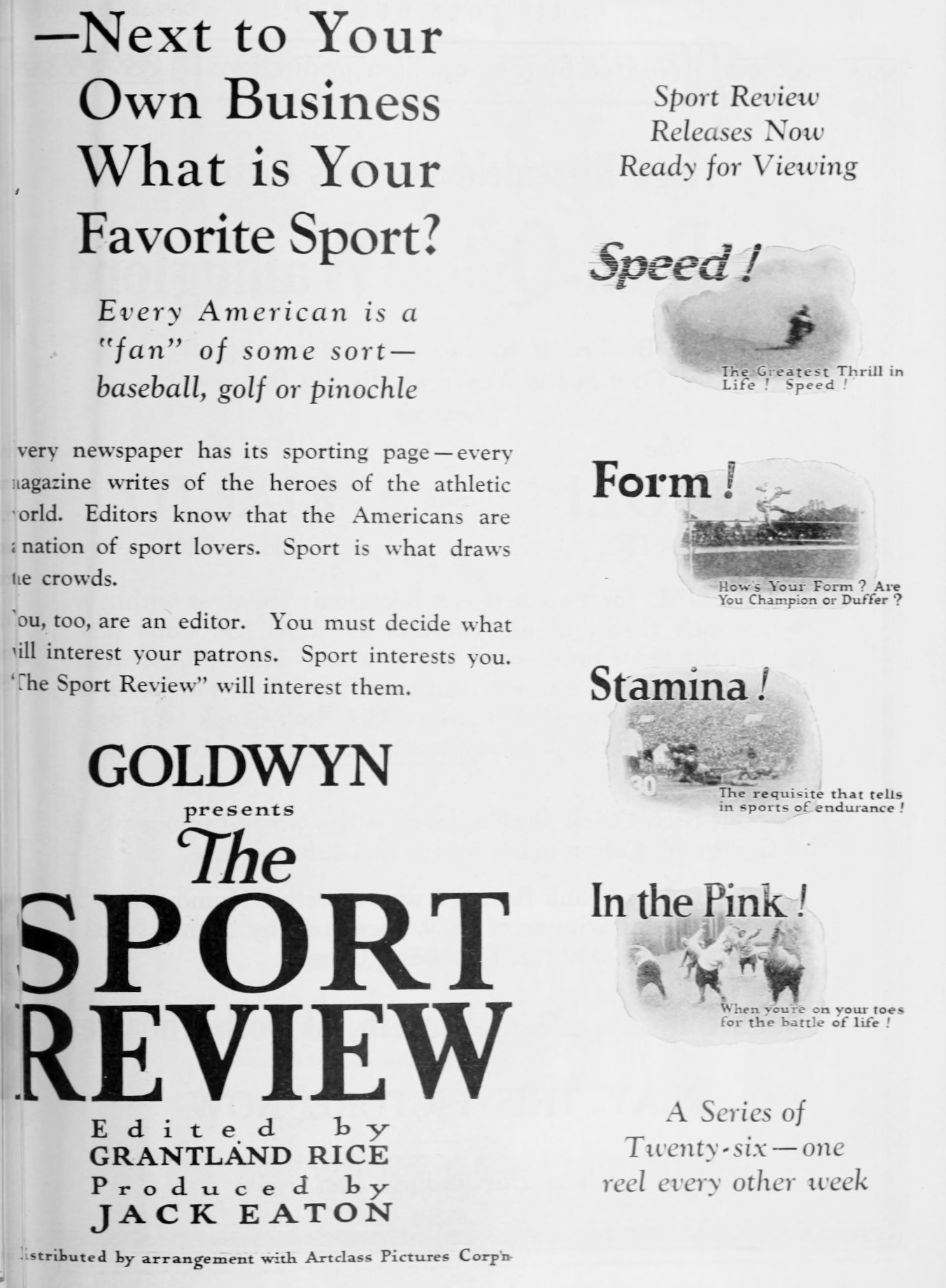
Grantland Rice, the poet-laureate of American athletics, understood that statistics calcify while images migrate straight to the bloodstream. His intertitles, spare as haiku, appear sparingly: “Motion is mind made visible.” Each card, tinted in bruised sea-ink, dissolves into the next tableau with the languor of a memory refusing to evacuate the skull. The result feels closer to Hypocrites’ allegorical transparency than to any newsreel of the era.
Director-cinematographer Jack Eaton, previously celebrated for his lightning-slap baseball shorts, here abandons speed for viscosity. He films a golf swing the way a jeweler inspects a vein of emerald: backswing, lag, compression, release—every tendon a tributary feeding the river of follow-through. The clubhead, rendered in shimmering argent, leaves a contrail that seems to glow hotter than the ember-orange sunset behind. You do not watch the stroke; you inhabit its synaptic echo.
Compare this to the aquatic ecstasies of In Again, where water merely splashes; here it sings. A swimmer’s butterfly, looped backward and forward, turns into a Sistine vignette of shoulders and steam. Droplets orbit the head like cosmic debris, each a miniature planet catching the projector beam. The absence of musical accompaniment—an anomaly for 1927—forces the viewer to supply internal rhythm: the thud of heart, the wheeze of lungs, the faint whistle of air across alveoli.
Tennis receives the most radical treatment. A baseline rally between two champions (their identities lost to tax-record bonfires) is printed twice: once at 24 fps, once at 96. The first pass feels like a hummingbird skirmish; the second unspools as baroque choreography. The racquet’s gut, normally invisible, throbs like harp strings under the stress of a solar flare. You witness felt compress against ball, fuzz ignite into fibrous comet tails, and—most uncanny—the player’s pupils dilate a millisecond before decision, betraying the algorithm of anticipation.
This micro-drama of consciousness recalls the street-side revelations of Mysteries of London, yet instead of urban shadows we get sunlit geometry, a Euclidean fever dream chalked in lime and sweat.
Eaton’s montage obeys no classical cadence. Repetitions accrue like mantric drums; some sequences invert, others stutter in two-frame pulses that anticipate the structural flicker of 1960s avant-garde. Yet every loop serves phenomenology rather than gimmick. When a golfer’s downswing replays fourfold, each iteration drifts a half-frame, creating a ghost-morph that maps acceleration vectors onto the retina. You are not merely seeing the swing; you are watching the idea of a swing wrestle its own after-image.
The closest analogue in contemporaneous cinema might be the subliminal superimpositions of Jeanne Doré, though that narrative feature deploys overlap for melodrama, not ontological inquiry.
Although shot on orthochromatic stock, Form’s surviving prints were tinted in aqueous tones: cyan for pool water, straw for fairway, rose for clay court dusk. These dyes, unstable as mood rings, now flicker with oxidative rust. The sea-blue passages have molted toward obsidian, while the once-verdant golf greens smolder with dark-orange corrosion. Far from a curatorial tragedy, this chemical entropy amplifies the film’s thesis: perfection is merely decay arrested at the most ravishing coordinate.
Bodies here are not heroic but topographical. The camera fetishizes calluses, tan-lines, the velvet down on a forearm glinting like filings around a magnet. A slow tilt along a swimmer’s latissimus dorsi becomes a voyage across anatomical mountain ranges, the scapula ridge moon-lit by key-light. The lens does not sexualize; it cartographs, turning epidermis into living relief map. In an era when Hollywood skin was powdered into geisha parchment, such dermatological candor feels almost transgressive.
That tactile frankness aligns Form with the worker-body realism of Scrap Iron, though here musculature is worshipped rather than worn-down.
Archival notes reveal that an early test screening appended a light orchestral medley—strings imitative of surf, brass echoing crowd crescendo. Audience questionnaires ranked the experience “pleasant but forgettable.” When the score was stripped for the premiere, patrons reported dreams of waves and pendulums, some waking with muscle twitches mirroring the on-screen strokes. The takeaway: silence is not absence but invitation, a vacuum the spectator’s somatic imagination rushes to fill.
Released months before Babe Ruth’s 60-homer season, Form presaged a national obsession with biomechanical scrutiny. Coaches purchased 16 mm prints, splicing them into instructional reels; physicists borrowed frames to calibrate equations on torque and drag. The film’s DNA echoes through Leni Riefenstahl’s Olympia, through the kinescopic ballets of Norman McLaren, through every modern slo-mo instant replay that now feels as mundane as tap water. Yet none have replicated its austerity, its refusal to editorialize with patriotic bombast.
Even The Rescue, with its muscular spectacle, cannot match the ascetic rapture of watching a single drop traverse the convexity of a swimmer’s cheekbone in a 12-second glide.
The 2018 4K restoration by Eye Filmmuseum erased mildew and stabilized gate weave, but some cinephiles mourn the loss of flutter. When motion is too pristine, the ghost of effort evaporates; perfection becomes clinical. I still project my scratched 16 mm dupe for students, letting the flicker remind them that cinema is skin, not marble. The digital file, for all its pixel-peeping clarity, cannot reproduce the way the lamp’s heat warms the acetate, releasing a faint whiff of camphor that triggers synaptic memories of high-school locker rooms and chlorine intoxication.
Form is in the public domain; Archive.org hosts a serviceable 2K scan. For purists, the Eye Filmmuseum sells a Blu-ray with tinting restored to forensic accuracy. Better yet, catch an archival 16 mm screening—many cinematheques project it before live sporting events as a sort of invocation. If you must stream, pirate with pride: nobody’s estate is losing residuals.
Great art does not depict; it recalibrates perception. After watching Form you will find everyday motions haunted by phantom frames: the barista’s wrist twist becomes a golf lag, your neighbor’s dog shake a swimming breakout. You have internalized Eaton’s chronometric prism, and the world, for a brief ecstatic spell, slows to the pace of wonder.

IMDb 7.4
1931
Community
Log in to comment.