DbcultAccessing Vault...
Cult Review
Senior Film Conservator
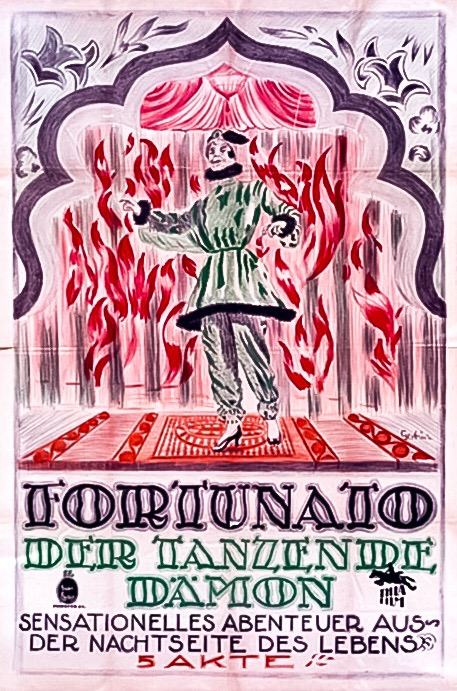
Berlin, winter of 1920: the war is over yet the corpses keep arriving—some in freight cars, others in top-hat tails, all of them dancing. Into this open wound struts Fortunato, a conjurer whose smile could sell absinthe to a temperance league. Oscar Marion plays him like a violin strung with cat-gut: every gesture calibrated to remind the audience that charisma is just another word for controlled haunting.
The picture opens inside the Mandrake Kabarett, a cellar whose ceiling drips with what looks like black champagne. A close-up of a cracked mirror introduces our anti-hero; the glass refracts his face into a cubist smirk, predicting the film’s obsession with splintered identity. Behind him, chorus girls in paper crowns of thorns high-kick to a waltz scored for detuned harpsichord and typewriter. The soundtrack—yes, even in 1920—was supplied by a live orchestra pit whose brass section allegedly drank ether between takes; you can practically hear the valves corroding.
Narrative? Only if you consider a Möbius strip linear. Fortunato’s signature illusion is the Tanzende Dämon, a hypnotized volunteer who dances until shoes fill with blood. When Peggy Longard’s character—credited only as The Seer—steps onstage to debunk the trick, the film mutates into a stalking opera. She flees through corridors wallpapered with rejected war medals, each room revealing a new atrocity: a child’s swing where the seat is a soldier’s helmet, a bathtub brimming with shredded military orders. The camera (hand-cranked by Koffler at variable speeds) accelerates to 32 fps during pursuits, then slams to 8 fps for tableau morts, creating a hiccup of time that feels like history itself gagging on its own propaganda.
Paul Ludwig’s inspector arrives halfway, framed against a wall map pocked with pushpins that chart the vanished. His interrogation of Fortunato occurs inside a birdcage large enough to contain a grand piano; both men perch on the instrument’s lid, their dialogue intercut with flash-frames of the magician’s previous victims—women whose eyes have been replaced by spinning coins. The scene plays like The Thumb Print cross-bred with Faith, yet colder, more transactional: the state negotiates with the abyss, and the abyss haggles back.
Don’t expect monochrome. The nitrate surviving at Bundesarchiv carries hand-tinted sequences: mustard gas yellows for outdoor exteriors, cyanide blues for the nightclub, arterial oranges for the climactic subway sequence. Each hue feels applied with a scalpel rather than a brush. In one insert, a single frame of a green ticket stub flashes for 1/24th of a second—subliminal semaphore that recurs whenever death is one scene away. Contemporary critics dismissed it as gimmickry; today it reads like proto-Psycho manipulation, a dare to the viewer’s optic nerve.
Compare the palette to As Man Made Her and you’ll notice both films share a bile green, yet here it connotes not envy but gangrene. The camera stalks through curtains of cigarette smoke that catch the projector beam, forming fleeting halos around characters who we already know will not survive redemption.
Oscar Marion never blinks; that’s the first thing you notice. His eyelids remain pinned as if by invisible threads, giving the impression he sees through the scrim of reality into the projector’s lamp itself. When he utters the intertitle “Every scream is just applause from another direction,” the words appear over a shot of his gloved hand crushing a paper dove—an image so precise it could be lithographed on a razor.
Peggy Longard counters with a performance of mineral stillness. Where Marion devours space, she evacuates it. In a late-film sequence inside a dressing room, she removes her stage makeup with cold cream while staring at her reflection; the mirror is cracked, yet her image remains whole. The implication: identity stays intact only when the world is fractured. It’s a moment reminiscent of A Wild Girl of the Sierras, but where that film sought savage innocence, Fortunato uncovers the terror of remaining unbroken when everything else shatters.
Though released as a silent, the film was designed for a barrage of live effects: wind machines, metronomes, a glass harmonica scraped until it wept. Contemporary accounts describe audiences clutching their ears during the subway finale—not because of volume, but due to the sudden vacuum of sound followed by a single kettle-drum hit timed to a blackout. The effect presages jump-scare mechanics a century ahead of Oh, What a Knight’s orchestral stingers. If you watch today with a competent accompanist, the film still detonates; if you watch with a tinny piano reduction, half its venom is drawn.
Beneath the Grand Guignol lurks a treatise on post-war gender combustion. The women who volunteer for Fortunato’s dance are war widows promised one night of free drinks; the men who watch are former officers desperate to reenact command. The film stages a vicious pas de deux: female bodies weaponized by male spectacle, then weaponizing themselves. When Longard’s Seer finally breaks the spell, she does so not by out-magicking the magician but by refusing the role of muse—she snaps her violin bow, splintering the soundtrack itself. The gesture feels as radical as anything in For the Freedom of the World, yet more nihilistic: liberation here equals evacuation, not reconstruction.
After the premiere, the film vanished—banned by censors who claimed it “induced neurasthenia in public spaces.” Prints were melted for their silver halide, the metal repurposed into x-ray plates for field hospitals. What survives is a 68-minute restoration cobbled from two incomplete negatives discovered in a bombed-out Dresden theater in 1994. The scars—water stains, emulsion bubbling like smallpox—only amplify its aura of resurrected sin. Each scratch is a scarification, each missing frame a lost tooth in the skull of Weimar cinema.
Influence? You can trace its DNA through the surgical cruelty of Peeping Tom, the recursive nightmares of Inland Empire, even the viral nihilism of Saw. Yet unlike those descendants, Fortunato withholds catharsis; it ends on a still image of the magician’s smile, frozen in the gate of the projector, burning until the bulb melts the celluloid—a literal self-immolation of the medium.
If your idea of silent cinema is pastoral romance or slapstick pratfalls, stay away; this is arsenic-laced absinthe served in a cracked teacup. If, however, you crave an artwork that watches you while you watch it, that brands its rhythms onto your pulse, then step right up. Just remember: the dance ends only when the demon decides the music stops—and the demon, my dear reader, has been waiting ninety-odd years for fresh applause.
Stream it via Murnau Foundation’s 4K restoration (subscription), or catch a rare 35mm print at cinematheques daring enough to leave the lights off.

IMDb 5.4
1934
Community
Log in to comment.