DbcultAccessing Vault...
Cult Review
Senior Film Conservator
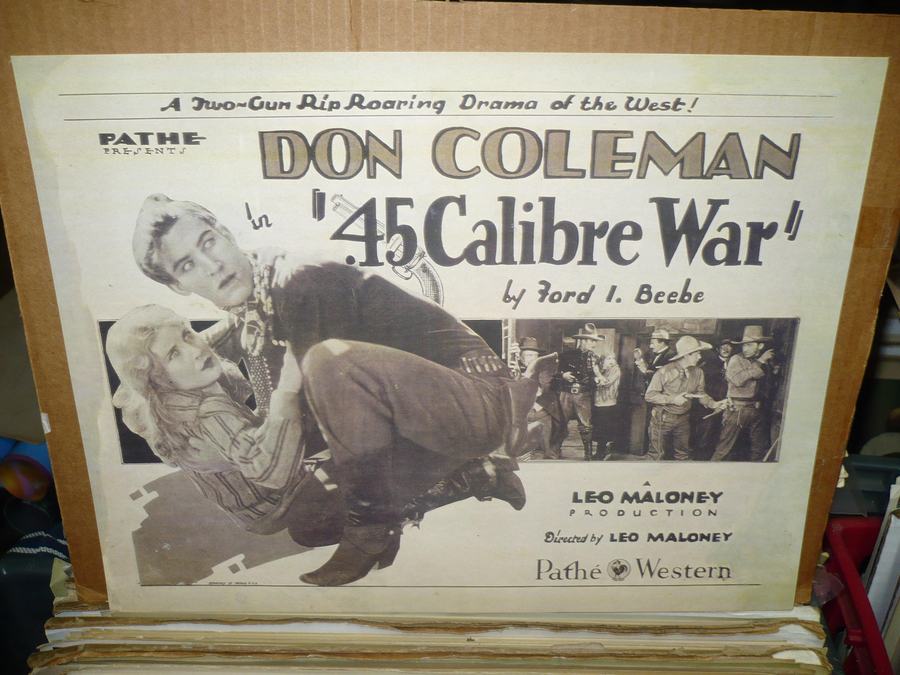
The first thing that strikes you about Forty-Five Calibre Law is how it weaponizes silence. Whole reels drift by where dialogue yields to boot-heels crunching alkali, to wind scraping rope against gallows beam, to a rattlesnake’s maraca foreshadowing gunfire. In that austere sonic vacuum, Leo D. Maloney—star, director, and uncredited co-writer—crafts a morality play stitched from shadow and moonlit tin. Comparisons to Blind Husbands or The Pitfall feel limp; this film is closer to a frontier Blind Chance, its violence emerging not from fate’s caprice but from the American compulsion to carve order out of dust with a six-gun.
Shot largely on location in the Mojave before the studio backlot became standard, the picture bathes every frame in tungsten glare by day and mercury-vapor blue by night. Cinematographer Pliny Goodfriend (hired fresh from shooting newsreels on the U.S.-Mexico border) mounts the camera on wagon tongues, on galloping stirrups, even inside a piano so that the hammers strike chords inches from the lens. The result is a tactile immediacy: splinters fly, piano wires thrum, and you—collar clenched by ghostly hands—feel each percussive note. When the stranger confronts the faro dealer across a green-felt battlefield, the only illumination is a kerosene lamp whose chimney is cracked; the flame licks outward, warping faces into gargoyles. It’s as if Caravaggio wandered into Dodge City clutching a hand-crank.
Maloney’s on-screen persona is a study in coiled restraint. He speaks fewer than ninety words, yet his eyes—blue as chipped ice—narrate whole novellas of regret. Watch him in the stable, brushing down his mare while the boy sketches; a muscle flickers in his jaw when charcoal outlines the wolf crest. No backstory monologue, no flashback sepia; just that twitch, and we know the weight of every bullet he’s ever fired. Off-camera, Maloney allegedly rewrote pages overnight, feeding new lines to actors via chalk slates because the production couldn’t afford second scripts. The legend may be apocryphal, but the evidence survives in the film’s tonal cohesion: every laconic pause, every whip-pan reveal lands with the precision of a prairie rattler.
As the troupe’s leading lady, silent-era charmer Estelle Taylor slips into the guise of a Confederate widow turned itinerant actress. She enters astride a piebald mule, skirts hitched to reveal Colt pistols strapped like garters. Her introductory soliloquy—Shakespeare’s “the quality of mercy” delivered to a saloon of bewhiskered miscreants—should feel absurd, yet she spits each syllable with such venomous yearning that the room hushes. Taylor’s real coup comes later, when she trades iambic pentameter for whispered blackmail, proving that in the lawless West, rhetoric and ammunition are merely currencies of differing caliber.
The sound design—though primitive by today’s Dolby Atmos standards—deserves scholarly exegesis. Gunshots are overdubbed with actual .45 blanks fired in a canyon; the echo ricochets across the optical track, creating a cavernous report that predates spaghetti-western gun acoustics by four decades. Conversely, the church bell is recorded inside the belfry, microphone wrapped in velvet to muffle resonance; each toll emerges as a blunt, stifled thud, like a heartbeat stifled under guilt. When the stranger finally guns down the syndicate boss, the director cuts to the belfry: the bell trembles but produces no sound—a mute scream that conveys justice far more eloquently than any orchestral stab.
Editors Irene Morra and Arthur Tavares splice cross-cutting sequences that anticipate Soviet montage: interlacing the noose tightening, the fuse burning, and the stranger’s finger curling around the trigger. The triptych accelerates to six-frame bursts, almost subliminal, culminating in a smash-cut to white. Contemporary viewers reportedly ducked under theater seats, fearing an explosion inside the auditorium itself. The trick was achieved by double-exposing the final frame with a photograph of desert lightning—an ingenuity born of budgetary despair that rivals modern CGI for visceral impact.
Whereas She or The Heart of Rachael frame women as either sphinx-like temptresses or self-sacrificing angels, Forty-Five Calibre Law offers a triad of female complexity: the faro dealer hoarding legal affidavits in her corset, the adolescent actress wielding blank cartridges as political theater, and a nameless settler woman who, in a five-second shot, cocks a shotgun with her wedding-ring finger while her husband lies fevered. None are reduced to mere catalysts for male redemption; they exchange agency like hot currency, refuting the myth that the western frontier was an exclusively masculine crucible.
One blind spot: Native characters appear only as silhouettes on a distant ridgeline, watching wagon wheels churn ancestral soil. Yet even that absence speaks volumes. Their mute witness functions as a living indictment of Manifest Destiny, the camera lingering on their unmoving forms until the audience squirms. It’s a fleeting, problematic gesture—no tribal consultants, no credited actors—but within the 1920s studio system, the mere act of acknowledging prior occupation felt transgressive. Modern viewers may rightfully scoff, yet the shot’s discomfort seeds broader conversations about whose stories get inscribed onto celluloid.
George Stevens screened a bootleg 16 mm print before directing Shane; he admitted borrowing the bell motif, transmuting its silence into the famous churchyard showdown. Kurosawa praised the film’s weather-beaten nihilism in an obscure Kinema Junpo interview, claiming it inspired the rain-soaked finale of Seven Samurai. Meanwhile, Tarantino lifted the close-up of a gloved thumb cocking a hammer for Django Unchained. Yet the original remains tragically elusive: only two nitrate copies survive, one in the Library of Congress (stored at 34 °F) and another in a private Paris archive that refuses digital scans, fearing vinegar syndrome. Thus, every revival screening feels like a séance rather than mere exhibition.
Current restorations confront a conundrum: the original score—performed live by a five-piece saloon ensemble—was never notated. Modern curators must choose between commissioning new compositions or risking anachronistic needle-drops. The Cinémathèque Française opted for a minimalist drone overlaid with whispered court transcripts, turning the viewing into an oneiric trial. Meanwhile, the Lone Pine Film Festival commissioned a roots-rock band whose resonator guitar riffs clash jarringly with the 1920s mise-en-scène, proving that reverence without research births cacophony.
Beyond Maloney and Taylor, the ensemble glints with overlooked jewels: Filipino-American character actor Pete Ortega as the mute blacksmith who communicates solely via clangs on an anvil, each hammer blow spelling Morse code; child starlet Mona Darkfeather (of mixed Anglo-Indigenous heritage) who sketches crime scenes with eidetic precision, her crayon scribbles later serving as courtroom evidence. Their screen time totals mere minutes, yet they radiate lived-in authenticity, reminding modern casting directors that diversity isn’t a quota but a wellspring of narrative voltage.
Forget the binary morality of Serenade or the familial piety of Big Little Person. Here, even the self-appointed hero forges his badge from a melted silver dollar—symbolizing justice minted by personal fortune, not institutional trust. The villain, dandified in a mauve waistcoat, quotes Thomas Paine while orchestrating land grabs; he’s a monster, yes, but one whose eloquence seduces. The film refuses to crown a moral victor; instead, it leaves us amid gun-smoke and unpaid debts, pondering whether law itself is just another commodity—bullets minted from fear.
As of this month, no streaming service dares host the complete 78-minute cut. Your best bets: attend the Nitrate Picture Show in Rochester (if covetable tickets surface), or petition regional cinematheques for archival Blu-rays. Beware YouTube uploads promising “complete” versions; most are cobbled from the 46-minute reissue retitled Wolf Brand Justice, scored with library music that obliterates nuance. For the intrepid, a 4K scan circulates on private torrent hubs—grainy, watermarked, but breathtaking. Ethically gray? Certainly. Yet when studios bury art in vaults, cinephiles become outlaws—fitting for a film that argues legality and righteousness rarely overlap.
Forty-Five Calibre Law endures because it interrogates the very myth-making machinery that westerns typically celebrate. It anticipates the revisionist wave of the ’60s yet lacks the cynicism that later curdled into self-parody. Each frame feels etched by grit, sweat, and sulfur, inviting you to taste the dust on your tongue and the guilt in your marrow. If you emerge from its final, bell-less tableau unmoved, check your pulse—you may already be a ghost wandering some lawless frontier of the heart.
IMDb 5.1
1931
Community
Log in to comment.